


New York is, finally, seeing record-low levels of traffic fatalities. In 2025, there were 229 deaths involving vehicle crashes, compared to 297 in 2013. This trend is largely driven by the success of street safety policies pursued by the city: expanded bike lanes and greenways, lowered speed limits, school streets, and other policies pursued under the umbrella of the Vision Zero program.
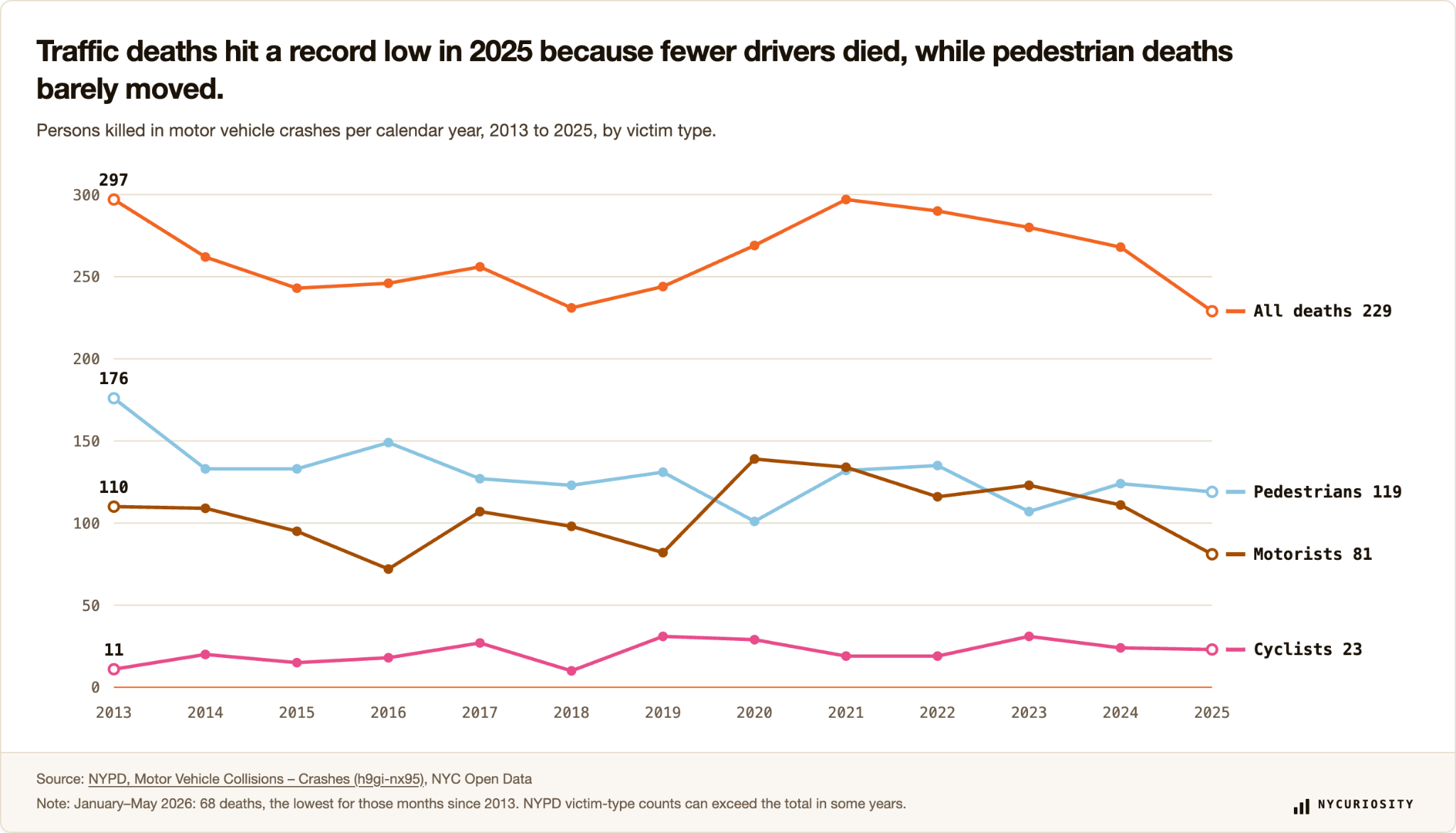
But this headline success is not the complete picture. In certain categories, such as traffic deaths involving cyclists and pedestrians, and in many community districts, traffic fatalities are actually on the rise in recent years. And while the falling number of overall fatalities is a change in the right direction, we are still not close to the city’s stated goal of Vision Zero: zero traffic fatalities. As I have written about before, New York’s leaders have repeatedly said they are committed to this priority, but their actions and policies have not yet translated to more than just partial successes.
This is especially unfortunate since the strategies and methods that can achieve Vision Zero are already known.

In fact, they have already been implemented in cities around the world and in isolated parts of New York itself. What is needed now is for these proven strategies to be implemented at scale and with much greater speed. Implementation of Low Traffic Neighborhoods (LTNs), comprehensive bus and bike lanes, and school streets — among other street safety policies — takes far too long per project and is rolled out inequitably, failing to reach the neighborhoods that would most benefit. To finally reach zero annual traffic fatalities, the processes that stop traffic incidents need to be funded, streamlined, and showcased across the city.
Taking the available data, and insightful conversations from the Center for an Urban Future’s (CUF) “What Will It Take to Deliver Livable Streets to More of NYC’s Neighborhoods?” event earlier this month, let’s dive into what can be done today and what still needs to be changed to unlock safer, better streets for the entire city.
Build where crashes are rising, then show residents the results
Councilmember Brooks-Powers spoke at CUF’s event about the need for hardened and connected street safety infrastructure. It is of limited use to build a bike lane on a single block that does not connect to any other blocks. So while the Streets Plan says we have to achieve a certain number of new bike lane miles, we need to be considerate of where we implement them. The Department of Transportation (DOT) should focus on not just maximizing the number of new bike lanes, but connecting the existing lanes and greenway systems to each other.
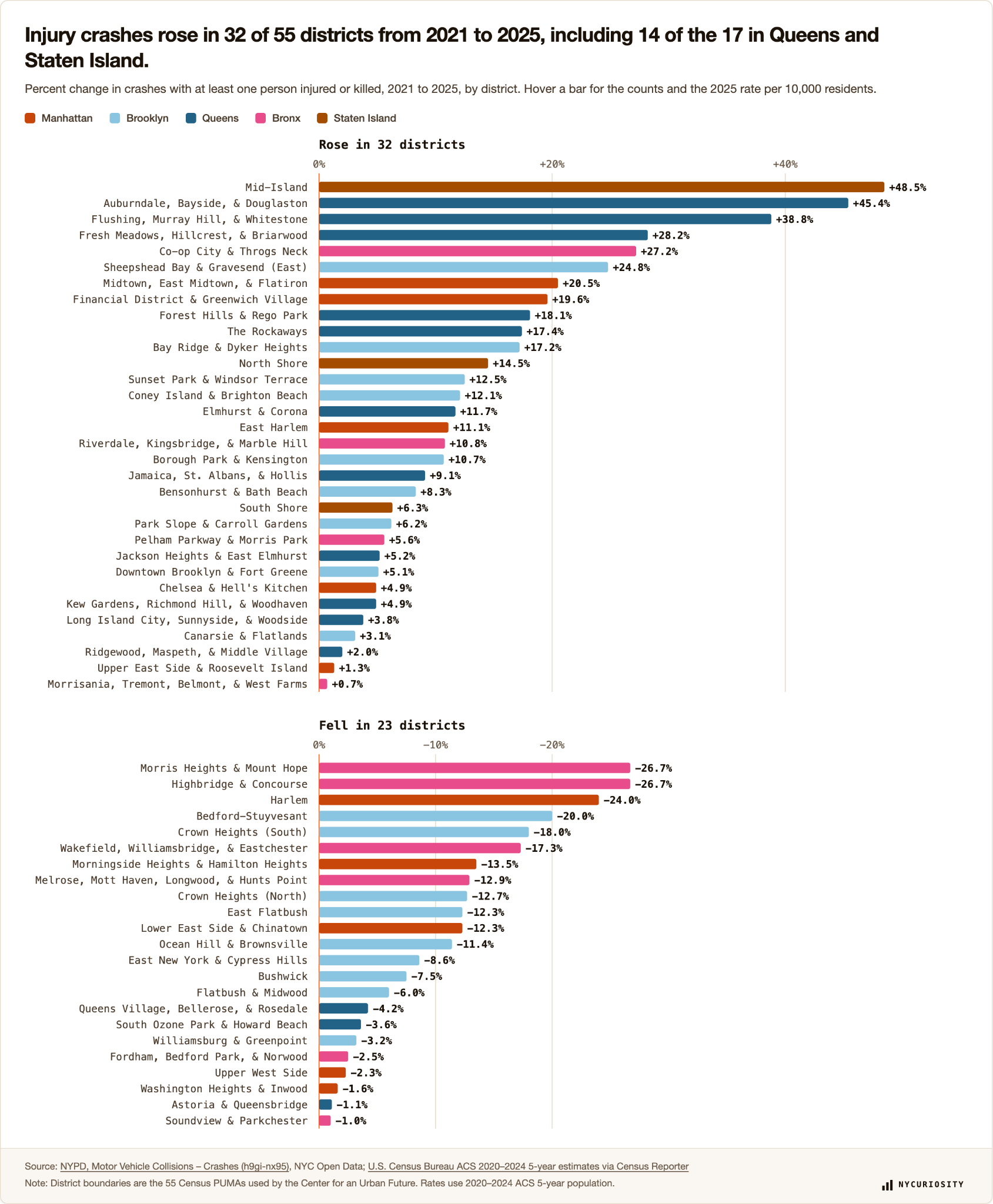
Expansion of new bike and bus lanes especially needs to focus on transit deserts. These areas would most benefit from improved street safety infrastructure, particularly considering that they have recently seen an increase in traffic deaths. Traffic injuries since 2021 have surged the most in Queens and Staten Island districts like Mid-Island, Bayside, and Flushing, where alternative transit options and street redesigns are most lacking. Adding additional travel options to driving in these locations would both improve their transportation options and increase street safety.
The Councilmember also spoke about how the implementation of one successful project can showcase what is possible to a community. The City should focus on a big win that can convince people that their intended strategy is worth doing and gain residents’ support for doing more of it. Agencies can also garner support for projects in specific neighborhoods by showing the success and impact of those projects in other, similar neighborhoods.
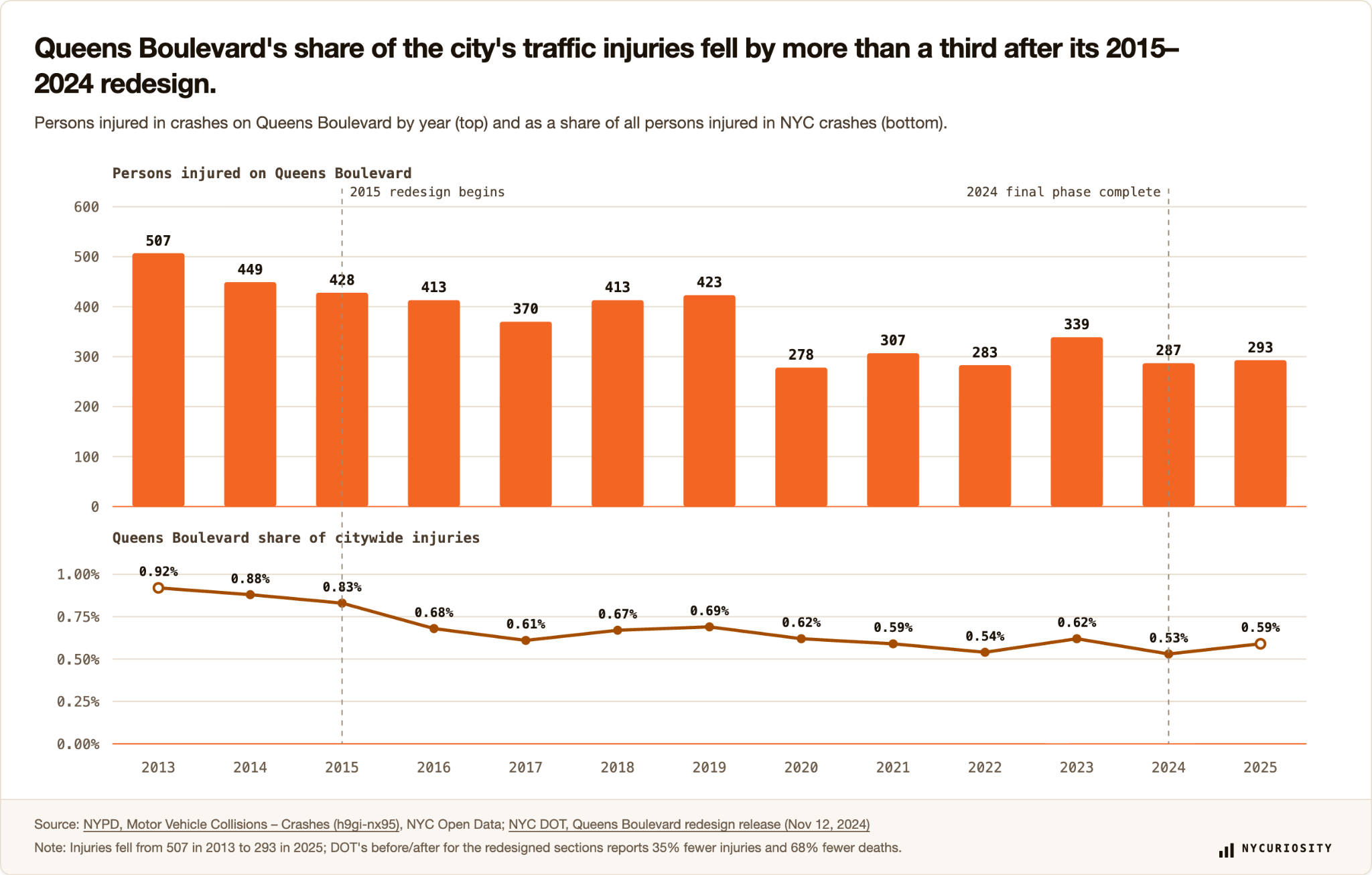
For example, the city should raise awareness of the success of the Queens Boulevard redesign. Since the redesign began in 2015, the new bike lanes and other measures have resulted in:
total roadway fatalities decreased by 68 percent, injuries decreased by 35 percent, and pedestrian injuries decreased by 45 percent.
We can borrow examples from other cities as well. Open Plans, for instance, is focused on Low Traffic Neighborhoods (LTNs) and school streets (turning the blocks in front of schools into open streets) as their top street safety priorities: both are relatively cheap and easy to get up and running. Their research points to London and Paris as examples of how successful these strategies are, and where history has shown that once one neighborhood implements an LTN, nearby neighborhoods want them too. As I wrote in my LTN blueprint post, the biggest barrier to LTNs isn’t feasibility but political willpower. By starting with a data-driven pilot program, DOT can demonstrate the success of this policy and build trust.
Community board support usually comes with conditions, and should not be the only voice a street project hears
Every opt-in or mandatory notice step in a street safety policy can add a veto point or prevent change from ever being tried. While opt-in programs like neighborhood slow zones sound nice in theory for putting community voices first, what often happens is that only those neighborhoods with the strongest advocacy networks or supportive community boards get such safety measures. Other neighborhoods, perhaps most in need of those effective opt-in programs, are left unaware or blocked by the loudest opposing voices that are more likely to be paying attention or showing up to community input events. This is worsened when those loudest voices are not necessarily representative of the community.
Part of any proposed street change is presenting the project at the relevant community boards (CBs) and the relevant agency, usually DOT, collecting feedback from the community board and residents who attend such meetings. But therein lies the issue: Are community boards entirely representative of their community? And are they structured in a manner that enables cooperation with those city agencies?
Data collected by the Manhattan Borough President’s Office in 2025 shows that the average CB member is older and more often a homeowner than the residents they are meant to represent. They also might not be representative of their community’s voice since they are an unusual group that is much more connected to elected officials and agencies and politically engaged. This becomes an issue when those CB members are passing resolutions that are supposed to represent their communities. How can a committee of 4-5 people solely represent the 150,000 or so residents they are meant to speak for?

So city agencies need to rethink how they engage with CBs, and their public meetings should not just be held through community boards. Agencies should present at a variety of groups and settings in a neighborhood to reach a more representative sample. Funneling community engagement primarily through the CBs results in a small and biased sample of voices that influence policy implementation.
This responsibility should not be placed on just DOT or the involved agencies either. Councilmembers, community boards, and local leaders must also step up to hold public meetings with a broader spectrum of neighborhood stakeholders. This includes targeted outreach to underrepresented groups, inviting such perspectives to public meetings they hold, and utilizing new technologies – community-generated data, real-time surveys, social media, etc.
Open Plans’ Executive Director Sara Lind brought up another interesting point: community boards, being purely advisory bodies, mainly exert power by saying no to proposals. They are structurally set up and incentivized to reject. CBs need to be empowered to come up with positive ideas and say yes.
One place where I’ve witnessed this phenomenon firsthand is the Canal Street redesign, long-promised by DOT but delayed yet again in Manhattan Community District 3. In discussions with the community and fellow MCB3 members, I’ve found near-universal support for a redesign. But if the CB simply passed a supporting resolution or didn’t request extensive DOT attendance at our meetings, we would feel “uninvolved” in the process or be unable to exert any influence. So multiple meetings are held requesting DOT engagement and answers, prolonging the redesign even further, and even a supporting resolution is likely to be passed with conditions, making the CB’s support less clear to DOT and other actors.
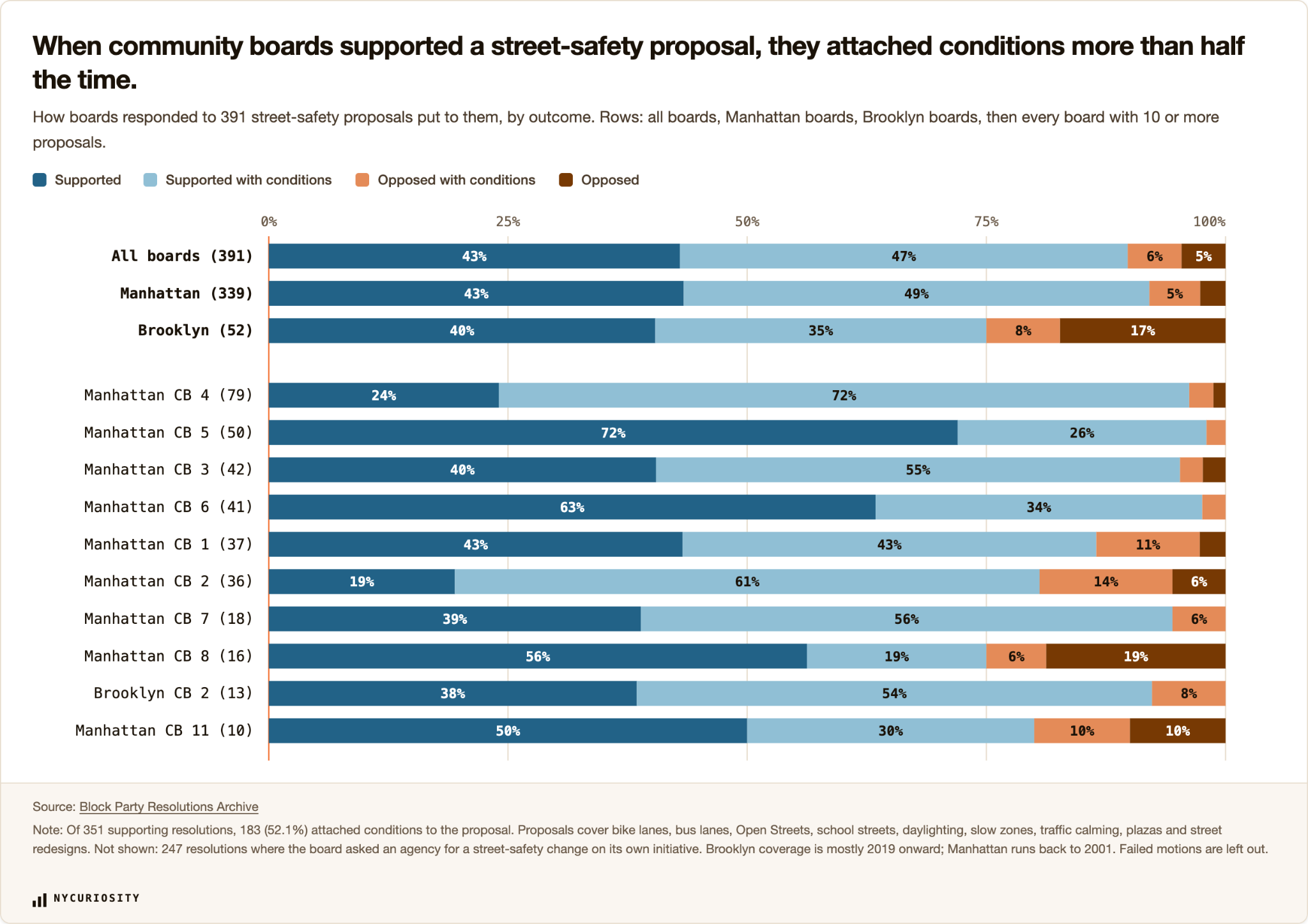
The data bears out this anecdotal experience. Using Block Party’s database of historical resolutions, I found that among 391 resolutions from 21 community boards in Manhattan and Brooklyn responding to a street-safety proposal, a plurality (47%) support street changes with conditions. So even when the CB supports a DOT project, their tool for expressing such support often involves attaching additional requests that may further slow down much-needed street improvements.
The delivery gap is a process gap, so fund and streamline what works
The best way to ensure that street redesigns and traffic safety improvements are implemented in a timely manner and in the places that need them most is to simply provide the funding and clear out the worst bottlenecks that excessively hamper these innovations.

I have previously written about the reasons why DOT has failed to meet its Streets Plan mandates: the agency is underfunded and under-resourced to properly install all the new miles of bike and bus lanes that are required of it. If the Mayor and City Councilmembers truly care about reaching Vision Zero as soon as possible, then at a bare minimum they should provide DOT the additional funding that the Council itself estimated would be needed to pay for the Streets Plan.
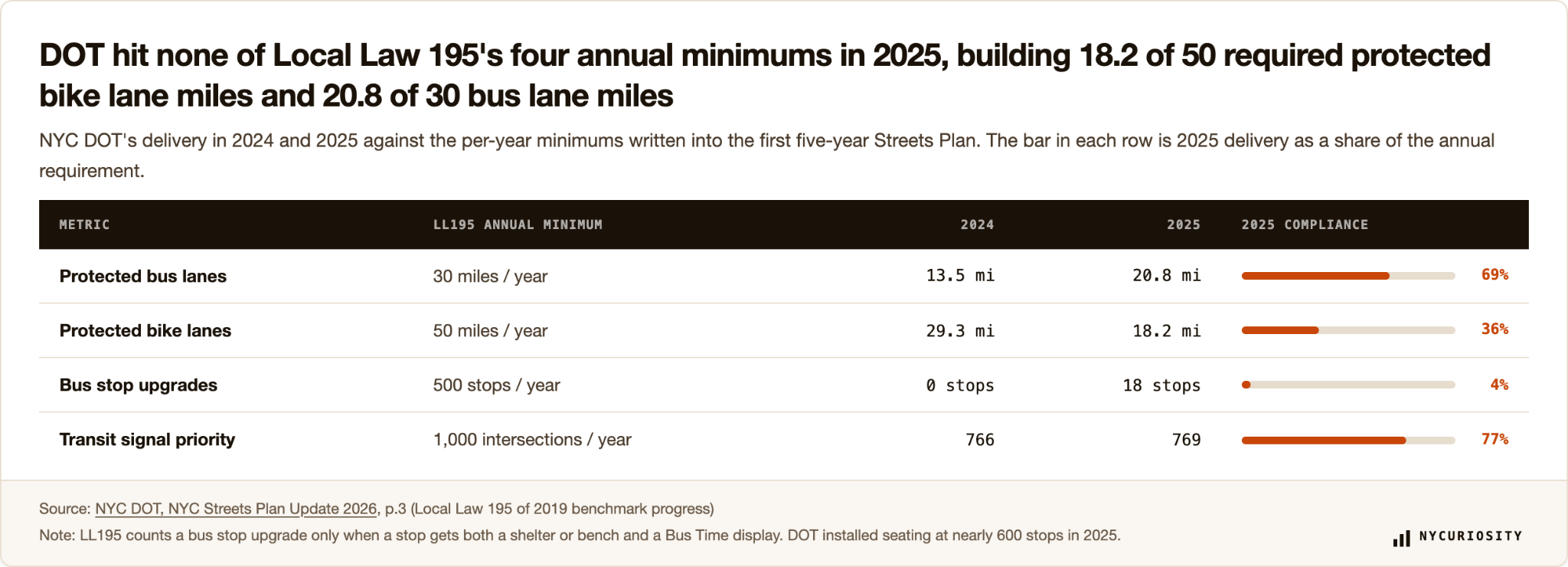
The Streets Plan is not the only policy that DOT has been charged with that remains underfunded and under-resourced. Low Traffic Neighborhoods, school streets, and street redesigns have all been done by the agency and proven successful. Providing specific funding for these policies would enable them to be implemented citywide.
Even where DOT may be properly funded and willing to implement new street safety measures, the process is too slow or too easily blocked by those other actors. Despite streets being clearly within DOT’s domain, numerous other public bodies and private citizens are able to slow or block a street redesign. While the agency should always be considering community input and experts’ opinions from partner agencies, it must also be enabled to act on the policies it knows work. At some point, we have to trust that the public body tasked with taking care of our streets also knows how to improve them.
The good news is that change is coming here, if the voters approve this November.
COGE’s ballot proposals include Question 3, which would allow the DOT to move much faster to install street redesigns. The proposal is titled “Accelerate road safety projects and the activation of underutilized city property” and would create a DOT Commissioner fast track for “critical safe street improvements when there is an identified immediate need for improvements”. This is the type of process reform needed to deliver safer streets now.

Moving too slowly on proven solutions for street safety or allowing unrepresentative actors to block an entire project for their neighborhood is costing lives. The city has the tools to accomplish Vision Zero today, and it now only needs to implement these tools at scale and at speed. While it is essential to retain community input, and a tricky matter to balance such public voices when they conflict with proven street safety strategies, much can be done to improve that balance from the current state.
Recommended Reading
A Blueprint for Safer, Quieter Streets in NYC

In 2024, there were 266 deaths and 54,137 injuries in NYC due to car crashes, with over half of those killed being cyclists or pedestrians. Every day on streets like Canal Street, parents weave with their kids through honking traffic on their way to school while cyclists and delivery vans and residents must contend with thru traffic clogging the roads.
COGE Is Just the Opening Act

“It’s easier to exchange a prisoner of war than it is to transfer a stenographer from the Tax Department to the Water Department.”