


“It’s easier to exchange a prisoner of war than it is to transfer a stenographer from the Tax Department to the Water Department.”
Mayor Mamdani has not ignored the necessity of structural reform to get government moving faster and delivering better. Nor has he underestimated the value of one of the most powerful tools available to reform-seeking New York City mayors, Charter Revision Commissions (CRCs).1
Within a few months of taking office, Mamdani launched his own CRC under the nickname COGE (the Commission on Government Efficiency). CRCs can rewrite the city’s constitution by referendum with only a simple majority of voters, and mayors can convene them at will. Even better, of the 22 charter amendments proposed by CRCs since 2005, voters have approved 20 of them.
When the Mayor launched COGE, he stated that its goals would be to find efficiencies in the bureaucracy (specifically: “improving efficiency, modernizing city government and ensuring government keeps pace”). The name and messaging are a direct reference to the federal Department of Government Efficiency (DOGE). Fortunately, unlike DOGE, which may have cost the federal government more than it saved it, the Mayor’s COGE appears focused on state capacity improvements that help agencies achieve their mandates. Recent polling from Blue Rose Research/Inclusive Abundance also affirms that voters prefer COGE’s capacity-building approach to DOGE’s slash-and-burn strategy.
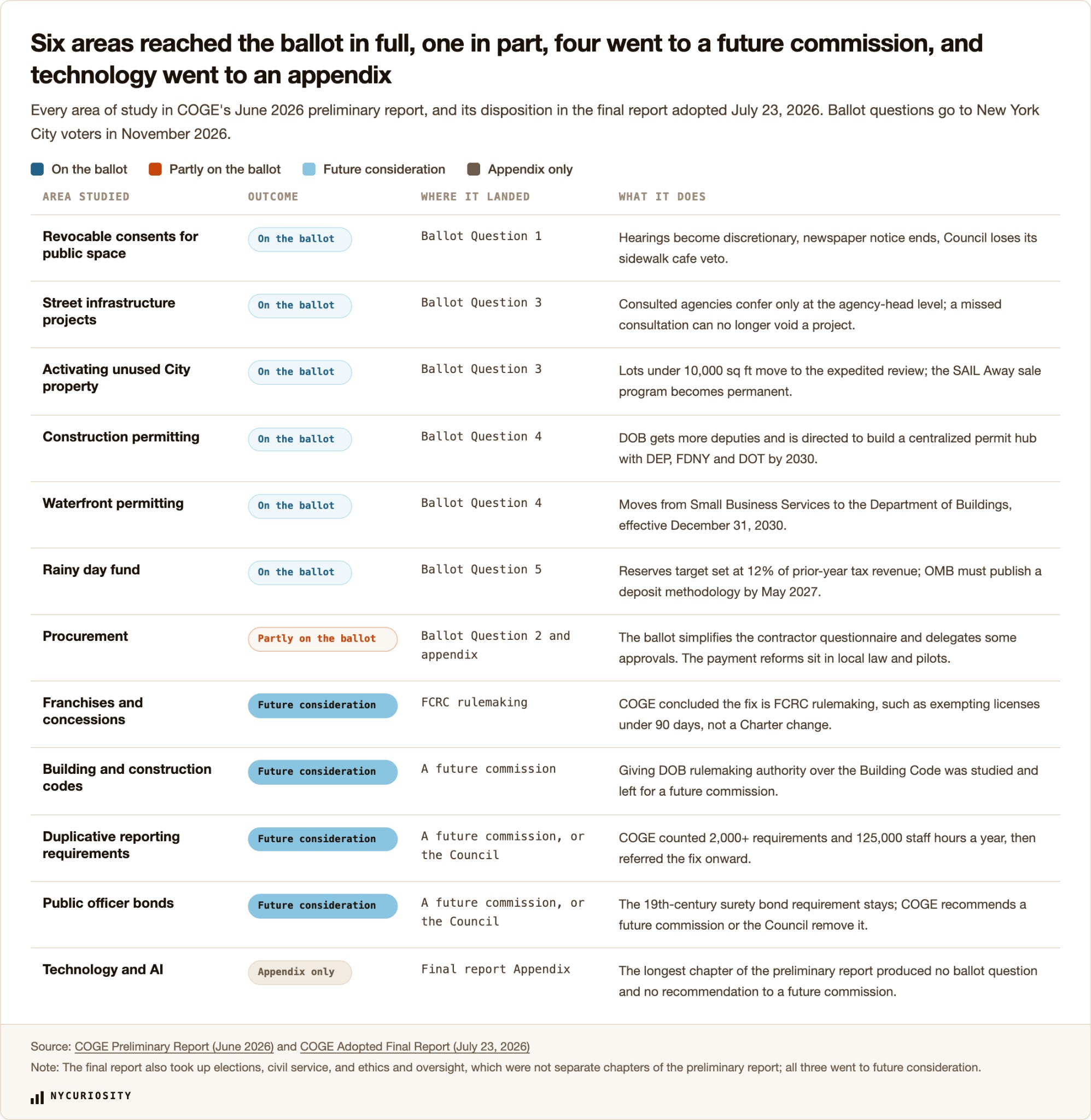
COGE moved fast to get its proposals on the ballot this fall. It was announced May 28, ran two public input sessions in every borough, drew more than 1,200 attendees, heard 250+ people give 25 hours of testimony, reviewed more than 600 written submissions, and on July 23 unanimously adopted its final report. Five ballot questions will now go to New York City voters in November.
I encourage New Yorkers to vote yes on all the ballot questions. Their passage would make vital adjustments to overburdened agency processes, resulting in faster and better delivery of essential city services.
Unfortunately, the changes they propose, while necessary to unlock a capable city government, are not enough on their own to bring government processes into the 21st century. That will require reforms outside the City Charter, many of which COGE studied and stated it could not address.
This post provides a summary of the COGE ballot proposals, reasons why you should vote yes on them, and then suggestions for where further government reform should focus in New York.
What each COGE ballot proposal covers, and why New York should vote yes
The most straightforward description of what New Yorkers will vote on this November is COGE’s own plain-language abstracts for each question, alongside the ballot text and the actual charter amendments. I encourage every voter to read at least one of these documents before voting.
Question 1: Streamline the approval process for pedestrian ramps, benches, and sidewalk cafés
If a restaurant or building owner wishes to install a bench, sidewalk café, or accessibility ramp, they need a “revocable consent” from the Department of Transportation, which requires a public hearing and paid notices in newspapers. COGE found that the outdoor dining process can take up to eight months. Meanwhile, the associated fees sometimes exceed the annual fee for using the space itself. Both the financial cost and administrative burden have made outdoor dining unsustainable for most restaurants.

This proposal would make those hearings discretionary, end the newspaper notice requirement, merge the sidewalk and roadway cafe applications into one, and remove the City Council’s power to disapprove a sidewalk cafe. COGE projects these changes would shorten the application process for roadway cafes (currently 3-5 months) and sidewalk cafes (currently 6-8 months) to just two months.
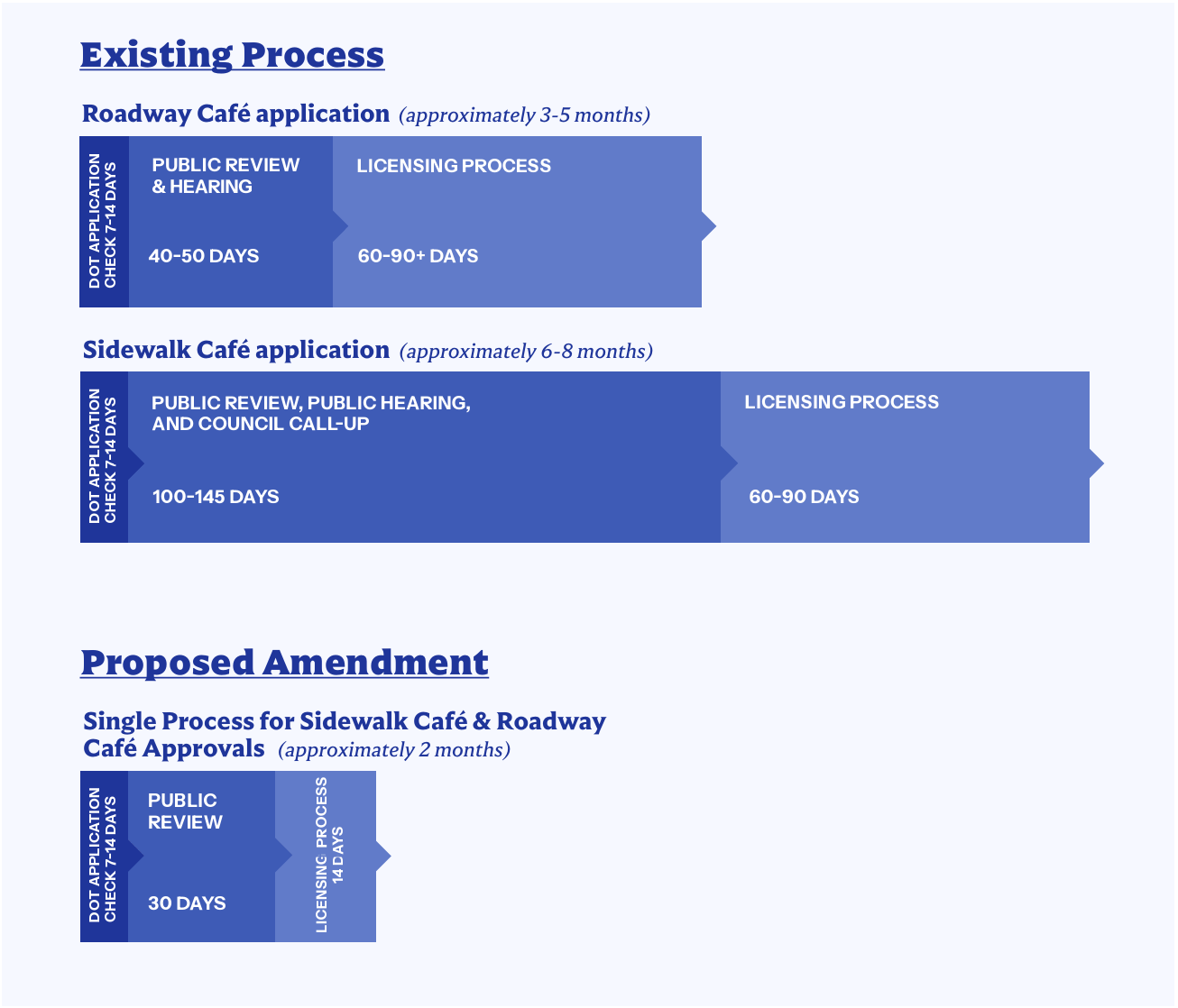
Even with this streamlined approval process, community boards, borough presidents, and Council members would retain their notice and their right to comment.2 While the proposed changes won’t entirely fix the reasons for the drop in sidewalk cafes, they’ll go a long way toward making the process simpler for both businesses and the city.
Question 2: Modernize city contracting to expand opportunities for small businesses and nonprofit organizations
This proposal would let the Procurement Policy Board simplify and tier the questionnaire every vendor is required to complete, so a small-scale business like a hot dog cart would no longer need to answer the same questions as a commercial bank. It removes a mandatory hearing on an annual client services plan, lets the Mayor delegate approval of certain contracts to agency chief contracting officers, makes permanent the online comment period that replaced in-person contract hearings, and requires the Procurement Policy Board to actually meet quarterly.
This is the proposal I am most excited about, as it could have far-reaching consequences: nearly 40% of the City’s budget goes toward procured goods and services. Implementing COGE’s suggestions here will vastly improve the City’s procurement process, resulting in providers being paid sooner and removing some costly uncertainty in the process. These are much-needed changes for a system that is well-known to be broken and that unjustly harms the contractors New York most relies on to function.
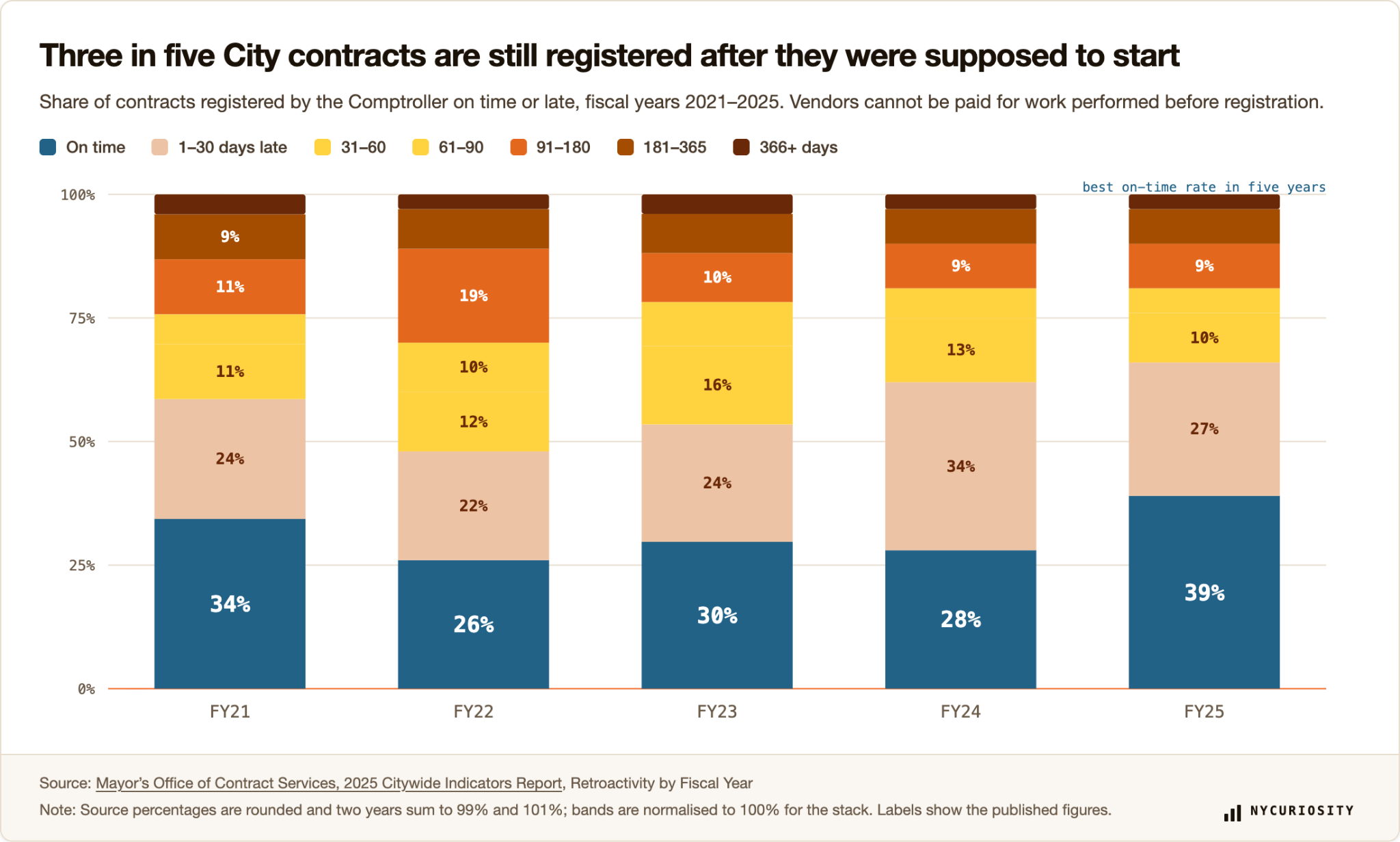
As I’ll discuss below, not all the problems with the procurement process can be fixed by simply changing the City Charter, nor do COGE’s proposals address all the issues. But improving the process in whatever ways possible through the Charter should still be done while more fundamental reforms are pursued.
Question 3: Accelerate road safety projects and the activation of underutilized city property
Agencies consulted on any major transportation project would confer only at the agency-head level.3 The most impactful change here is that a technical failure to consult multiple other agencies could no longer be used to stop or rescind a completed street safety project.
This would greatly streamline project timelines. For example, the Fire Department (FDNY) would no longer have to confer with every affected firehouse, and the Department of Transportation (DOT) could begin work on a project justified by crash data before completing notifications. In 2025, DOT designated 37 major transportation projects, of which 13 were delayed by the review process. This reform would unblock those 13 projects in future cases.
A new fast track would also be created for the DOT Commissioner to approve “critical safe street improvements when there is an identified immediate need for improvements”. This is a similar concept to the fast track for affordable housing that voters approved last November.

Similar to the other proposals, these reforms would speed up the administrative side of overdue street improvements and delayed land use applications. Safeguards remain for reviews and community input, but highly constricted agencies like DOT will be allowed to actually implement desired street changes promptly. Given that DOT has been hitting a fraction of its Streets Plan targets for years, strategies to shorten the transition from a crash-heavy roadway to a new bus or bike lane are worth pursuing.
Question 4: Simplify the building permitting process
This proposal lets the Buildings Commissioner appoint more than two deputies and citywide borough commissioners who can sign off on construction documents, directs the Department of Buildings (DOB) to build one centralized permit submission system with the Department of Environmental Protection (DEP), FDNY, and DOT by 2030, and moves waterfront permitting from Small Business Services to DOB.
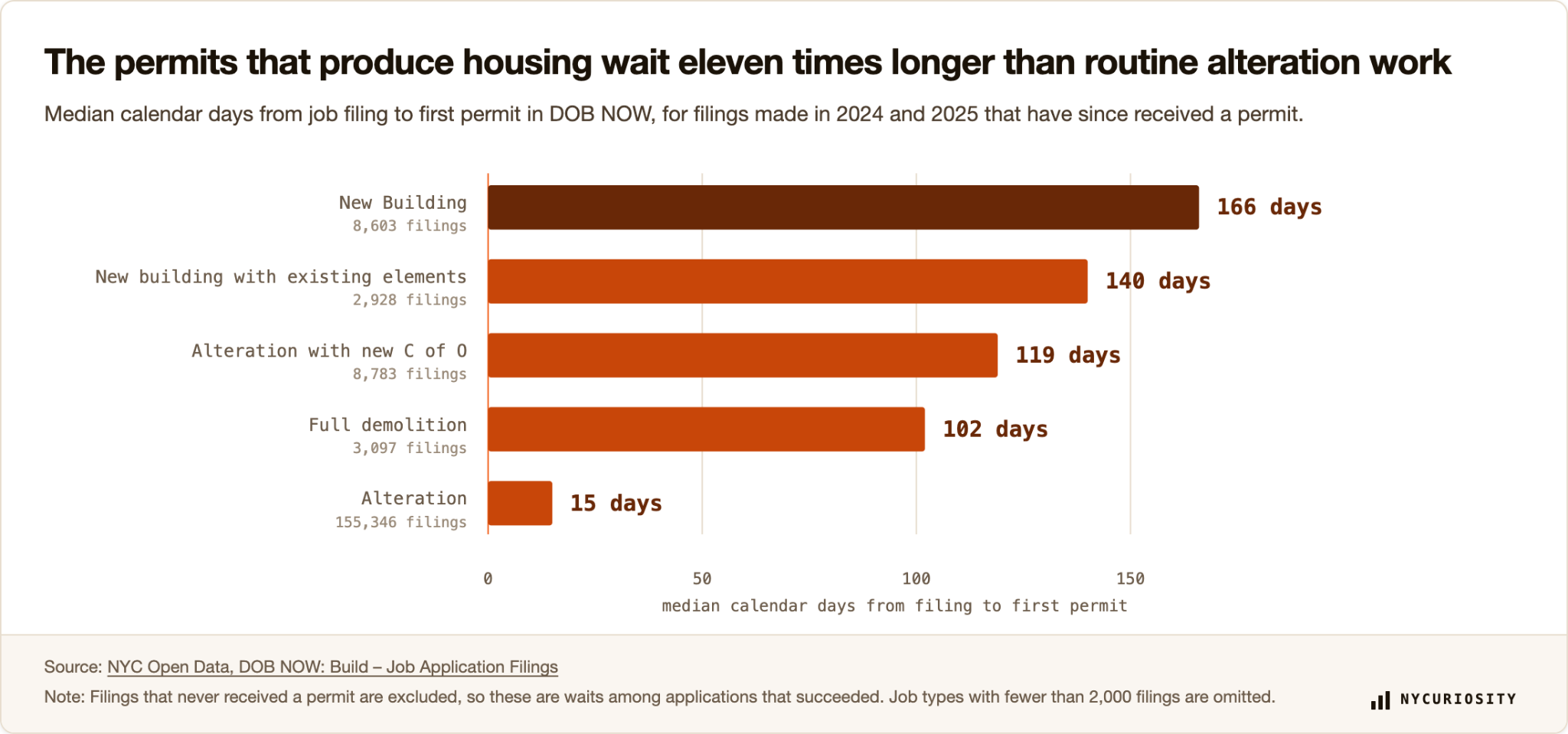
The centralized permitting hub is the most exciting idea of this bunch. The current process to build or renovate in New York involves applying for up to 40 permits and approvals from 18 separate offices. This is another common-sense reform that streamlines an administrative process while retaining necessary safeguards. Other states, like New Jersey and Pennsylvania, have had tremendous success with centralizing application processes into one application or incentivizing speedier decisions with refunds for missed deadlines. It is long overdue for New York to do the same.
Question 5: Require contributions to the rainy day fund to strengthen long-term fiscal resilience
New York created a rainy day fund by referendum in 2019 but never set a target or a deposit rule, so contributions have been whatever the Mayor and Council determine each year. This proposal would set a target of 12% of the prior year’s tax revenue across reserves and require the NYC Office of Management and Budget (OMB) (in conjunction with the City Comptroller) to publish a deposit methodology by May 2027, updated every four years. Deposits will still require appropriation, so this is more like a commitment to a plan than a hard mandate.
Current NYC Comptroller Mark Levine has beaten the drum on the need for mandates for the rainy day fund, and while this doesn’t go all the way toward doing that, it is still a positive step forward. Setting a target will relieve the inconsistent nature of the rainy day fund and stabilize the City’s finances for potential future hard times. As with the other reforms proposed by COGE, my hope is that this is just the beginning of more work to be done in this area.
COGE takes necessary steps on state capacity, but it doesn’t provide all the solutions
COGE proposes to tackle slow processes where the City Charter is the source of the delays. The reforms it introduces would massively speed up permitting and approval processes. But many sources of delays in public service delivery come from other sources: staffing issues, State law, outdated technology and data infrastructure, or agency practice.
Consider the procurement process, where COGE proposed some modest changes but also acknowledged that “the Commission determined that many solutions to the issues affecting City procurements also lie outside the Charter.” In these cases, COGE only documented the problems for future actors to solve. Addressing them may have an even larger impact on government effectiveness than the initiatives COGE did advance to the ballot.
Assuming these ballot questions are approved by the voters, what changes should the city and state governments tackle next to make New York run better?
Two particularly problematic blockers on government capability are named by COGE but not addressed: failure to adopt new technology and excessive reporting requirements. Without reforms on these issues, all other public process improvements remain subject to outdated modes of operation.
COGE’s technology chapter in its reports was its most ambitious, covering what government could do with ideas like an 18F-style in-house team of engineers and designers, no vendor lock-in, and agencies whose data systems actually talk to each other. It warned that new tools are “improving faster than any procurement process or budget cycle was built to absorb.” The State Capacity Ecosystem team, of which I am a part, has written about this exact concern and why it is going to become a bigger and bigger problem for government capacity if not addressed soon.
Unfortunately, there is no ballot question or referral to a future commission concerning these ideas. In COGE’s final report, technology reform only exists as a three-page appendix describing what the NYC Office of Technology and Innovation (OTI) is already working on. This ignores the fact that OTI is operating in a broken, outdated system and has limited ability to change that on its own.
On reporting requirements, COGE surveyed every city agency and reviewed the reporting portal maintained by the Department of Records (DORIS). They found more than 1,500 reporting laws passed or updated since 2011, more than 2,000 separate reporting requirements on the books, nearly 1,000 reports produced every single year, more than 350 every quarter, and over 125,000 staff hours a year spent writing them. I found similar evidence in my Legislation Implementation Tracker, which extracts obligations from the text of every local law enacted since 2014 and counts 888 reports due at least once a year.

Yet, having measured and acknowledged the severity of this issue, COGE only recommended that a future commission take it up. So what can actually be done to address these gaps in state capacity, and where should government reform efforts focus next?
The agenda for the Council, Albany, and the next commission
Here are my recommendations, largely corroborated by COGE’s final report and by Vital City’s panel of former officials and scholars advising the commission:
Fix civil service in Albany. State law governs civil service rules in NYC, so this one requires cooperation with Albany. As I wrote in December, the certification waits and the Rule of Three are why the City carries thousands of vacancies year over year. In that post, I describe a number of fixes that would enable the City to attract, hire, and retain much-needed talent and labor. All state capacity issues flow through public employees, so fixing civil service hiring and bringing in new talent faster must be prioritized.

Give the Reports and Advisory Board Review Commission (RABRC) a larger role. Charter §1113 lets RABRC waive reporting requirements. COGE found that since RABRC was created, local laws have required or revised over 1,500 reports, but RABRC has eliminated only 28. Auto-refer any report DORIS shows unfiled for two cycles, and make RABRC vote on retention. I wrote more about the effects excessive reporting requirements have on slowing down government processes here.
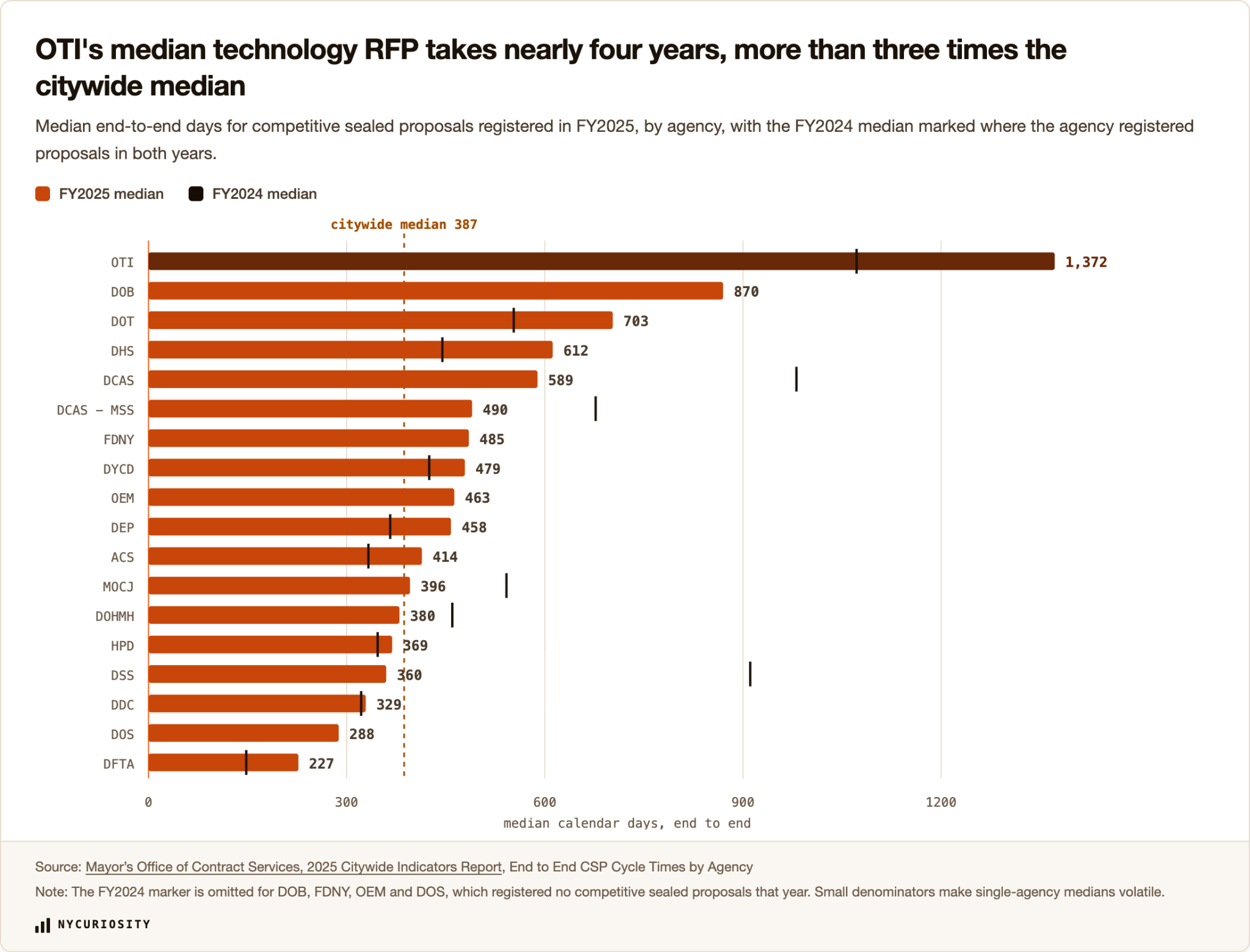
Create a separate technology procurement track. A 1,372-day median is not a process that can be optimized at the margins, and requires fundamental change. With the pace of technology development, particularly with AI, moving faster than ever, government needs to move faster to take advantage.
Restructure OTI to be central to every agency’s technology adoption process. This requires a radical reframing of OTI’s role in city government. Colorado recently made such a change and is now the leading example on how government can successfully implement new technologies.
Give every builder agency the powers that bodies like the Economic Development Corporation (EDC) already have. Former NYC DOT Commissioner Polly Trottenberg put it best in her advice to the commission: “Every agency should be able to procure and hire and do what an EDC or School Construction Authority can.” Learn from successful agency programs and private-public partnerships, like EDC’s revitalization of the NYC Ferry, and adapt to new models of work system-wide. It requires Albany to unlock this ability for the city.
Procurement reform, procurement reform, procurement reform. There is so much broken with the current system of public procurement. Too much to summarize in this bullet or include in this piece – but look out for a piece covering this soon.
Show up in November, and then keep fighting for reform
I highly encourage New Yorkers to vote yes on all five proposals, as they will result in a city government that runs faster and better.
But just passing these ballot questions will not be enough. Relative to the scale of problems hampering the City’s ability to deliver, COGE put forward modest reforms to the voters. Reforms that determine whether a shelter provider makes payroll, whether the City can hire an engineer, and whether it can buy software before that software is obsolete are not on the ballot. These fixes will require action in Albany, in the City Council, and in further commitments by this Mayor’s administration.
I’ve written before about the incredible potential of CRCs and how they could be used to transform state capacity, such as reforming elections and fast tracking affordable housing. Friend of the Substack Sebastian Hallum Clarke has also investigated how, in the past few decades, CRC ballot initiatives have almost always been approved by the voters.
Only the Council’s final vote would be removed from the process. The Council called up 10 to 15 sidewalk cafe applications a year over the last decade and denied only a handful. Yet the usage of this power adds up to 30 days to every application, whether or not they get called up. Therefore, a rarely exercised veto is costing every restaurant in the city a month, in a city where active sidewalk cafe licenses collapsed to just 47 after Local Law 121 of 2023.
Specifically in this ballot proposal, “projects that realign a roadway, including by removing a traffic lane or parking lane, for over four consecutive blocks or 1,000 feet, and projects that add or remove a bike lane of any length.”