


On Tuesday, March 3rd, 2026 at 10 AM, the New York City Council Committee on Transportation and Infrastructure kicked off its hearing. The meeting consisted of discussion of several important pieces of legislation, dealing with streetscape policies from daylighting crosswalks to changing sidewalk cafe regulations. Each of these topics is worthy of its own post on the dynamics of the new bills. But today, I’m going to talk about the NYC Streets Plan.
Where did all the sidewalk cafes go?

In the summer of 2020, as COVID-19 raged on and local restaurants, cafes, and businesses fought desperately to remain open, the city allowed for many parking spots and roadsides to be taken over by sidewalk sheds. These little huts, often constructed of wood or aluminum, provided outdoor seating for diners and transformed the streetscape. For a little w…
Streets Plan was passed by the City Council in 2019 as Local Law 195 (LL195), mandating the NYC Department of Transportation (NYCDOT) to release 5-year transportation master plans with quantitative goals ”to prioritize the safety of all street users, the use of mass transit, the reduction of vehicle emissions, and access for individuals with disabilities”.
To be included in the first 5-year plan was the following laundry list of requirements1:
150 miles of physically or camera-protected bus lanes over five years, with at least 20 miles in the first year and at least 30 miles during each subsequent year
Transit signal priority at 750 intersections during the first year and 1,000 intersections during each subsequent year
250 miles of protected bike lanes over five years, with at least 30 miles in the first year and 50 miles in each subsequent year
Bus stop upgrades like benches, shelters, and real-time passenger information at 500 bus stops each year
Redesigning at least 2,000 signalized intersections over five years, with at least 400 redesigns each year
Accessible pedestrian signals at no fewer than 2,500 intersections, with at least 500 installations each year
Assessing and amending commercial loading zones and truck routes
Developing parking policies to promote the master plan’s goals of safety, mass transit use, reduced vehicle emissions, and access for individuals with disabilities
Within the first two years, create and maintain one million square feet of pedestrian space
The two headline pieces of these mandates were the 50 miles of bike lanes and 30 miles of bus lanes required per year. Since NYCDOT is responsible for 6,300 miles of streets and highways and over 12,000 miles of sidewalk, this represented an improvement of just over 1% of total street mileage per year. On the surface, it did not seem like an exceptionally difficult bar for NYCDOT to clear.
And yet, the Transportation Committee meeting spotlighted NYCDOT’s consistent failure in recent years to meet the Plan’s benchmarks of bus and bike lane improvements.
Let’s dive into what exactly was in Local Law 195 and the first edition of the Streets Plan in 2021. I’ll then look at the data and possible explanations for where and how NYCDOT has fallen behind on its goals, and how gaps may be bridged. Lastly, I’ll make some recommendations for what I believe should be in the next 5-year plan, which will be released next year.
How well has NYCDOT complied with its mandates?
LL195 required NYCDOT to report “in February of each year regarding an update on any changes to the master plan and the progress towards achieving the benchmarks laid out in the plan”. These progress reports have not been inspiring.
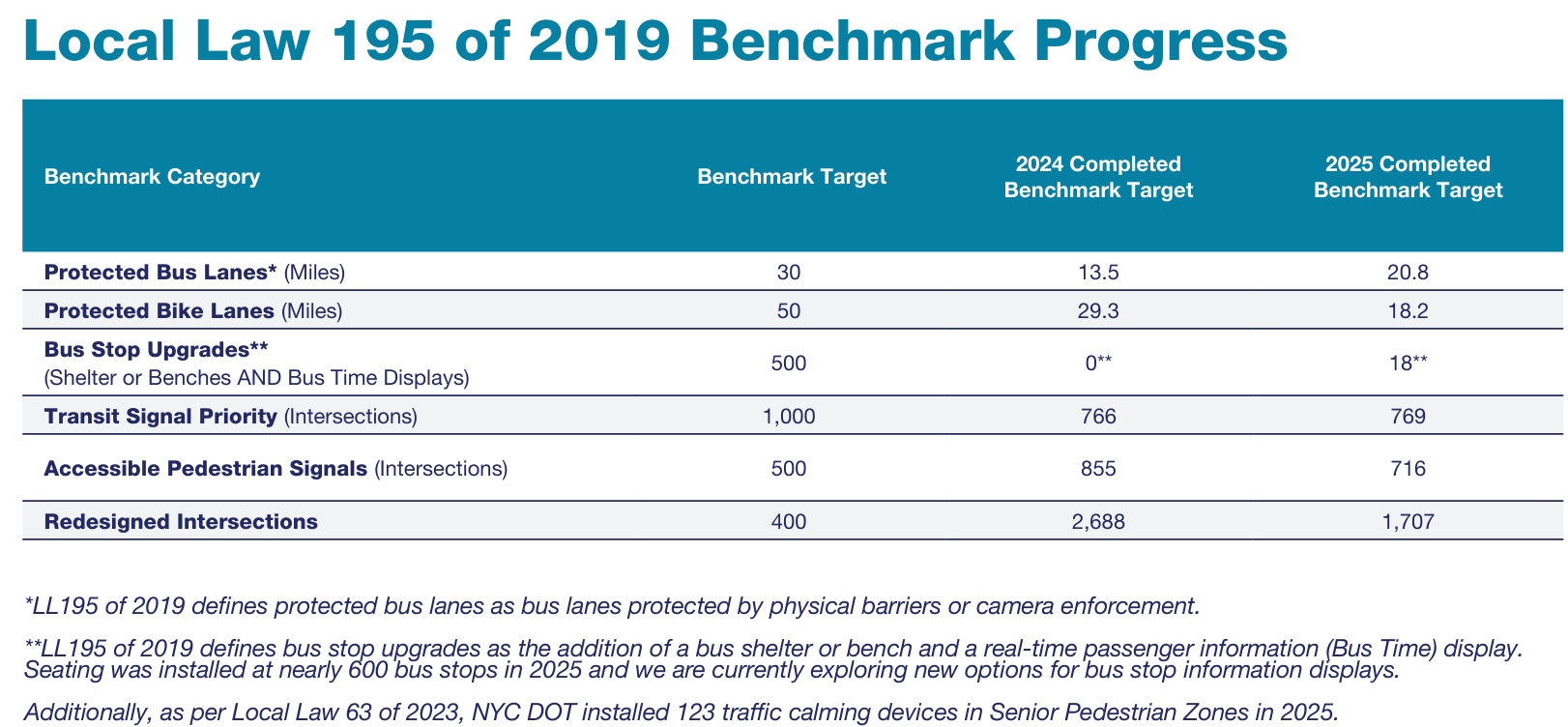
In 2024, NYCDOT only managed to construct 13.5 miles of new, hardened bus lanes (45% of the required amount). In 2025, the agency only managed to construct 18.2 miles of new, hardened bike lanes (36% of the required amount). In neither year did the agency meet the requirements on either mandate, nor its mandates for bus stop upgrades2 (upgrading only 4% of the required total in 2025) or transit signal priority updates (77% of the required total in 2024 and 2025).
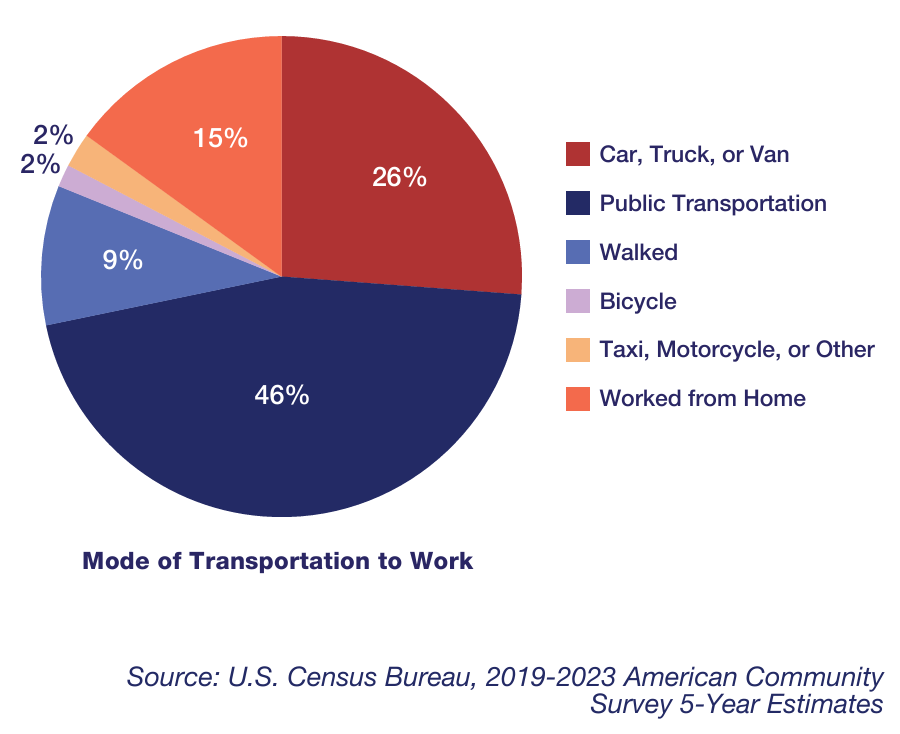
At the same time, NYC residents and tourists have increasingly been using bikes and other forms of transit besides cars to get around. While bus and subway ridership has not yet recovered to its pre-COVID peaks, usage has certainly trended up in recent years, while Citi Bike and scooter rides have also surged. The city’s bike lane network has not kept up with the growth in riders. If Mamdani’s promise of free buses comes to fruition, we may see a similar uptick in bus ridership without the commensurate improvement in protected lane coverage.


Clearly, total new mileage of protected bus and bike lanes has not come close to expectations. Bus speeds have also improved only marginally, and this is with fewer household vehicle registrations and congestion pricing helping things along. NYCDOT has not met its mandates so far, and in the next year, more requirements will appear.
The Council’s original 2019 bill also contained requirements for the second version of the Streets Plan, which is due by December 1, 2026. These include:
complete a connected bicycle network, and ensure a bicycle lane network coverage index of 100 percent (i.e., 100% of NYC residents must be within one mile of the bicycle lane network)
installation of physically or camera-protected bus lanes on all routes where they can be installed
installation of accessible pedestrian signals at no fewer than 2,500 intersections over five years
installation of bus stop upgrades at all bus stops
redesign at least 2,000 intersections over five years
installation of pedestrian ramps at no fewer than 3,000 street corners
That means NYCDOT will be on the hook for a great many more intersection, signaling, and accessibility upgrades over the next five years, on top of playing catch up with the previous mandates that they have fallen behind on.
It remains to be seen how the agency will define completeness for a “connected bike lane network”, though the legislation did provide some criteria for connectedness based on “the number of choices a cyclist has for turning from one bicycle route onto another, without leaving the overall network.” The criteria for installation of protected bus lanes on all bus routes “where such improvements can be installed” similarly leaves some wiggle room.3
How NYCDOT interprets these benchmarks for the next Streets Plan will be indicative of what it prioritizes. After all, what we measure reveals what we care about.
Why has NYCDOT fallen short of its mandates?
In a recent interview with Ben Max on the Max Politics podcast, Councilmember Lincoln Restler cited three primary reasons for why NYCDOT has not met its Street Plan mandates:
Insufficient staffing levels
Lack of political willpower by the Adams administration
Leadership/management failures
While 1) is interesting and I’ll address it below, 2) and 3) present factors that the new Mayoral administration has the opportunity to immediately remedy. Throughout his Mayoralty and particularly in the latter years, Mayor Eric Adams frequently backed down or reversed course on major bus and bike lane infrastructure upgrades. Mamdani’s NYCDOT can strike a different course.
Two well-known examples are the 34th Street busway and the McGuinness Boulevard redesign that included new bike lanes. Pressure from adjacent communities and the federal government contributed to such decisions, but both were cases where NYCDOT had full authority to add new mileage and reversed course when encountering such pressure.
The Adams administration's backing down on such projects represented wasted time and energy by NYCDOT on projects that would have added to the new bus and bike lane mileage totals. Not only did it prevent new miles from being added, but it also sucked away time and energy from projects that could have been implemented elsewhere. However, not all faults can be placed with the prior Mayor and his leadership team.
One critique I have of LL195, as I do with much of the well-intentioned legislation that comes out of the City Council, is that additional funding was not sufficiently provided alongside the new mandates. When new regulations are enforced or infrastructure upgrades are enacted, the affected agency must devote greater resources in terms of labor, capital, and time in order to comply. If legislators don’t provide funding to carry out the requirements of the new legislation, agencies are forced to stretch thin and often fail to meet goals.
The fiscal impact statement provided with LL195 provides a table of estimated expenditures for NYCDOT to carry out the mandates of each of the first two five-year plans:
The NYC Council Finance Division estimated that over the first 10 years following passage of LL195, Streets Plan mandates would cost NYCDOT over $1.7 billion. That is an addition of about $170M in overall expenditure per year. This breaks down into $628M expense and capital expenditures for Fiscal Years (FY) 2022-2026, and $912M total expenditures for FY2027-2031. Meanwhile, the FY25 Executive budget for NYCDOT was $1.45 billion.
A breakdown of the costs by each portion of the requirements was also provided, which I have converted into a bar chart here:
The only mention of funding anywhere in the statement for all these expenses is that the source of funds to cover estimated costs will be the General Fund. At no point between 2021 and 2025 did NYCDOT receive a budget increase of $170M to cover the expected costs of the first 5-year Streets Plan. Yearly budget increases in that time period fluctuated between $20M to $150M. But this also represents the total budget increase, which must also cover additional expenses from other legislation adding work for NYCDOT (like the Dining Out NYC program, in which NYCDOT must review all business applications for sidewalk cafes) and inflation during the period.
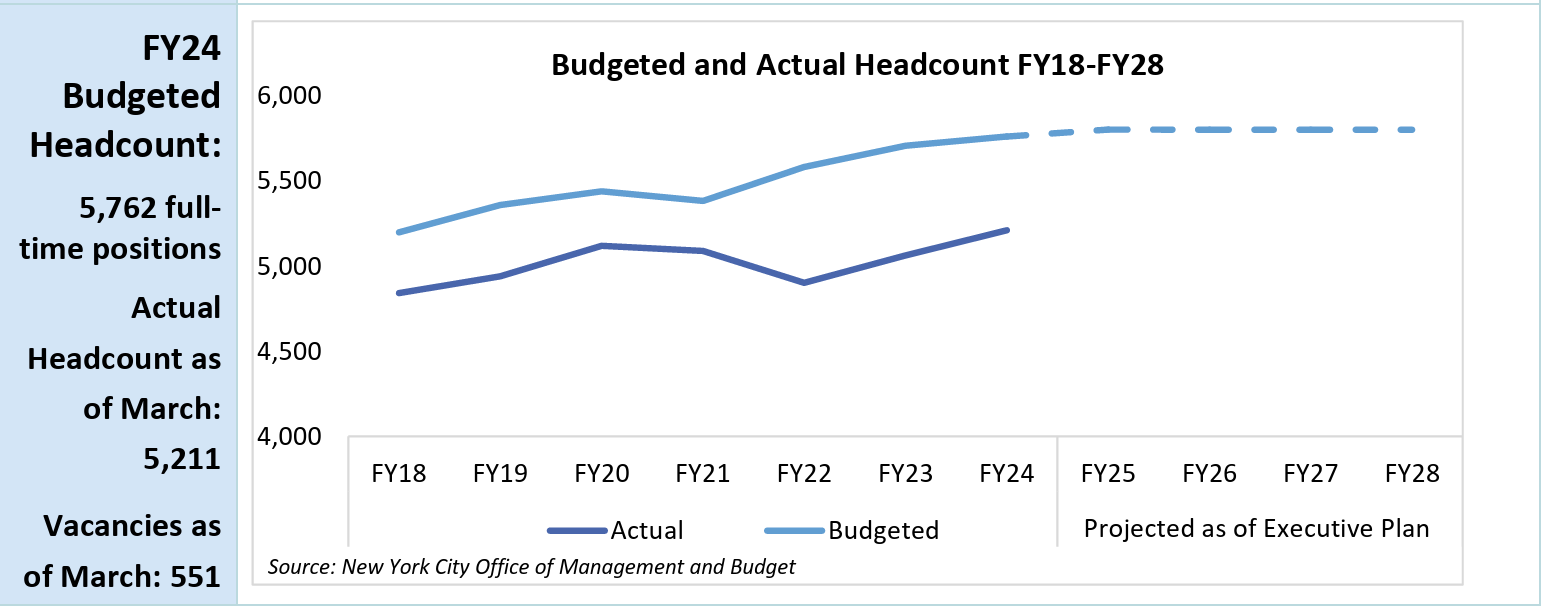
At the same time, as Councilman Restler mentioned, NYCDOT staffing levels did not meet expected requirements either. When LL195 was passed, NYCDOT estimated that an additional 40 support staffers would need to be hired, costing $5.5 million annually between FY2022 and FY2031. Instead, due in part to the COVID-19 pandemic and Citywide hiring issues (which I have previously covered here), the years covering Streets Plan 2021-2026 saw headcount at NYCDOT actually decline and only in recent years recover.
So while the Adams administration and NYCDOT leadership bears some of the responsibility for failures to meet mandates, it’s arguable that the agency was also set up for failure. Without proper increases in funding, nor the ability to hire needed staff, NYCDOT is unable to devote the effort required for extensive street transformations concurrently with its other responsibilities.
What should be in the 2026 Streets Plan?
The COVID-19 pandemic was a massive and unexpected interruption to many City services and funding sources. Civil service hiring reform is needed at the State level to improve all NYC agencies’ ability to hire more employees, with better skills, and faster. Neither NYCDOT nor the City Council bear the entire blame for Streets Plan shortcomings. But both the agency and the Council have the power to make some changes that can improve the odds of success for the next 5-year Streets Plan.
As NYCDOT Commissioner Flynn mentioned in the Council Transportation Committee hearing, the City should focus on more than just maximizing new lane mileage without an eye toward quality or equity of those bike and bus lanes. More than just additional bike/bus miles is needed for NYC to reach its Vision Zero goal: in 2024, there were 266 deaths and 54,137 injuries due to car crashes, with over half of those killed being cyclists or pedestrians.
The next Streets Plan should shift from a maximum new mileage lens to a focus on comprehensive redesign of the streets network, such as Low Traffic Neighborhoods (LTNs)4 and an enforcement of the Greater Greenways Plan. Such systematic and comprehensive street redesigns are necessary to eliminate traffic deaths and make NYC a world-class walkable city. The Council can aid NYCDOT in this perspective shift by either passing new legislation changing the mandates of the next Streets Plan, or on simply focusing their attention in Transportation hearings elsewhere.
A Blueprint for Safer, Quieter Streets in NYC

In 2024, there were 266 deaths and 54,137 injuries in NYC due to car crashes, with over half of those killed being cyclists or pedestrians. Every day on streets like Canal Street, parents weave with their kids through honking traffic on their way to school while cyclists and delivery vans and residents must contend with thru traffic clogging the roads.
What this means is not just adding bike/bus lanes wherever possible to maximize new miles, but doing so in a strategic manner that expands existing networks and connects pedestrian paths and transit corridors. It also means pairing new protected lanes with other street and sidewalk improvements, all done at the same time.
Redesigning these residential streets to become narrower one-way streets with expanded pedestrian sidewalks or car-free pedestrian plazas would reduce traffic and traffic-related casualties while improving the air quality, noise quality, and overall quality of life for all who reside in the LTNs.
Similarly, NYC can and should do more to cohesively improve its greenways citywide and better connect the parks throughout the rest of the city. Outside of Manhattan, less than a quarter of residents live within 1/4th of a mile of a greenway - making access particularly lacking in lower-income neighborhoods that would most benefit from greenway amenities. The Greater Greenways Plan announced by a coalition of city agencies in 2025 is an excellent first step in providing necessary green infrastructure for the City’s residents. Yet at the time of the report’s publication, only 17 miles of new greenway were actively under construction.
NYC Mapped Its Greenways. Now It Has to Build Them.

Anyone who has spent time on the Hudson River Greenway, on Manhattan’s west side waterfront, knows how incredible the greenway experience in NYC can be. Lush vegetation alternating with modern urban parks and playgrounds, revitalized piers and well-preserved 19th-century ornamentation, all with unbeatable views of the Hudson River and NYC’s tallest skys…
The 2026 Streets Plan is the perfect opportunity to codify these fundamental and comprehensive street redesigns into law. The City Council should advance legislation requiring NYCDOT not just to build more miles of bike and bus lanes, but to do so in a more deliberate manner that redesigns streets and in a more connected manner that connects the new bike and bus lanes.
How can we improve NYCDOT’s performance?
For the dream of a comprehensive, connected network that turns the potential health, transportation, and economic benefits into reality, concrete plans and timelines on a larger scale, backed by much greater funding, will be necessary. The biggest threat to establishing neighborhood-wide transformations will be the potential cost of doing so. However, DOT can be directed to utilize low-cost methods for pedestrianizing streets, such as tree planters and painted traffic directions, which can effectively redesign roads in speedy and simple fashion. The advantage of not needing construction of entirely new roads means DOT can provide high return on taxpayers’ money by implementing one-time permanent changes.
If the Mamdani administration is serious about improving the quality of life for New Yorkers, it should include additional funds for both the Streets Plan and especially for greenway development in the outer boroughs in its next proposed budget. The City Council has the opportunity to weigh in on the preliminary budget and should take the lead in demanding more funding for such street improvements. It is not enough to pass legislation demanding better streets. The Council and the Mayor must put their money where their mouths are. A mandate without a budget is not a plan, it is a wish list with legal formatting.
The Mayor and DOT Commissioner should also be pushed to prove that they are serious allies of pedestrians by agreeing to a specific timeline for greenway development and providing the funding figures required to actually build the proposed segments. In the March Transportation Committee meeting, the Commissioner and his team were unable to answer Chair Abreau’s questions about how much more funding is needed to meet Streets Plan mandates. I expect the Commissioner to come better prepared for the upcoming preliminary budget meeting and future Transportation Committee hearings.
For definitions of what many of these requirements actually mean in terms of pedestrian space, protected lanes, upgrades, and more, I highly recommended looking at the text of the legislation: https://legistar.council.nyc.gov/ViewReport.ashx?M=R&N=Text&GID=61&ID=3734799&GUID=97EA9752-B037-424C-B11F-5BD3847361F5&Title=Legislation+Text. Definitions for all these terms are helpfully laid out!
When pressed to explain why the agency installed so few bus stop upgrades, NYCDOT leadership responded that more shelter and bench upgrades were completed than required in 2025. However, since LL195 defines an upgrade is shelter/benches AND bus time displays, the agency missed the mark due to few installations of the latter device.
From LL195, “In addition, each report due beginning February 1, 2028 shall include the bicycle connectivity index for the previous year.”
LTNs are groups of residential blocks redesigned so cars can access local roads but not drive straight through, cutting down on dangerous shortcuts. Street traffic is reduced with tools like protected bike lanes, curb extensions, and small pedestrian plazas. LTNs bundle many initiatives NYC is already experimenting with like Open Streets, busway-only streets, and traffic-calming designs into a cohesive neighborhood-scale strategy. Rather than relying on a single block closure or an isolated bike lane, LTNs connect these elements so residents experience an entire network of safer, quieter streets.