


Two weeks ago I published the NYC Council Legislation Implementation Tracker, a public tool that scans every local law enacted by the City Council since 2014 and extracts the specific obligations each one places on city agencies. Users can read and filter, for every local law’s obligations, who must act, what they must produce, by when, and how often. The launch post argued that agencies are held accountable to a ledger they (and the public) could not see.

Since launching this tracker, I have been fortunate to receive coverage in The City Reporter and a feature in Searchlight, and have received feedback from dozens of agency staff and readers. The tremendous response to this tool has led me to make several enhancements to the tracker and to begin thinking about how to reduce the administrative burden that city agencies face. This post covers both those developments.


The tracker has gotten some upgrades
Attention improves a public tool fast, and I have been able to implement some excellent suggestions provided by readers and early users of the tracker.
Reviews from agency staff, community board colleagues, and other New Yorkers caught real gaps in the dataset. For example, legislation carrying citywide duties on “each city agency” now carry their own tag instead of hiding under Unspecified. Other improvements to the legislation scraping process and how obligations are tracked and assigned to agencies have resulted in slight changes to the headline numbers.
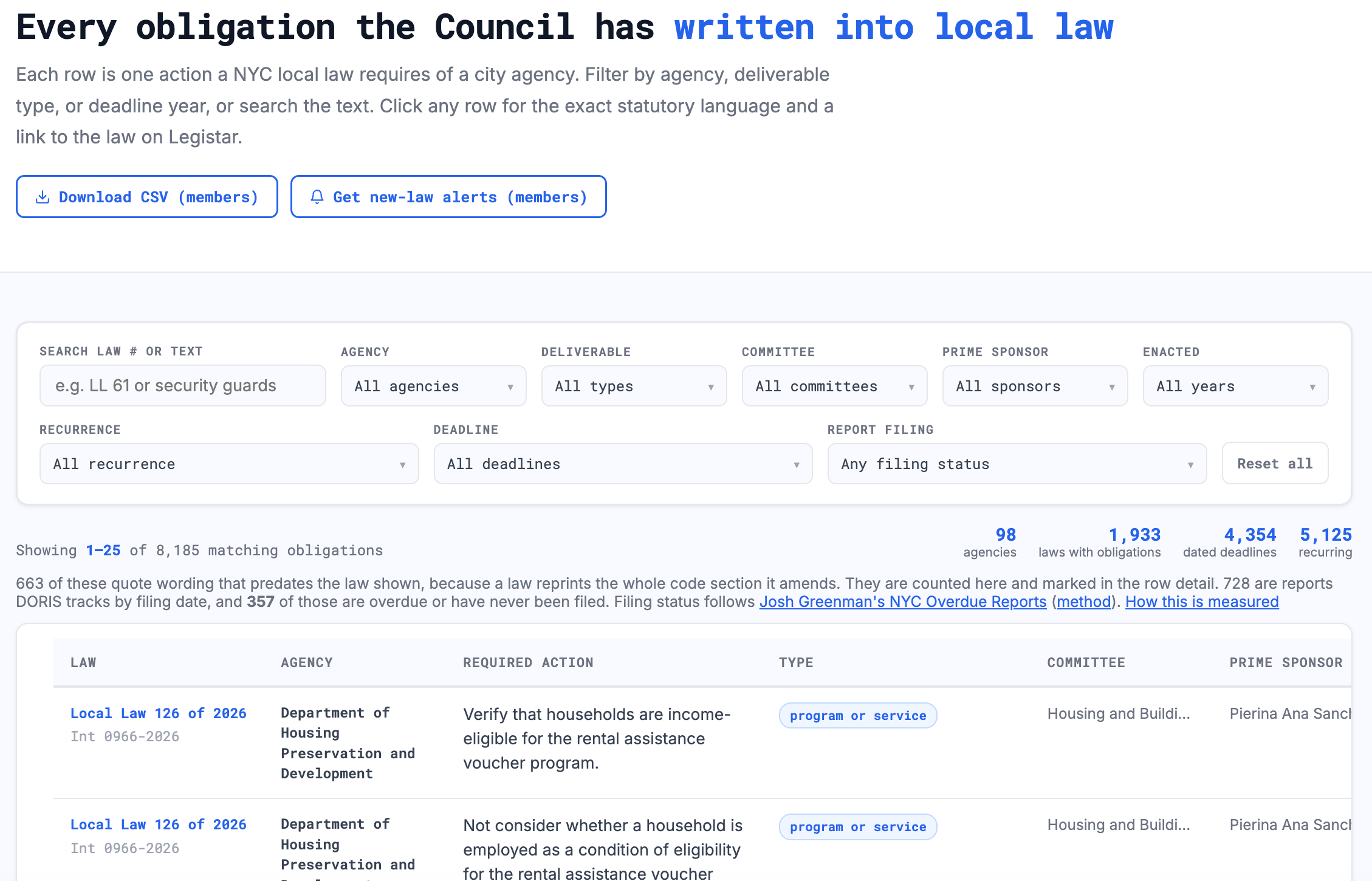
As of today, the tracker contains 8,185 obligations from 2,138 laws, 4,972 of them standing obligations. The tracker will continue to be improved upon and is a constantly evolving tool, so expect to see these numbers change further, though likely just marginally. The legislation scraper will also be running monthly to keep the tracker fresh with new local laws. Please send me corrections or suggestions for anything you spot in the data or the tool. The methodology page will also continue to document every correction.
Significantly, the tracker’s report pages now also show whether each required agency report actually arrives, matched against the Department of Records’ (DORIS) register using the method Josh Greenman built for his NYC Overdue Reports tracker. Integrating DORIS data into the legislation tracker helps track which reports agencies are actually providing, and where they may be falling behind.
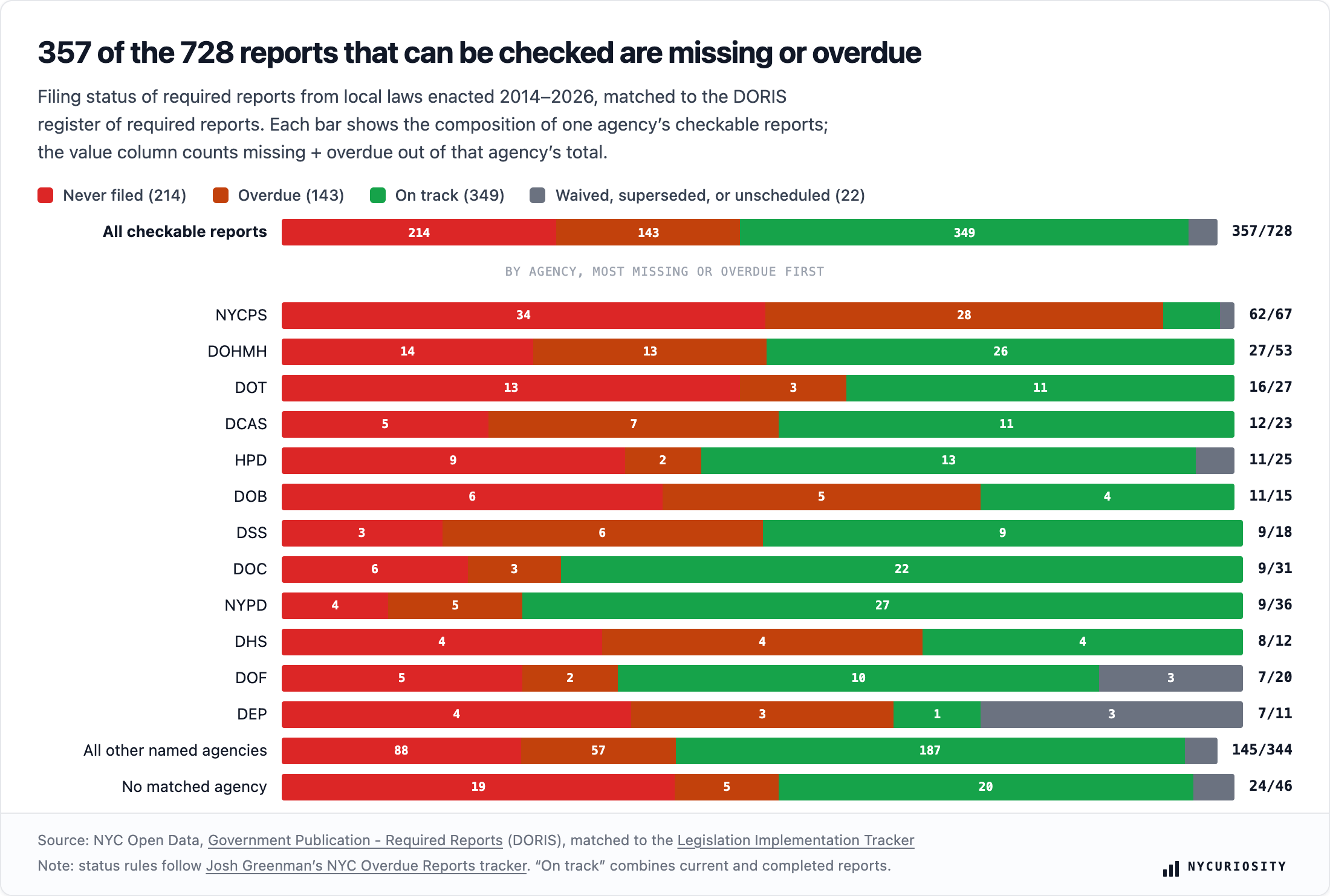
Several rounds of additional data audits and validation against DORIS’ register and Legistar’s own metadata have resulted in slight adjustments to the headline figures.
The City Reporter put the count in front of the people who could act on it
Katie Honan’s City Reporter piece asks whether Mayor Mamdani’s efficiency push should tackle the reporting load his own Commission on Government Efficiency (COGE) flagged, and she uses the tracker’s data to quantify that load: more than 8,000 obligations, over 1,500 of them reports, more than 850 recurring at least once a year. When we spoke, I told her what the data makes clear: there is a disconnect between legislators talking about what they passed and the agencies tasked with carrying it out.
Her coverage of the tracker also surfaced debate over the best solution to agencies being overwhelmed with obligations, or whether it is something to be solved at all. Citizens Union’s Grace Rauh wants the city to reconvene the Report and Advisory Board Review Commission (RABRC), the public body that can retire obsolete reports. RABRC has only exercised this power 28 times ever and has not met since December 2024. Reinvent Albany’s Alex Camarda suggests limits on new reporting bills. Meanwhile, Speaker Menin’s office defends reporting as the Council’s oversight tool.
What can be done to alleviate the burden on agencies?
I weighed in with my own suggestions as well in my column over at Citizens Union’s Searchlight, “Unfunded and Unfinished: How Council Mandates Slow the City Down.” In that article, I make the argument that when the Council passes a law, it reliably tells an agency what to do and unreliably supplies the money and people to do it.
Across 254 fiscal impact statements, only 13% mention personnel at all, and 18% declare the new work will be “absorbed within existing resources”. As I wrote when I launched the fiscal impacts tracker, these unfunded mandates explain why agencies often fail to meet such obligations. The burden also concentrates where New Yorkers most feel slow service: ten agencies carry six in ten of the Council’s mandates, led by the Department of Health and Mental Hygiene with 582 obligations and the Department of Transportation (DOT) with 442.
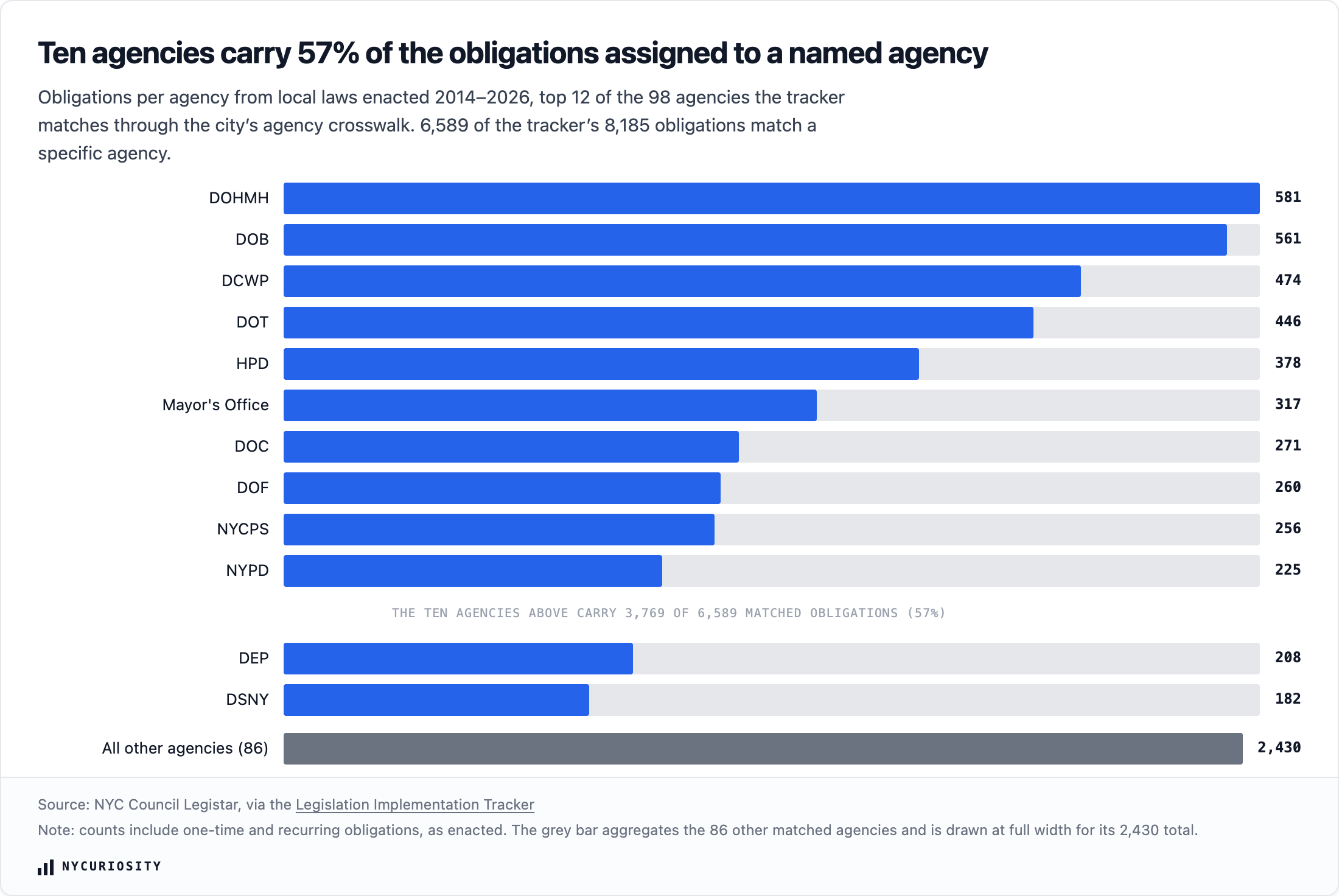
This is certainly the case with the Streets Plan mandates, in which the Council stacked new obligations and expectations onto DOT without equivalent increases in funding or staffing. New mandates and recurring obligations increase the administrative burden on each existing city worker, resulting in a fixed pool of time and energy being increasingly divided among a growing pile of mandated reports.

My Searchlight column proposes four changes the Council should adopt, none of which reduces the Council’s power to legislate or to demand information:
A labor price tag on every mandate. Every bill imposing an ongoing duty states which unit will do the work, the staff hours it takes per cycle, and whether those hours are new or diverted from existing tasks. The estimate creates a running public record of why agencies slow down.
The funding decision on the record. When a fiscal impact statement shows a recurring cost, the bill names a funding source or the Council takes a separate recorded vote to require absorption within existing resources. Unfunded mandates would stay legal in this framework but would be explicitly acknowledged by those voting on them.
Sunset obligations by default. New recurring reports and advisory bodies expire in five or ten years unless renewed by simple majority vote. The timeline for sunsetting obligations can be customized to the task, but a date must be set. Only 155 of the 2,138 local laws enacted since 2014 set their own expiration today, while the other 93% run forever.
Retire what has already died. Automatically refer to the RABRC any report the DORIS’ register shows as unfiled for two consecutive cycles, and require a formal retention vote. Of the 728 required reports whose filing status can be checked, 214 have never been filed once, and 143 more are overdue.
The demand for cutting administrative burden is real
In addition to the administrative burdens my tracker counts, Mayor Mamdani’s COGE also measured reporting requirements and heard testimony on sunsets. COGE put five charter questions on November’s ballot, allowing voters to aide the city in government reform.
What the attention this tracker has been getting has shown is that there is real demand by the public for reducing administrative burden and unlocking faster and more effective government. COGE’s reports and findings from other civic groups like Citizen’s Union is adding to the momentum toward actually making these reforms.
If you work at a city agency and the tracker gets your obligations wrong, please tell me. And if you are also interested in government reform and how to bring New York’s public sector into the modern era, let’s chat.
Curious what institutions you recommend to be helpful/useful to this generally? I feel like you have written on this before.