


The following is an excerpt from my latest post in The Bigger Apple. To read the full piece, check out the article here and subscribe to The Bigger Apple for more insightful NYC policy analysis!

As a member of my community board, I have the pleasure of attending monthly full board meetings. At these meetings, local representatives or their liaisons from City Council members to State legislators provide whatever updates they so wish, typically on legislation the elected has introduced, been working on, or recently had passed.
Initially, I was greatly impressed by the parade of bills and resolutions being touted. As the procession repeated itself with each passing meeting, however, I began to wonder why all our City’s problems weren’t fixed yet, given the impressive volume of legislation being passed in the City, State, and federal chambers.
As I began having conversations with workers at city agencies, and political advocates doing on-the-ground work, a more complete picture of these policies emerged.
While agencies often supported the policies being passed, they were frequently exasperated with the burden of new work being piled on without the requisite support of new funding and staffing. Very often, the bills being passed by our proactive and energetic legislators do not adequately consider the means or mechanisms for implementation. These unfunded mandates ultimately undermine public trust in government effectiveness when the law says one thing but the government is unable to enact or enforce it.
City Council Fiscal Impact Statements
Since the passage of the current New York City Charter in 1989, which abolished the Board of Estimate and massively expanded the City Council’s role in NYC governance, some version of fiscal impact statements have been required to vote on proposed legislation.
Chapter 2, Section 33 of the New York City Charter outlines the nature of and requirements regarding fiscal impact statements (FIS). Among these requirements are that all proposed local laws and budget modifications must be accompanied by estimates of “the fiscal impact of the law or modification on the revenues and expenditures of the city”. Such costs and revenues must be estimated for the fiscal year the legislation would become effective, the following fiscal year, and the fiscal year in which the “full impact” of the legislation is expected to occur.
Regarding the accuracy of these estimates, however, the Charter is much more forgiving: “If the estimate contained in a FIS is inaccurate, such inaccuracy does not invalidate the local law or budget modification”. Critically, appropriating the money to fund the expenditures outlined in the FIS is also not required. While the costs of new legislation must be listed out by the City Council, they can then thereafter be ignored by the Council. An FIS can acknowledge that a proposed local law would add massive expenditures to the budget while no funding or revenue sources for the legislation is specified.

So while fiscal impact statements are not comprehensive in delineating the potential impacts of a new local law, nor do they even have to be accurate, they still provide a starting point for measuring the costs of new legislation. In the case of proposed local laws, the required involvement of the Office of Management and Budget also, in theory, brings some rigor and emphasis to accuracy in the estimates.
Introducing the City Council Fiscal Impacts Tracker
These FIS are provided in unstructured Word document attachments on Legistar (link), so in order to better understand the totality of potential costs of mandates and legislation being passed by the NY City Council (NYCC), I aggregated all the fiscal impact statements since 2014 into the NYC Council Fiscal Impacts Tracker.1
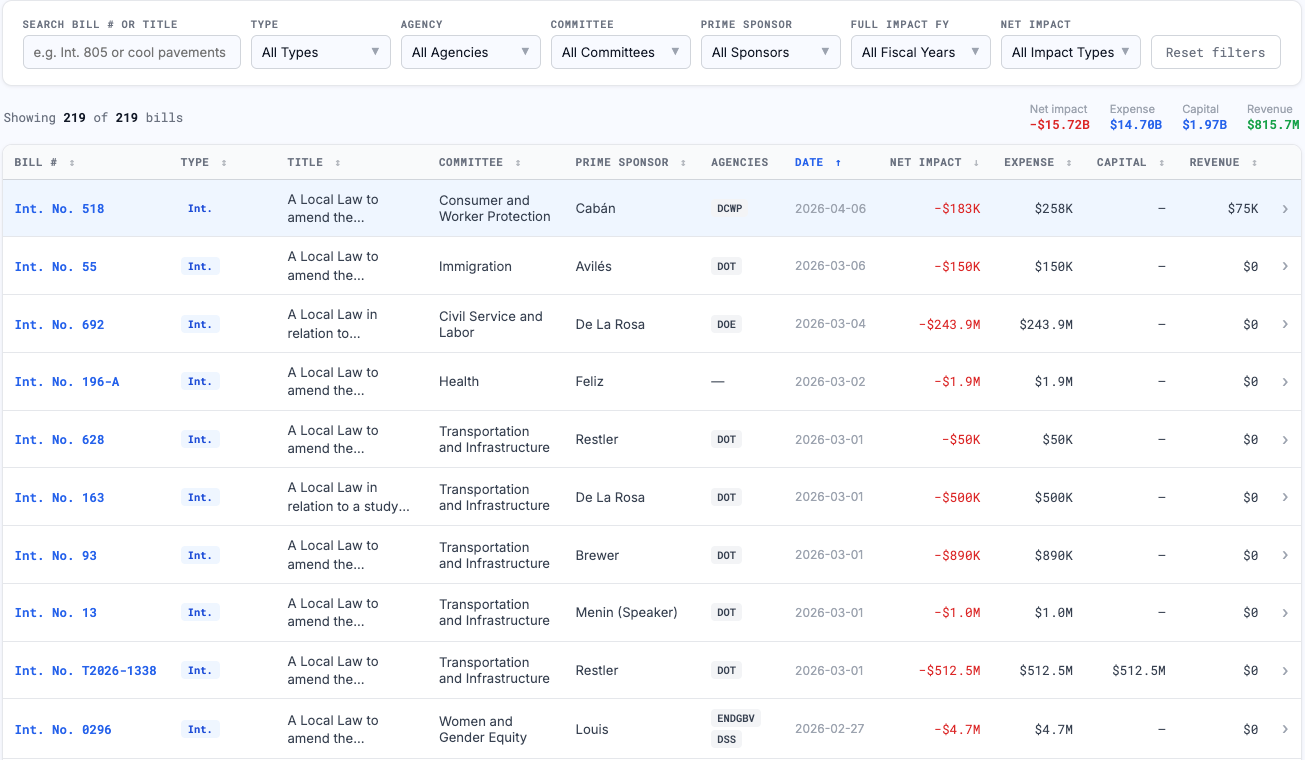
The tracker parses available FIS (see footnote) to break them down into the estimated revenue, expenses (operational and capital), and net fiscal impact of the associated local law.
Of the 1,563 fiscal impact statements in the Legistar API for Jan 2014- Apr 2026, 219 were added to the table. The FIS not added to the table were either because both revenue and expense impacts were zero (1,108 cases), no revenue or expense impacts could be found/extracted by Claude (183 cases), or there were duplicates with proposed bills and enacted local laws (~90 cases).
What the data tells us about new costs
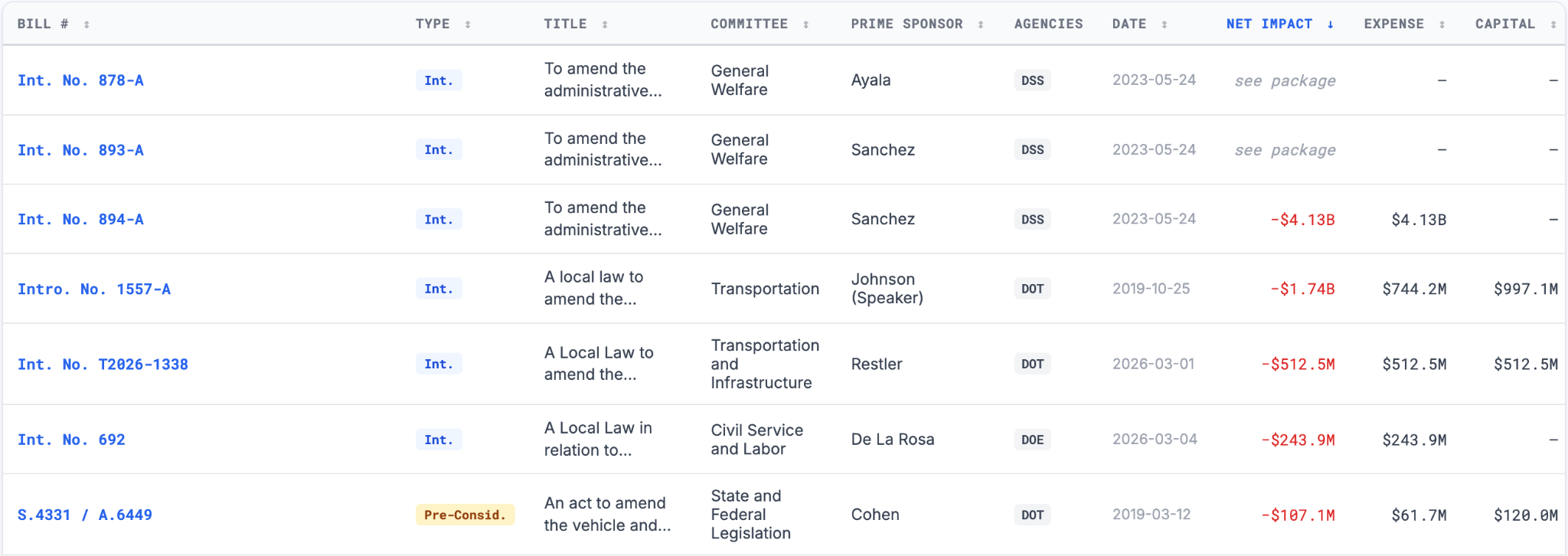
Even with the limitations to what data could be scraped, the database contains over $7.5 billion in net fiscal impact (operational expenses + capital expenses - revenues) for City agencies introduced by Council legislation between 2014 and 2026. That represents a fiscal burden larger than the total FY25 budgets for some of the largest agencies, like the departments of housing (HPD), police (NYPD), sanitation (DSNY) and transportation (DOT).
To read the rest of this article, diving into the mostly costly local laws over time and suggesting solutions for proposed legislation cost control, head over to The Bigger Apple:
I want to fully acknowledge that this database is not perfect - I used Claude Code to help me pull and parse the data, and there are likely many missing records. Legistar’s API is not the easiest to work with for pulling these attachments historically (see more about this in my methodology doc here), and the FIS themselves have not followed a standardized format over time. While recent FIS often include a table with expenses/revenues listed out (yay!), older ones involve paragraphs of unstructured text in which I used Claude to extract relevant numbers (not quite as reliable). I have done my best to manually validate all results, but there is a lot of data to sort through. Given potential extraction mistakes, I encourage users to click on the row for any legislation they find in the table and follow the Legistar link to verify exact numbers.