


Mayor Mamdani has shown a determination to make NYC run better. A key part of this effort has been finding efficiencies in agency processes and cutting out regulations that end up hurting more than they do good by overburdening an agency. At the State level, Governor Hochul recently announced a partnership with Stanford’s RegLab to identify irrelevant or outdated regulations.
Reducing unnecessary and outdated regulations to speed up public bodies’ processes is an excellent idea. But where did all these regulations come from, and how did we reach this point where politicians across the political spectrum are all calling for cutting them down?
Several months ago, I launched my NYC Fiscal Impacts Statement tracker. This is a tool that tracks, aggregates, and tags the fiscal impacts documents attached to most New York City Council (the Council) legislation. The goal was to illuminate the financial costs the Council adds onto agencies and the overall City budget, often without allocating funding or specifying where the dollars would be supplied from.

Financial costs are not the only relevant obligation that the Council imposes on city agencies, and fiscal impact statements do not tell the entire story of Council legislation. Just as important are the administrative obligations created by new laws.
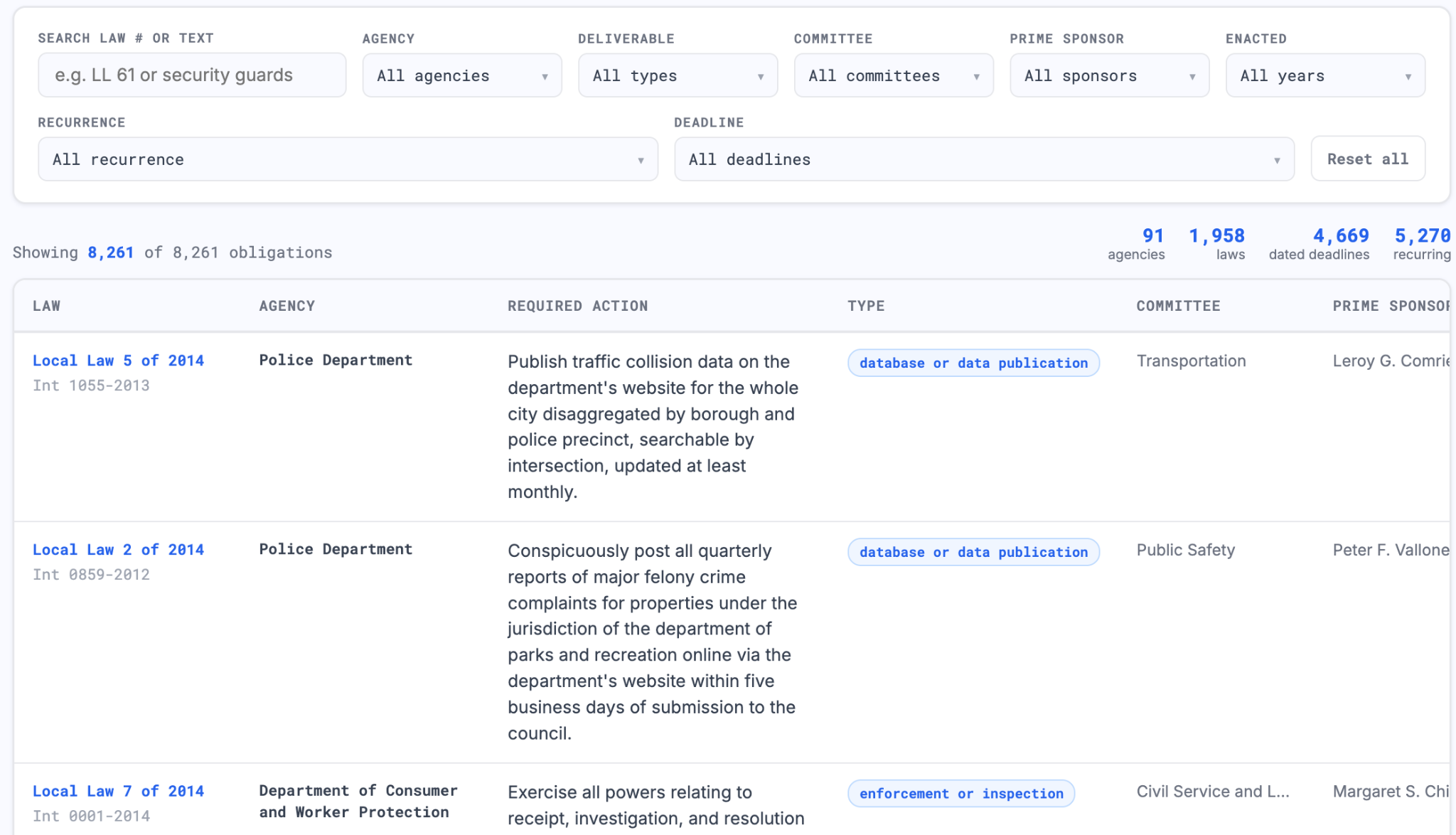
Local laws create new obligations that range from recurring reports on some subject to new enforcement of a regulation to compliance with a process an agency is directed to follow. For example, Local Law 5 of 2014 requires the Police Department to publish traffic collision data monthly, searchable by intersection. These obligations determine how agencies actually spend their staff time. They also contribute to the regulatory bloat that the Mayor and Governor are now fighting to reduce.
It is not easy to understand all the new regulations and expectations (hereafter referred to as ‘obligations’) that come out of the hundreds of local laws that the Council passes each year. This is relevant for citizens who want to better understand why agencies act in the often complex ways they do. It matters even more for the workers at the agencies themselves, who are tasked with interpreting and implementing each new legislative demand on top of the existing ones.
So I built the NYC Council obligations tracker. It uses public Legistar data to pull the full text of every local law enacted since 2014, distills each law into the specific obligations it creates, and organizes them by agency, deadline, deliverable, and recurrence. The count so far: 8,261 obligations from 2,138 local laws, with 5,258 of those obligations being recurring.
Every chart in this post, and the data behind it, lives at the NYCuriosity data hub.
The tracker makes every local law more transparent and readable
For each of the 2,138 enacted local laws currently in the database, the tracker extracts every discrete obligation from the law’s own text: who must act, what they must produce, by when, and how often. Each obligation is tied to an exact quote from the law, and 95% of those quotes are string-verified against the source text. 77% of obligations resolve to a canonical city agency through NYC Open Data’s NYC Agencies and Governance Organizations dataset, while the rest stay tagged with the law’s own vague phrasing. This in itself turned out to be an interesting finding (more on that below).
The result is a browsable ledger of Council demands with several tools:
an obligations table filterable by agency, committee, deliverable, and deadline
an interactive and filterable agency workload view
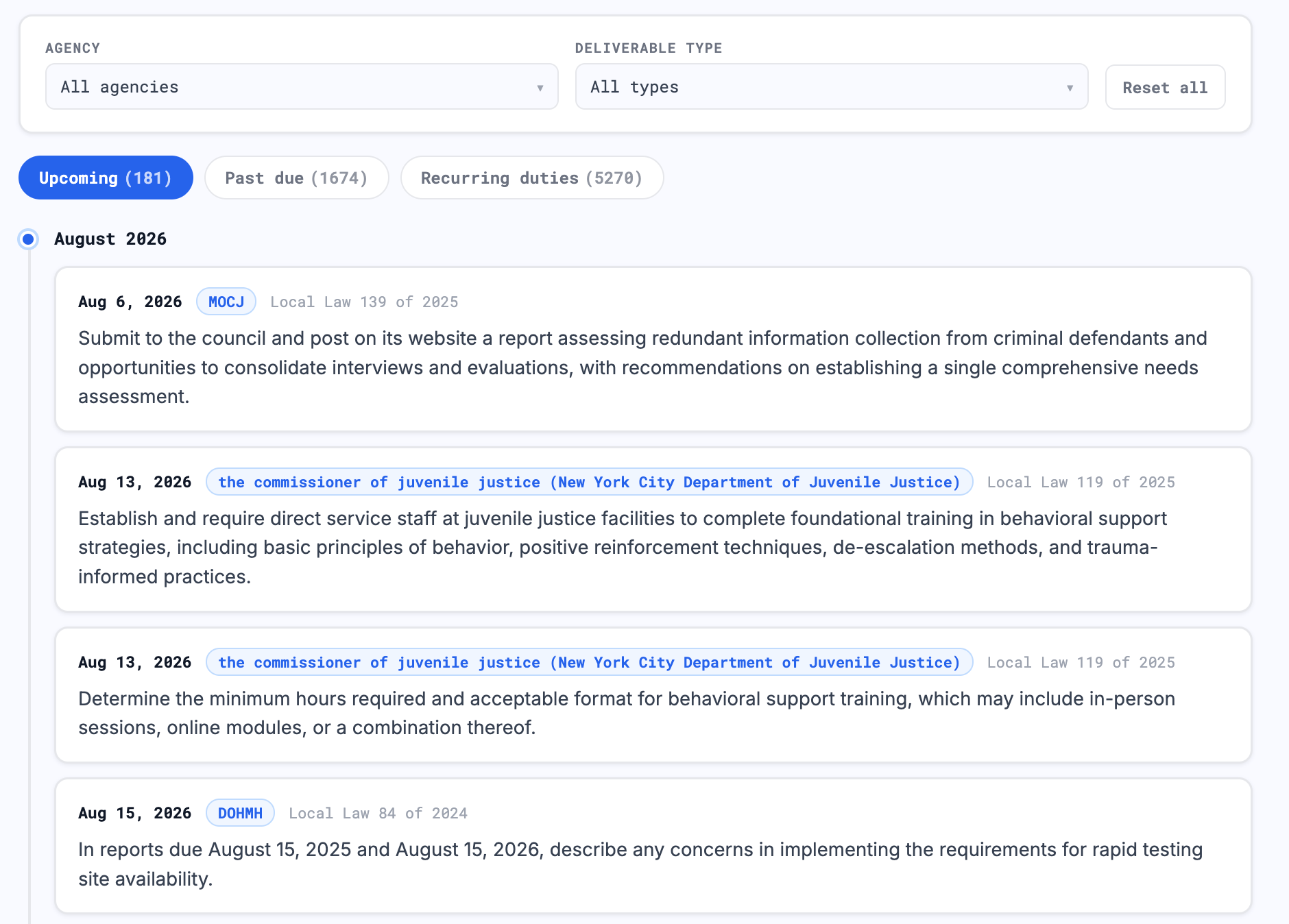
a deadline timeline to keep tabs on what reports or directives are coming due
a per-law implementation checklist, to provide every new law with a checklist of who is responsible and what exactly is now required
Most obligations never retire, they stack
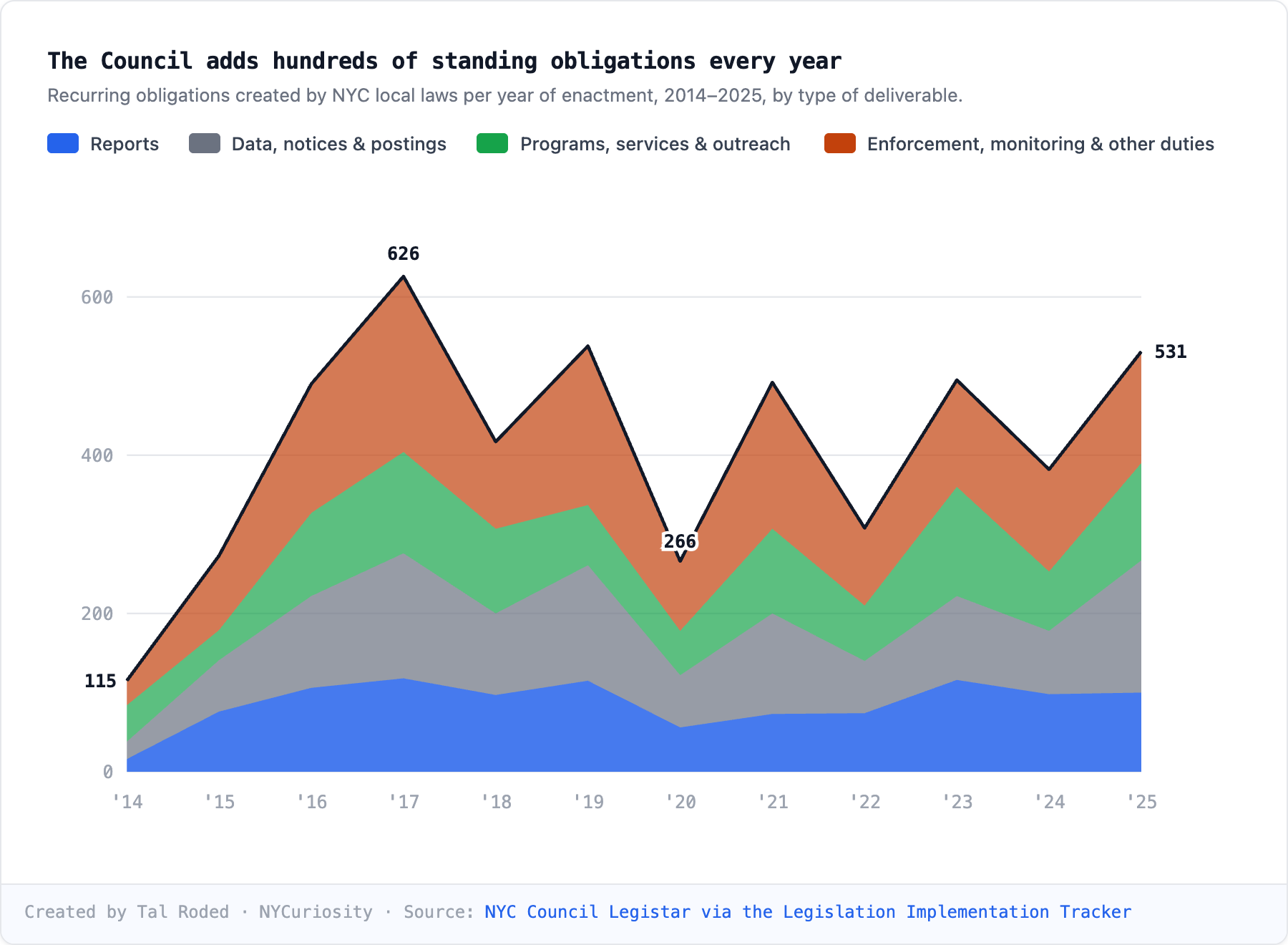
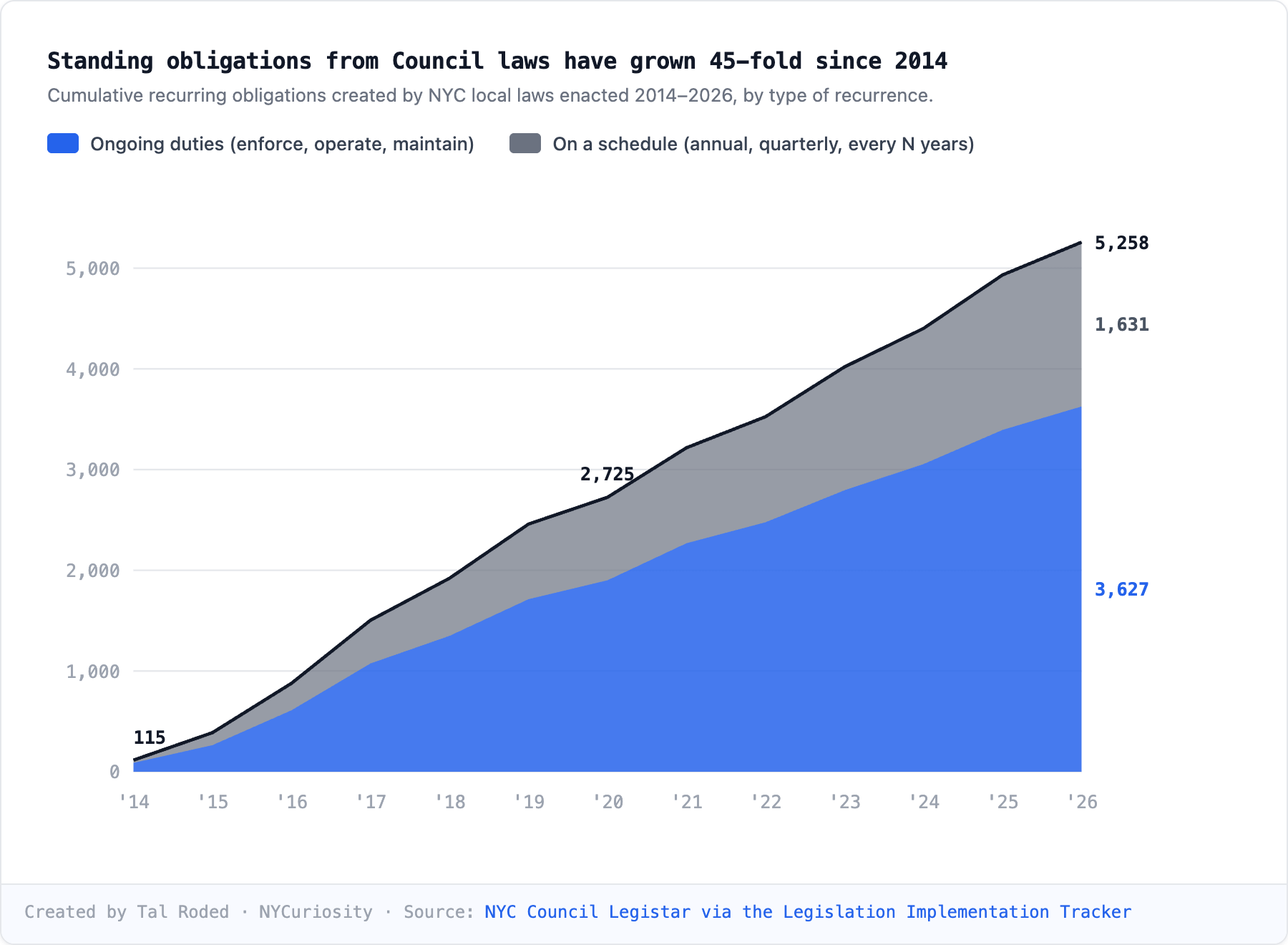
64% of the Council’s obligations are recurring. This could take the form of an annual report, a quarterly inspection, or a standing duty to enforce a rule. Recurring obligations stay on agencies’ books unless a later law repeals them, which is exceedingly rare.
This means the Council’s demands on agencies do not reset with each legislative session. Instead, demands and expectations on agencies accumulate. Since 2014, the number of new, recurring obligations per year has fluctuated between 115 and 626. Through August 2026, a total of 8,261 obligations were added to city agencies’ dockets. 5,258 of these are explicitly recurring.
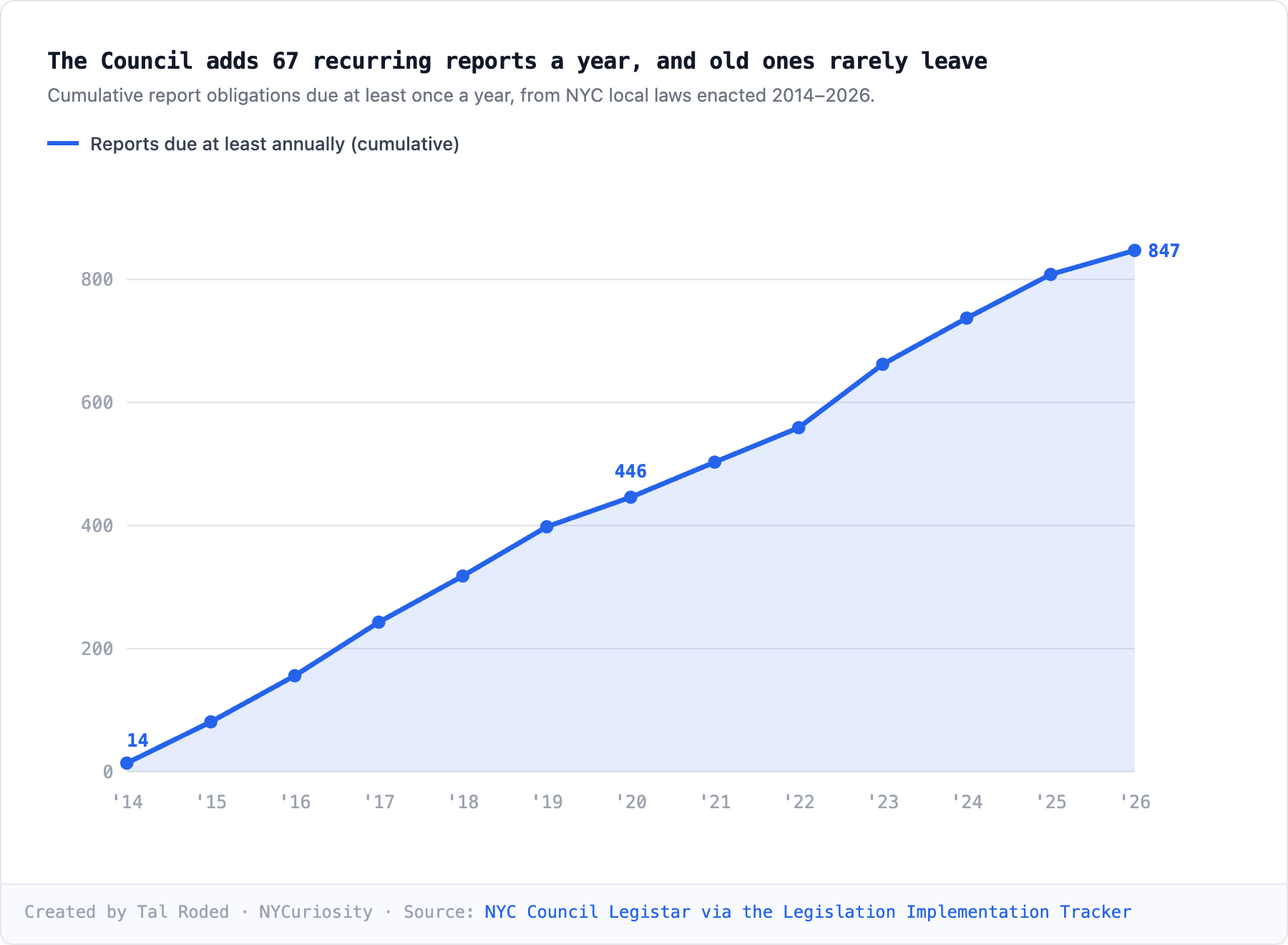
One of the Council’s favorite obligations is a report: 1,545 of the 8,261 obligations are reporting requirements, and 847 of them recur at least once a year. That is 67 new recurring reports per year, every year, with no public accounting of which ones arrive, get read, or still serve a purpose.
As I’ve previously written with the case of the NYC Department of Transportation (DOT) and their Streets Plan mandates, new obligations and expectations are often being stacked onto agencies without equivalent increases in funding or staffing. This increases the administrative burden on each existing city worker, resulting in a fixed pool of time and energy being increasingly divided among a growing pile of mandated reports.

New York City is not unusual in regard to this growing list of reports and regulations for public agencies. Stanford’s RegLab scanned 500 million words of statute across all 50 states and found California’s reporting requirements grew 400% from 2000 to 2025 and that 30% of California’s ongoing reports may never be filed at all. In Maryland, RegLab found the legislature would need 14 weeks just to read the reports its laws require. The Maryland legislature only meets for a 13-week session.
A handful of agencies carry most of the load
Ten agencies carry six in ten of the Council’s mandates. The Department of Health and Mental Hygiene leads with 569 obligations, followed by the Department of Buildings (525), the Department of Consumer and Worker Protection (454), the Department of Transportation (424), and Housing Preservation and Development (354). These are the agencies New Yorkers most often complain are slow, and the tracker now unveils one reason why: they are the agencies the Council tasks most heavily.
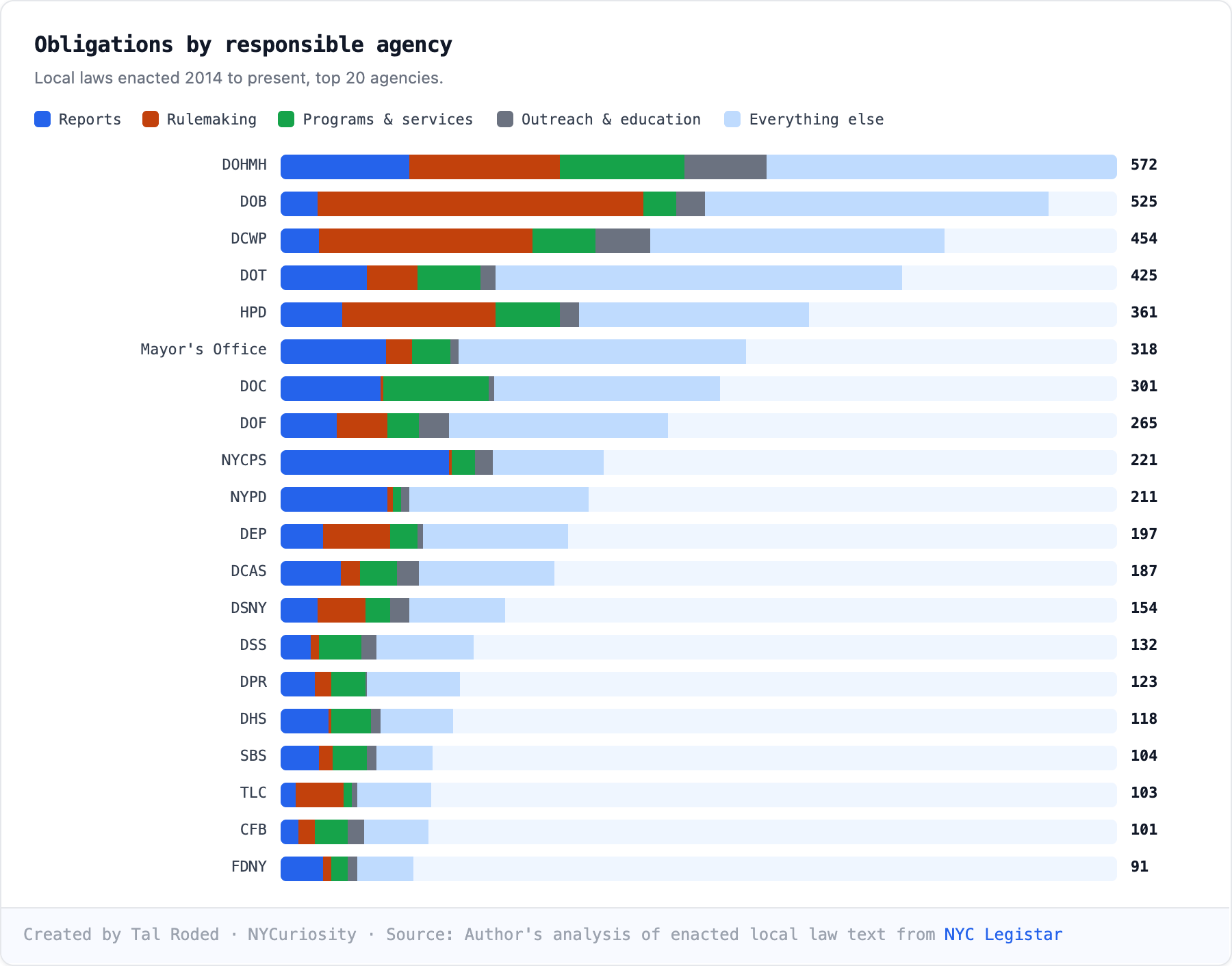
Interestingly, 477 obligations, over 5% of the total, name no resolvable implementer at all. The law assigns work to “the administering agency”, or simply “an agency designated by the mayor”. An agency employee reading the law cannot tell from its text whether it applies to them. That is a transparency gap written into the laws themselves that can result in confusion, uncertainty for agencies, and unintended impacts.
City Hall and Albany are pruning; the tracker can help
Mayor Mamdani has shown a determination to make NYC run better, and cutting low-value obligations has been central to it. The Commission on Government Efficiency launched in May, the OPEN for Small Business package cut more than 50 rules in July, and Public Interest Technology Crews are now beginning to be embedded with agencies. At the State level, Governor Hochul’s July executive order directs a statewide “regulatory reset” to identify outdated and duplicative rules.
Jackson Gode’s recent essay “So You’re State Capacity Curious” also distills what federal policymakers should take from this movement, and his takeaways can equally apply as a checklist for the NY City Council: define the outcome before drafting the mandate, confirm the agency can actually execute it, streamline existing rules before adding new ones, and reconsider whether a mandatory report is the right instrument at all.
I strongly support the recommendations of his article. But every one of those steps requires knowing what obligations already exist, and I have not previously seen a publicly available database. This new tracker can help identify why an agency is slow or expensive on some task: sometimes the answer is sitting in the stack of 5,258 standing orders. At a minimum, it makes the rules governing agencies legible, and states plainly what each new law will add to the pile.
Not all obligations are bad, but transparency is good
I want to be clear that this tool does not argue against obligations. Regulations are necessary to safeguard the public and give agencies direction on how to achieve what elected officials determine should be prioritized. But it is also true that rulebooks for public bodies have grown so long that such well-intentioned obligations backfire when stacked too high, constricting agencies instead of guiding them. This can sometimes lead to agencies being unable to comply with new mandates when they find their hands tied.
Reports exist because the Council has a duty to oversee agencies; the problem we face now is endlessly stacking these reports without reading or pruning existing ones when possible.
Whether you want more obligations or fewer, transparency and cross-branch communication make government work better. If agencies can see exactly what each new law requires of them, and whether it touches them at all, they can comply faster and better. If Council members can see what they have already demanded of an agency before demanding more, they can write sharper laws. And if the public has an easier way of tracking and understanding new obligations, this may earn more trust in our public institutions.
Explore the tracker
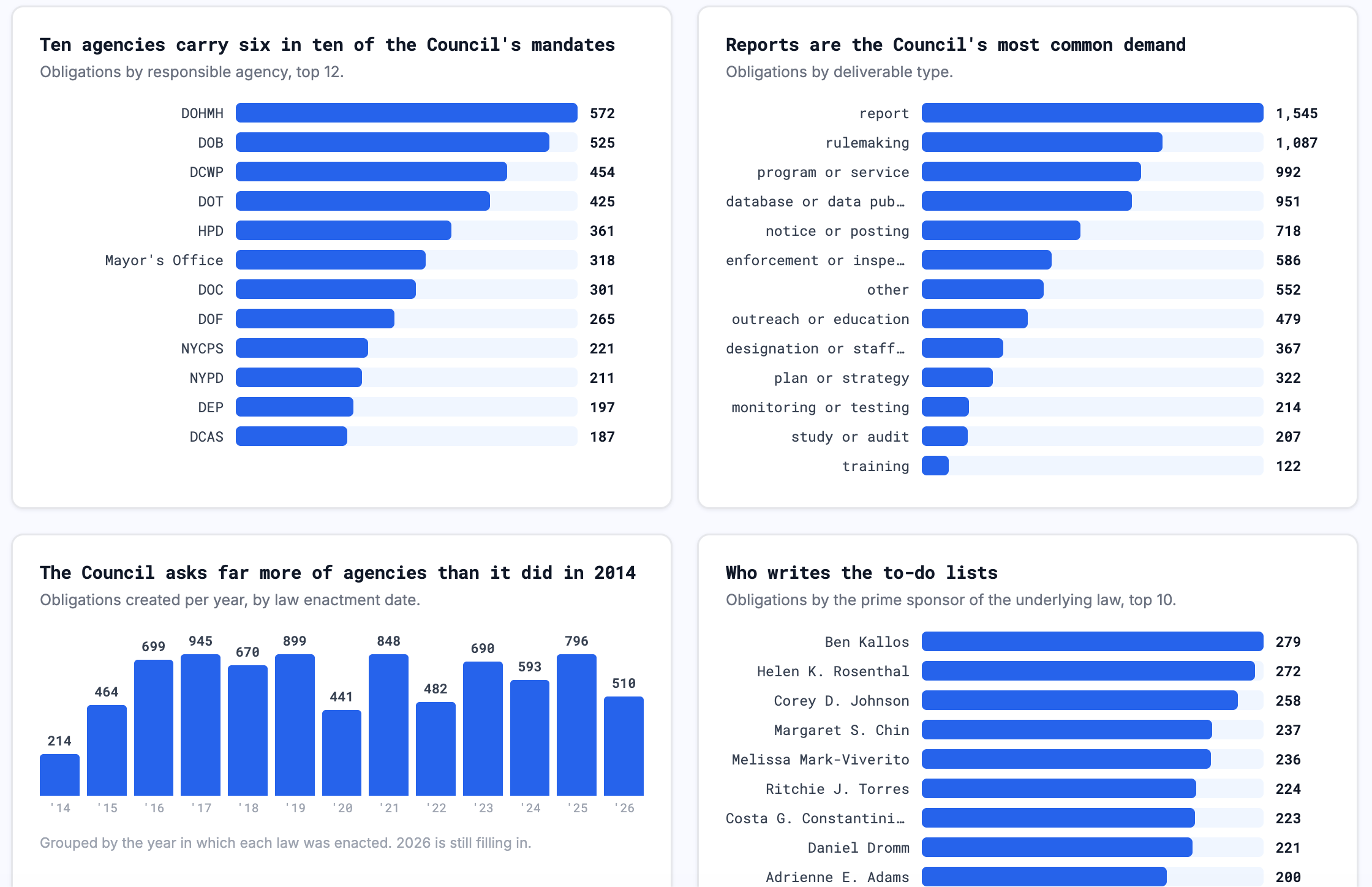
The obligations tracker and its tools are free to browse: the full obligations table, agency workloads, deadline timelines, and a checklist page for every local law since 2014. The data hub for this post has the charts above with downloadable data for members. Members can also sign up for customizable email alerts when new laws create obligations for the agencies, Council members, or topics they wish to follow.
If you work at a city agency and the tracker gets your obligations wrong, or you know of an obligation it missed, please let me know. The extraction is automated, and I correct it as often as I can, but given the volume of legislation, I can’t catch everything. The goal of this tracker is for it to be a ledger that the Council, the agencies, and the public can trust. If you have a request for additional features or tools to be added, please reach out!
Amazing work! Great use of data. Was there anything in particular that really stood out for you?
It seems your argument is against transparency. You don't delve into the reasons these reports are mandated. City government is increasingly opaque and you seem to say less transparency is better. It's not. 125,000 man-hours is nothing in a city government the size of NYC.
Where's your alternative? Perhaps, if the agencies responded to council members and the public, they wouldn't be mandated to produce these reports, but they don't.
I think your efforts hide the reality and gov cover to politicians who want to keep secrets.