


This November, Mayor Zohran Mamdani faces a major test: how he will handle negotiations with public sector unions. He has, on the one hand, expressed solidarity with organized labor; on the other, he has pledged to make government more efficient and to make taxpayer dollars go further than before. Those impulses are in tension in ways New Yorkers should appreciate.
New York City government employs about 290,000 full-time workers, and four unions alone (the United Federation of Teachers, DC 37, the Police Benevolent Association and the Uniformed Firefighters Association) represent over 212,000 of them, nearly three in four city workers. Their salaries, pensions, health insurance, and other benefits take up $60 billion of the City’s $126 billion budget for this fiscal year. The details of the next city union contracts will be instrumental in determining how much expenses will grow in upcoming years and how large the next budget gap may be. This is where fiscal trouble may loom for the mayor.
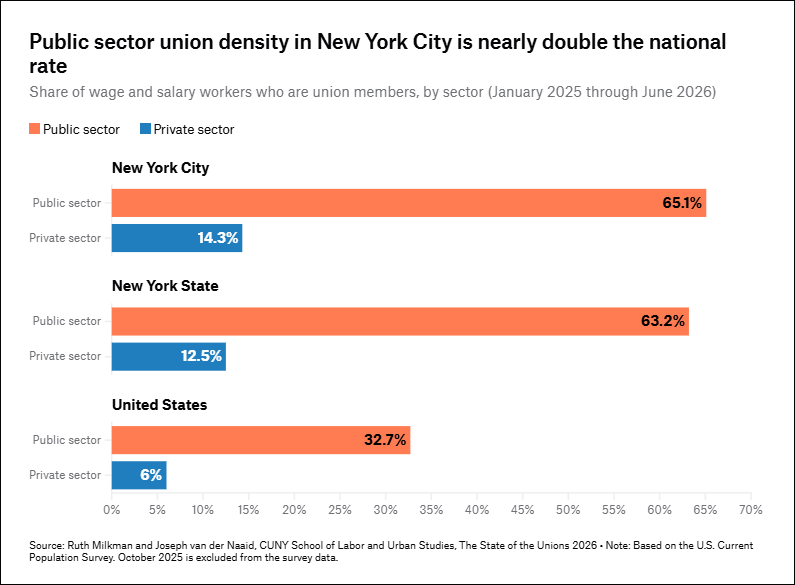
November 6 is the date on which the contract with the city’s largest union, DC 37, is set to expire. The terms of that contract will set the precedent for further contract negotiations to come through a time-tested process called pattern bargaining, “in which the City and one union come to an agreement that serves as a template for everyone else.”
Though with respect to the private sector, Mamdani has thus far positioned himself as a champion of worker rights through actions like creating a new Office of Street Vendor Services and fighting for fair pay for delivery workers, when it comes to public sector workers, he represents management. And the City budget gap and prior commitments currently have projected expenses outpacing revenues, meaning that the city’s ability to provide large union pay raises is severely limited.
Without a doubt, some raises are inevitable. Recent inflation and private-sector wage growth mean public sector wages have fallen further behind. Between Q2 2021 and Q2 2026, wages in private industry rose 22.9%, or about 4.2% a year. At the State level, five-year contracts with CSEA and PEF agreed to in August 2026 range between 3% and 4.5% annual raises, coming out to a 19.3% pay increase compounded over the contract term.
A rank-and-file caucus inside DC 37 is now campaigning for higher pay raises in their next contract. Striking reasonable negotiations with the unions that balance their demands with the City’s financial constraints will be a key determinant in how much larger those forecasted deficits grow.
In my piece at Vital City, I cover how the budget already has gaps with planned 1.25% raises, and unions will be demanding more in these upcoming negotiations. I also discuss strategies to help balance the budget while negotiating with unions and what the mayor can do outside the negotiations (headcount reductions or revenue raisers).


