


The following is an excerpt from my post in The Bigger Apple. To read the full piece, check out the article here and subscribe to The Bigger Apple for more insightful NYC policy analysis!

Government expenses are expected to grow 4.5% annually over the next few years; city revenues, meanwhile, are projected to grow only 2%, assuming no economic setbacks from a bad year on Wall Street or broader instability. The compounding gap between those two figures means budget shortfalls will only grow.
To balance the books, the City has two options: raise revenue or cut expenses.
Raising revenue means either growing the tax base — desirable but slow — or increasing taxes, which requires Albany’s blessing for income taxes (unlikely) and is deeply unpopular for property taxes.
Increasing the tax base is the most desirable course of action as it grows the economic pie for all involved. Unfortunately, it is also one of the more difficult levers for the City government to control, as it relies on complex economic conditions at the city, state, and federal levels. I proposed some policies the Mamdani administration could pursue in this post, but even if the City follows through on them, it will take years for the effects to translate to City revenues at scale.

That leaves cutting expenses as the most immediate lever available. To that end and to his credit, Mayor Mamdani created Chief Savings Officers (CSOs) at every City agency, tasked with finding savings. Their plans came due on March 20. Here’s what we know so far.
The Mayor’s Strategy: Chief Savings Officers
The CSOs were tasked with identifying 1.5% in savings for 2026 and 2.5% for 2027 and beyond. The total came in at over $1.7 billion — right around 1.47% of the $116B FY26 adopted budget.
What the Mayor’s Office has shared publicly is far less: an “initial list of approved items” across 16 agencies totaling about $250 million over FY26 and FY27. The gap between $1.7B identified and $250M released raises questions worth examining — about what’s in the approved items, and about whether agency-identified savings alone can close a budget gap that keeps widening.
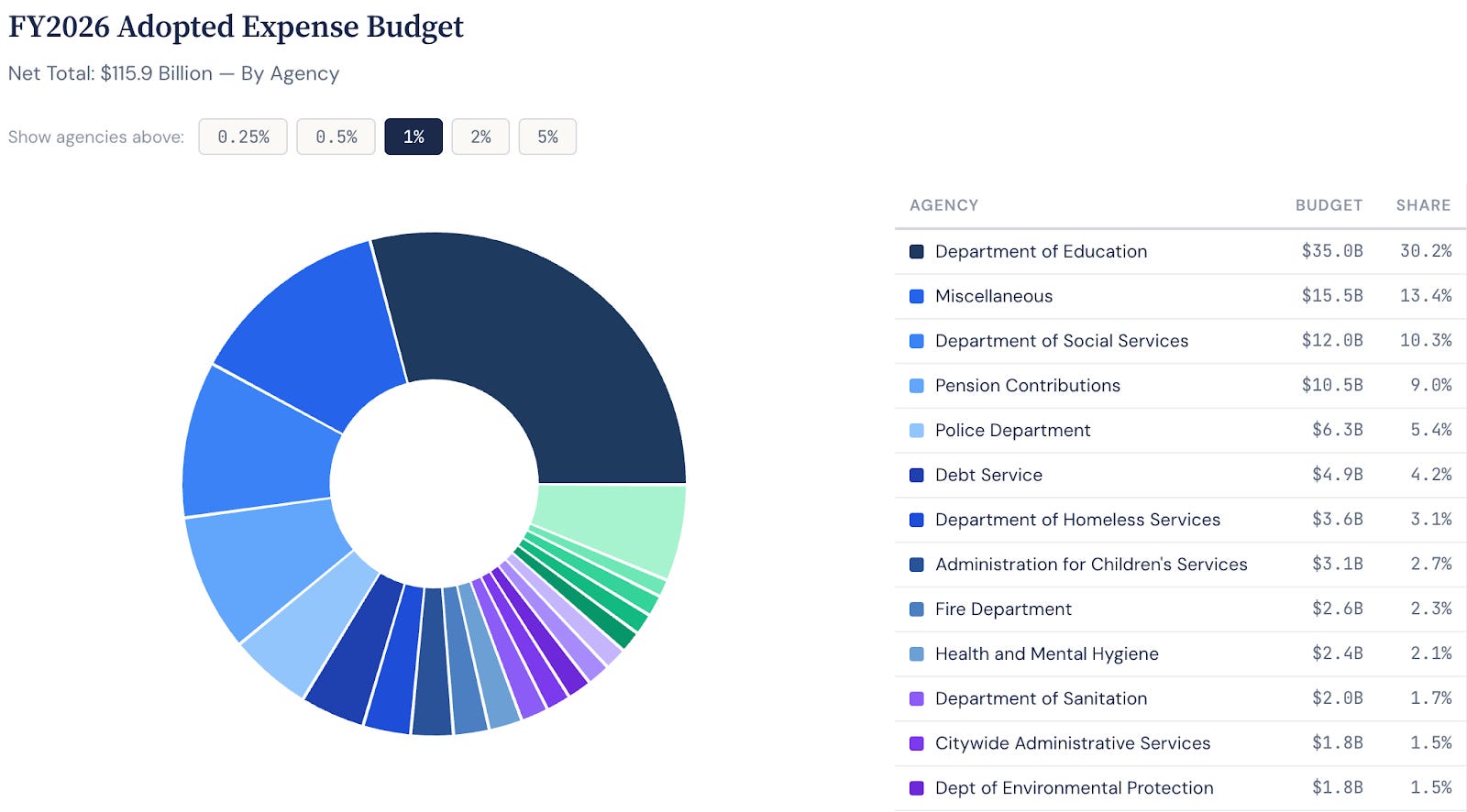
What we know about the CSO reports so far
I’ll use this “initial list of approved items” in my analysis below.
To put the CSO actions in context, I compared them to the relevant agency’s FY25 accepted budget. For each agency, the % of FY25 budget calculation is:
- FY27 savings ÷ FY25 budget (for agencies that have FY27 savings)
- FY26 savings ÷ FY25 budget (for agencies that only have FY26 savings – e.g., DOC, MONS)
The logic here is that FY27 is potentially more of a “steady state” ongoing savings target (of 2.5%), so it’s the more meaningful denominator year to benchmark against. For agencies with no FY27 figure, FY26 is used as the only available data point.
Given all that, here are the released savings by agency, sorted by largest savings for FY27:
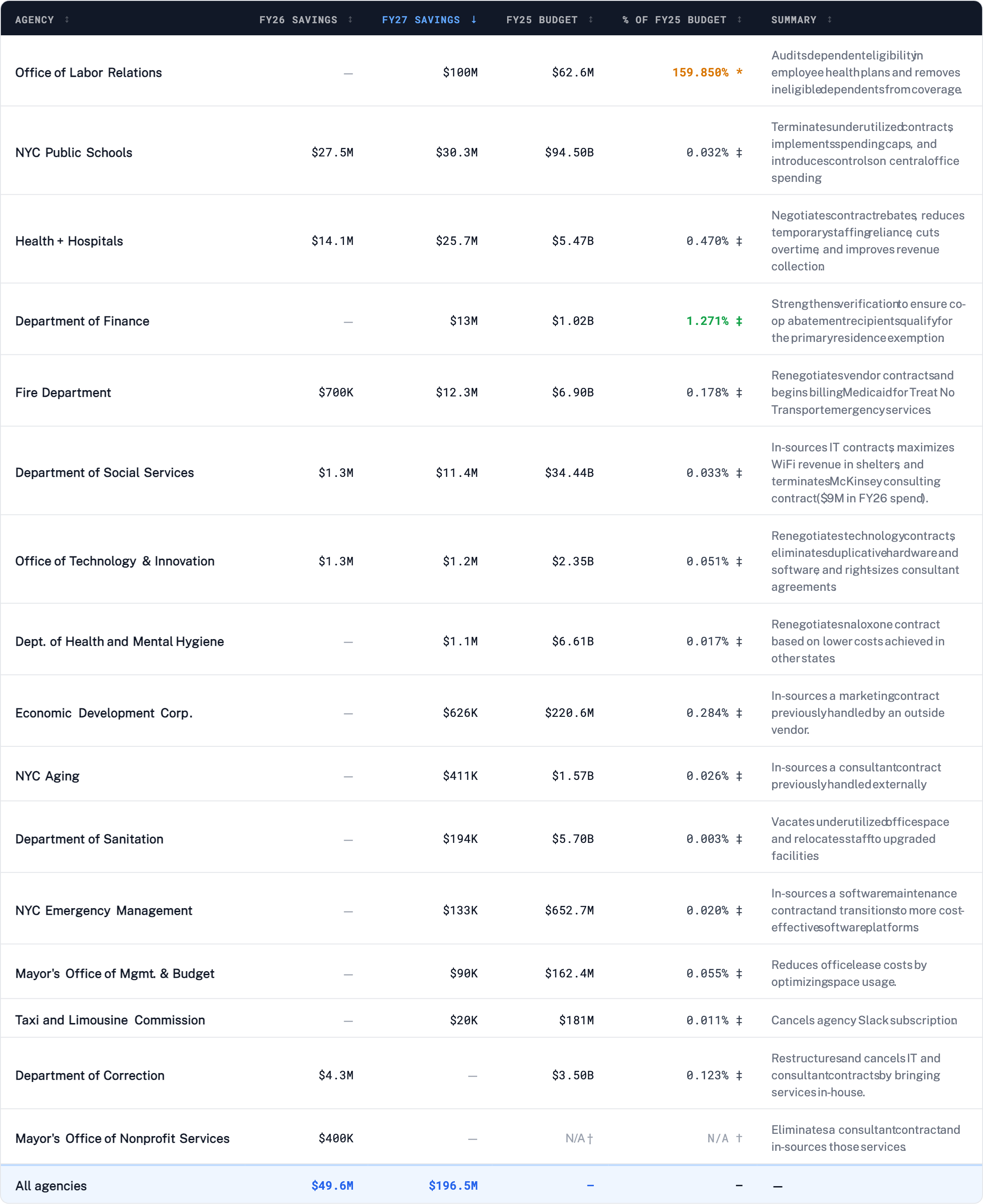
The Office of Labor Relations (OLR) dominates. A single administrative action — a $100M audit removing ineligible dependents from employee health plans — accounts for roughly 51% of total FY27 savings in the Mayor’s announcement. This one item, from a tiny agency, dwarfs everything else on the list.
The Department of Finance (DOF) has the most substantive savings relative to its own size, at 1.27% of its FY25 budget. Its single savings item — strengthening verification for the primary residence co-op abatement — would on its own get DOF nearly to its FY26 savings target.
Most other agencies’ savings are well under 0.1% of their budgets. The savings announced for MONS, NYCEM, TLC, OMB, and DSNY are effectively symbolic. If the released items represent the largest savings for those agencies, they risk falling far short of the 2.5% FY27 target.
What the savings items tell us about priorities
To read the rest of this article, including comparisons of CSO savings items to other City budget options, head over to The Bigger Apple:
And make sure to subscribe to The Bigger Apple for more insightful NYC policy analysis!