


AI has incredible potential to tackle state capacity problems.
The benefits that current Large Language Models (LLMs) like OpenAI’s ChatGPT and Anthropic’s Claude can provide as tool builders are particularly powerful relative to the current frustratingly outdated methods used for many government functions. Governments run in many ways on unstructured text (regulations, forms, case files, transcripts), and that is exactly the context in which LLMs can thrive.
The question now is whether government institutions are ready to embrace this evolution in how they build, which will require adapting operations to take advantage of the new fast-paced builds unlocked by AI tools. Currently, the rules and processes that govern how bureaucratic teams function make it exceedingly difficult to do so.
As Jennifer Pahlka said in her excellent post on government reform,
“[S]ervice delivery is only the most visible piece [of AI’s impacts]. The same expectation shift is going to hit regulation, permitting, enforcement, how quickly an agency can respond to a new problem, how a legislature decides whether a law is working. If a small team with the right tools can map a regulatory regime in a week, the timelines we have now, in which rulemaking takes several years--or even multiple presidential terms--become indefensible…The bar is rising on the whole surface of what government does, not just on the forms people fill out.”
AI is not a miracle tool that will solve every problem in government bureaucracy. Just like computers, the Internet, phones, and all other previous technological advancements, there are good uses and bad uses.
But the capabilities of these models to enhance state capacity with proper use and guidance is now too large to ignore. Not adapting ways of work in government to quickly adopt AI in the public sector will only result in continued failure to provide practical solutions to any of today’s most pressing problems.
In future posts I will dive deeper into individual applications of AI-driven state capacity transformation, and look at specific examples in New York and elsewhere. I would like this article to serve as a catalog and starting point for where public agencies, legislatures, and any other policy institution can harness the power of the latest AI models for the public good.
The following use cases, already being implemented by many public bodies locally and nationally, can serve as examples for all government bodies to follow for building out state capacity in the 21st century.
Improving Public Service Delivery
Problem:
Eligible residents routinely fail to receive benefits they qualify for. Application backlogs, multi-week call center waits, eligibility rules written at a college reading level, and English-only forms create what researchers call “time tax” and drive benefits churn (people losing coverage at renewal despite still qualifying). SNAP, Medicaid, unemployment insurance, and housing vouchers are all well-known examples.
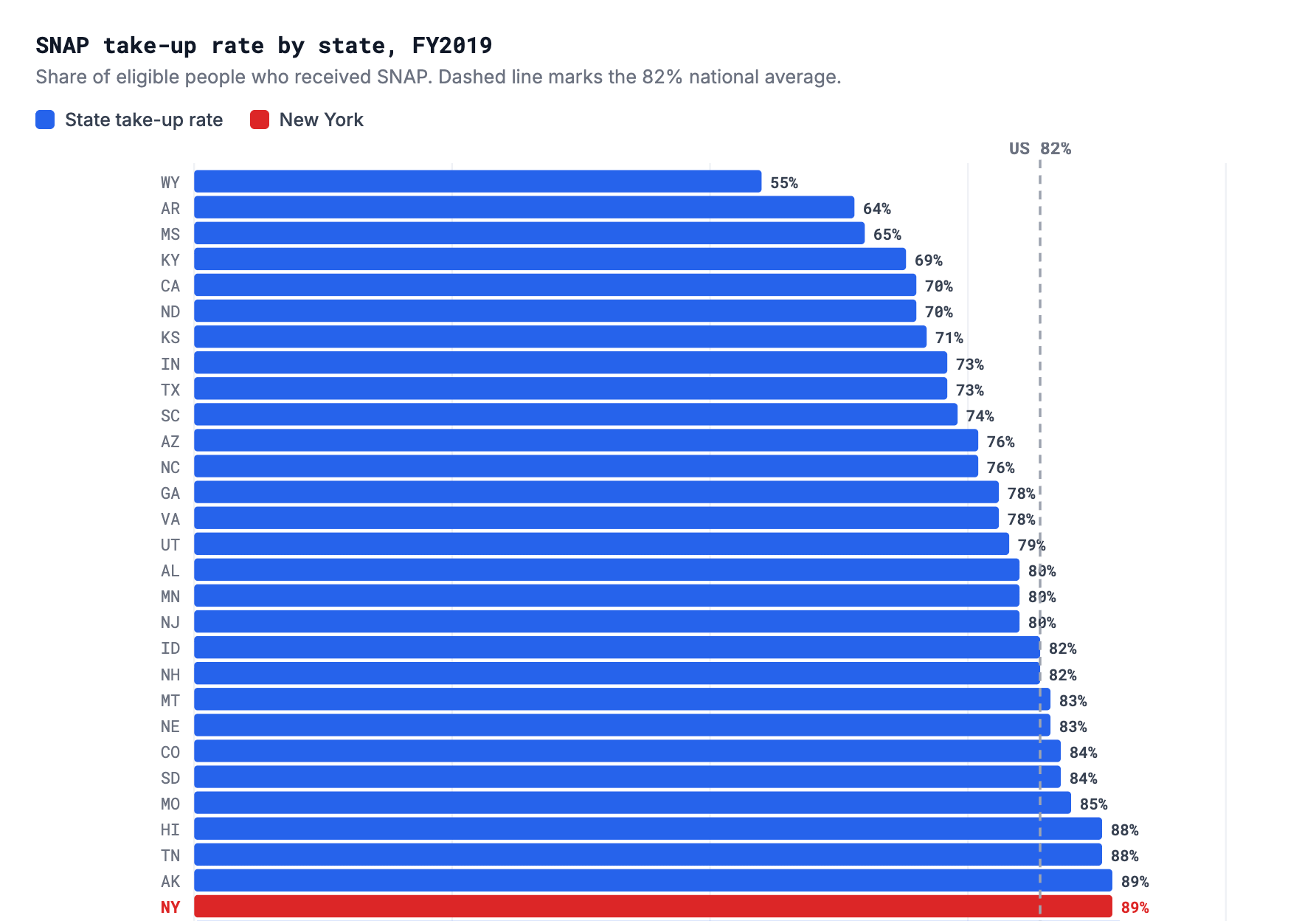
For example, SNAP is one federal program with one set of rules. Yet in 2019, only ten states enrolled 100% of eligible people, and the national average was 82% of eligible people enrolled. Wyoming reached just 55% of its eligible population.
How AI Can Help:
Multilingual benefits navigators that answer eligibility questions at 2am in a resident’s first language, reducing call center load.
Document and case processing that clears determination backlogs (verifying pay stubs, IDs, residency proofs) so caseworkers can focus on judgment calls.
Caseworker copilots that surface the relevant policy clause mid-call instead of forcing a transfer.
Plain-language rewrites of denial notices and renewal letters, which are a leading cause of avoidable churn.
Examples: Code for America and Nava’s benefits work, California and Minnesota’s eligibility modernization, and philanthropy-funded pilots.
How to mitigate risk:
Keep a human in the loop on any denial or adverse determination. AI can triage and draft cases and responses but never issue the final “no.” Disclose to residents when they are talking to a bot, audit outputs for disparate error rates across language and demographic groups, and protect PII at the model layer. Build a clean human fallback for every automated path.
Procurement and Contracting
Problem:
The arcane rules that determine how government buys things is one of the deepest sources of our present dysfunction. The procurement process is slow, expensive, and stacked against small vendors. NYC is one of the worst offenders in this case: in FY2024, it registered 85% of its non-profit contract value late. That is a number that has only been trending worse with each passing year.
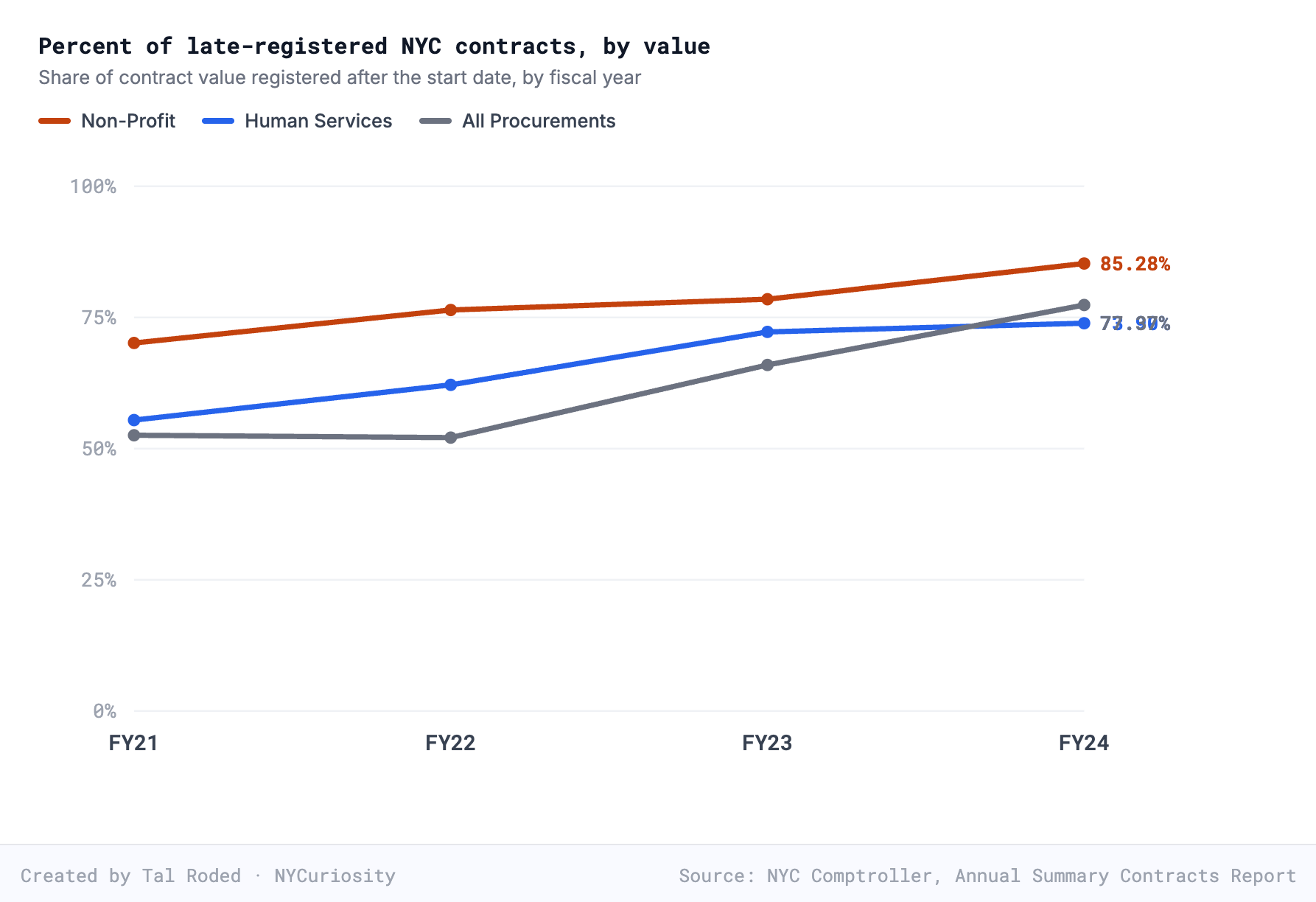
Even in ideal cases, procurement cycles routinely run a year or more, requirements are written in ways that lock out small and newer vendors, and the paperwork burden means agencies often re-buy what they already have or stick with incumbents because switching is too painful.
Procurement is the chokepoint on nearly every other reform; you can’t deliver a better service if it takes 18 months to contract the software. The same dysfunction that AI tools could help fix is what blocks government from adopting them, making this one of the most important domains to address. Of course, some procedural unblocking will need to be done first.
How AI Can Help:
Drafting and standardizing RFPs and scopes of work from a plain-language description of what an agency needs, cutting weeks off the front end.
Summarizing and comparing vendor bids against stated criteria so evaluation committees spend their time on judgment, not on reading hundreds of pages.
Flagging waste, duplicate contracts, and improper payments by scanning spending data across agencies.
Simplifying vendor onboarding and registration, the step that disproportionately screens out small and minority-owned businesses.
How to mitigate risk:
Award decisions stay with human evaluators and must remain auditable and challengeable; AI ranks and summarizes options, but it does not pick winners. Watch for models that quietly favor incumbents or large vendors whose documentation is more polished, and keep procurement integrity rules (conflict-of-interest, transparency) fully intact around any automation.
Improved transparency and advocacy
Problem:
Government is hard to watch from the outside, and even harder to understand and interpret. Open data portals are technical, regulations are written in legal jargon, and even seemingly simple processes span multiple agencies with no single map. The result is people feeling abandoned or antagonized by systems intended to help them.
AI can reshape work outside the public sector too. It is being utilized by journalists, advocates, and capable citizens to investigate government data and shed light on systems that are difficult to understand or follow from the outside. Asking agents to answer questions based on specific government websites, databases, or even looking at city charters or state constitutions has proven to be effective.
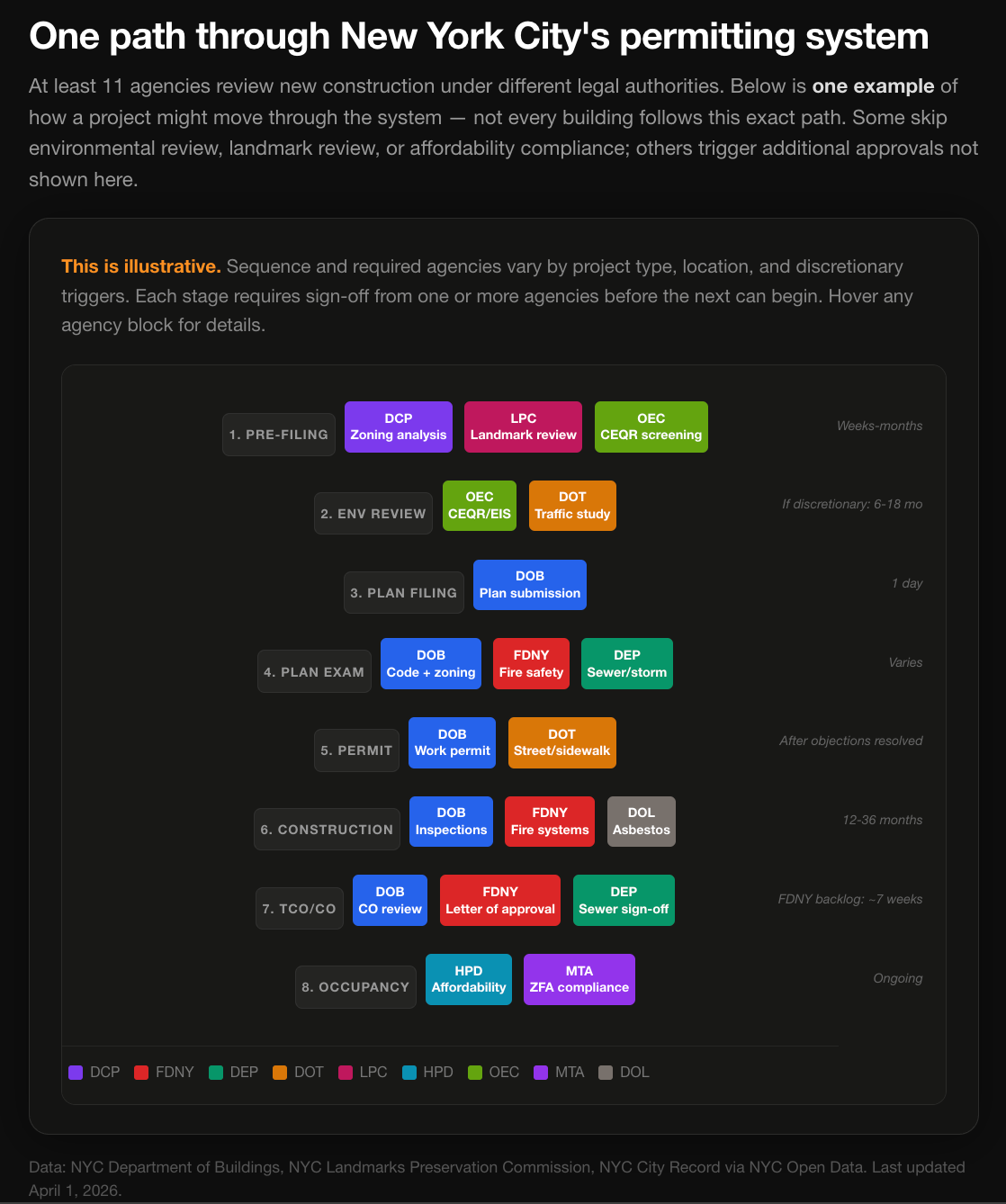
It is easier for anyone to work with and understand government open data portals, to have lawyer-jargon regulations and laws explained to them, to create maps and diagrams of complex government processes For example, look at this beautiful visual from Vital City breaking down an example of the process a building permit goes through in NYC:
How AI Can Help:
Plain-language explanation of laws, regulations, charters, and constitutions for non-lawyers.
Interactive document explorers over City Council, state legislature, and Congressional transcripts and data.
Taking transcripts and data from the New York City Council up to the U.S. Congress and producing summaries and interactive document explorers to help the public track and engage with all levels of government.
And of course I have to plug my own tool, Block Party, where our team has been working to increase awareness and engagement of NYC community boards meetings and resolutions.
How to mitigate risk:
Hallucination is the central risk when AI explains the law to the public. Model responses must always cite source documents, link back to primary sources, and frame outputs as starting points to verify rather than authoritative legal advice. More work will need to be done to address the equity gap: the people best positioned to use these tools are often already the most engaged.
Workforce and Institutional Knowledge
Problem:
State capacity is ultimately about people, and the public workforce is stretched thin, aging, and losing institutional knowledge as experienced staff retire. New hires onboard slowly because the knowledge they need lives in colleagues’ heads or in scattered, outdated manuals. Every other use case in this post runs through these same overstretched employees. Augmenting their knowledge and talent with AI tools is capacity-building in the most direct sense.
How AI Can Help:
Copilots that help civil servants draft memos, navigate internal policy, and answer routine questions without pulling a senior colleague off their own work.
Capturing and making searchable the institutional knowledge of departing employees before they leave.
Faster onboarding through tools that let new hires query “how do we do X here” and get an accurate, sourced answer.
Offloading rote tasks (data entry, summarizing case files, scheduling) that drive burnout and turnover.
How to mitigate risk:
These tools must be used as augmentation and not for headcount reduction. Using them as a path to layoffs would only degrade the inputs, skills, and verifications that the AI tools depend on. As with all the other use cases, validate internal answers against authoritative sources.
Cutting Through Red Tape and Streamlining Processes
Problem:
We currently face a crisis of effectiveness in government, and AI is coming at the right time to help reduce procedural bloat, revamp government systems, and aid both local and federal bodies to better govern.
Regulatory codes accumulate over time but rarely get pruned, leaving duplicative, contradictory, or obsolete rules on the books. Application systems are fragmented across agencies, so a business opening a restaurant files the same information five times to five offices.
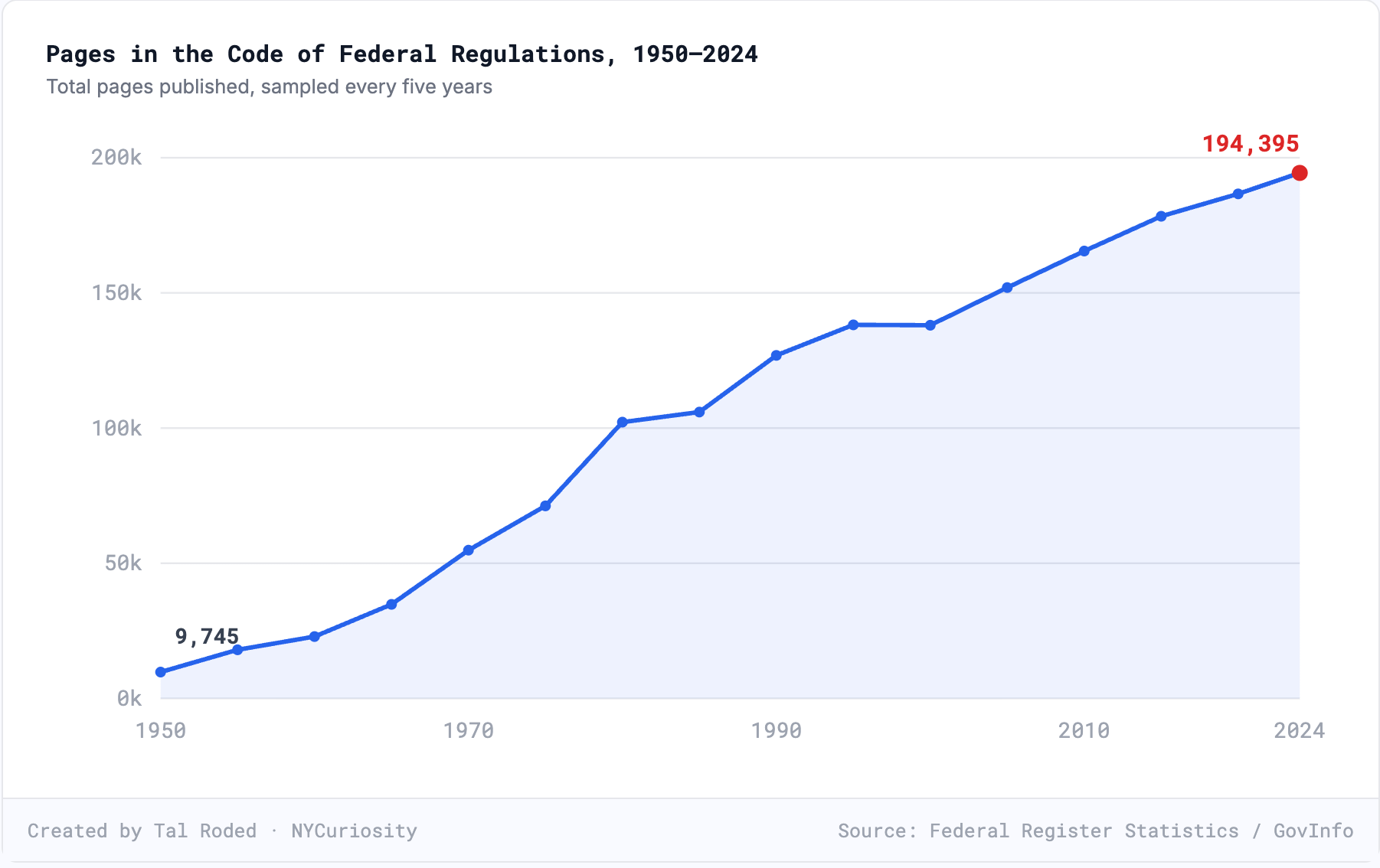
One example is the Code of Federal Regulations, which has grown from 9,745 pages in 1950 to 194,395 today, roughly twentyfold, and holding about 1.08 million distinct restrictions. To expect any process subject to these federal regulations to be able to move quickly when subjected to so many restrictions is unrealistic.
Excitingly, Governor Hochul recently announced a partnership to do this exact kind of outdated code-cutting in New York.
How AI Can Help:
Unifying separated application portals into one front door. Even where the consolidation itself is not AI, AI can sit on top: a single conversational intake that routes a request to the right agencies and pre-fills downstream forms from one set of answers.
Automating routine internal paperwork (data entry, cross-referencing, status updates) that consumes staff hours.
How to mitigate risk:
AI flags candidate rules to cut; humans and the proper rulemaking process decide. Don’t let “the model said it was redundant” become a shortcut around required public comment or legal review. Pilot on one agency before scaling, and keep an audit trail of what was changed and why. Of course, proper training and development of back-end structures like connected data pipelines and cleaned databases is necessary for such benefits to be unlocked.
Policy Evaluation
Problem:
Government rarely checks whether its own laws and programs work. Retrospective review of enacted legislation or policies is exceedingly rare, evaluation data is scattered across agencies, and fiscal projections are rarely revisited against actual outcomes.
Take the NYC Council, which passes many laws carrying large fiscal impacts on the city budget every year. Rarely are the estimated costs of their legislation actually verified, and never is the body held accountable for these costs stacked onto agencies every year. Tools like my NYC Fiscal Impact Statement tracker can help with oversight and evaluation of legislation.
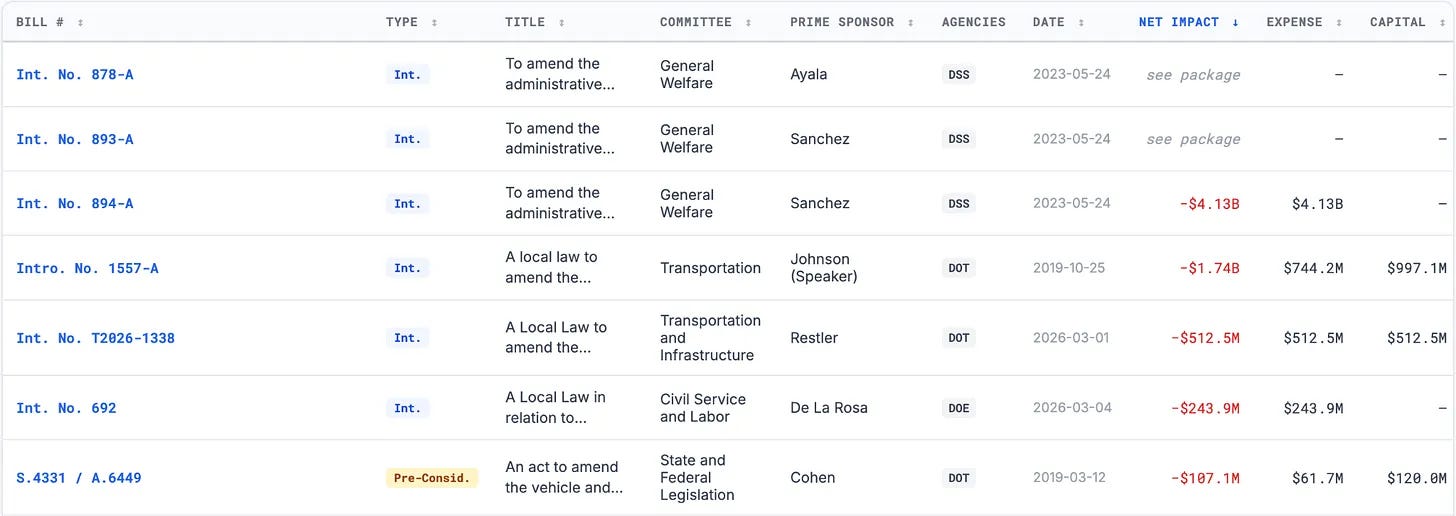
Relatedly, test-and-learn is another big area of opportunity. Laws are usually enacted with little advance testing, so edge cases and unintended consequences are discovered only after they cause harm, often years into implementation. As Pahlka mentioned in her post, “If an advocate can stress-test a policy against thousands of edge cases before it gets enacted, the standard for what counts as due diligence in lawmaking starts to move”.
How AI Can Help:
Synthesizing program outcome data across agencies to estimate what is actually working.
Scanning thousands of pages of audits, reports, and agency filings to surface underperforming or redundant programs.
Natural-language querying of administrative datasets so a staffer can ask a question instead of commissioning a study.
Stress-testing draft legislation against thousands of hypothetical scenarios and edge cases before enactment.
Red-teaming proposed rules: prompting a model to find the loopholes, perverse incentives, and groups a draft accidentally excludes.
Rapid drafting and iteration so legislative staff can revise text and immediately re-test.
How to mitigate risk:
AI surfaces correlations, not causation – so treat its output only as leads to investigate. Keep methodology transparent, validate against ground-truth data, and guard against optimizing for whatever metric is easiest to measure rather than what matters.
Simulations are only as good as their assumptions, so they supplement real-world piloting rather than replace it. Document the assumptions behind any stress test, and treat surprising results as questions for experts and not conclusions.
Conclusion
The first step for state capacity to improve is to recognize that better tools and solutions exist. My hope with this article is to surface how AI has rapidly changed the solution set on what it takes to solve current challenges in the public realm. The above examples highlight just a portion of the possibilities.
For public bodies like city agencies or state governments to truly harness these new possibilities, the way our institutions function will have to change. Procurement processes and regulations determining how civil servants work must be updated.
We need to develop frameworks that allow for the rapid implementation of AI in government, and in public adoption of privately created civic technology, while mitigating risks. Refusing to recognize or utilize new technology because of its potential downsides does not work. Neither will trying to integrate this new technology with outdated ways of work, which will only block the benefits and amplify the downsides.
We also need more and better legislation to construct a coherent AI policy, in New York and nationally. Agencies, local governing bodies, and individuals can all benefit from AI being integrated into digital service delivery and other public services, but the wide scope of impact requires deliberate construction of processes.
Ignoring AI and not passing any legislation regarding proper use or failing to set-up systems to respond to potential labor market fallout is becoming increasingly dangerous for trust and confidence in public institutions.
How these AI models will continue to develop and what new tools and use cases will be possible just months from now is anyone’s guess. But what’s clear is that they are already capable enough to support and enhance government goals from policy research and writing to digital public service delivery and even the tricky regulations space.
More and more, state capacity will become synonymous with the implementation of these types of tools by both independent actors and government itself.