


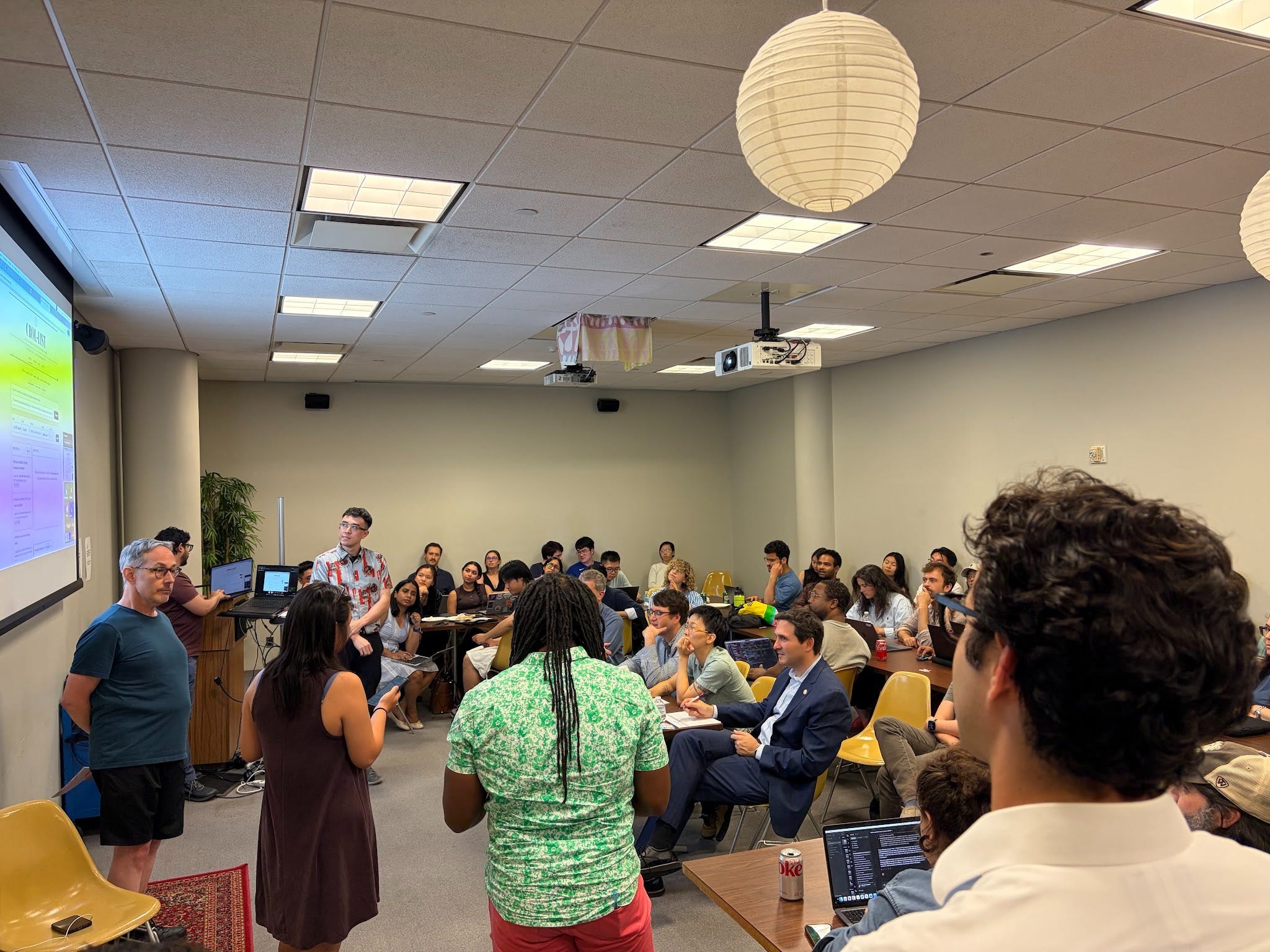
On June 24th, I co-hosted a state capacity-themed hackathon with Henry Grunzweig and Jeremie Ponak. The initial goal of this event was to bring technologists and government practitioners together to tackle pressing public problems with quick demos of possible tools built using AI.
Given just two hours to build, my expectations for actual results were low. But as each team showcased their projects at the end of the night, I, along with the rest of the audience, was struck by a realization: AI has completely transformed development timelines, and skilled technologists guided by experienced public servants can now construct solutions to long-standing government gaps in a matter of hours.
Read more here about our takeaways from the event and project highlights. Projects ranged from a playable 311 complaints videogame to a dashboard mapping NYC flood burden against flood-resilience capital spending to an encyclopedia of NYC civic data. Subscribe to the State Capacity Ecosystem (SCE) Substack for updates on future hackathons and other events.

It has never been easier for individuals to affect change and solve problems for the public. Anyone with access to an AI model and a willingness to explore the available data can plug in holes where there are missing public services or address information gaps.
Of course, building a new tech tool is only one part of the process for any project aimed at public adoption. The hard part of deploying government software is the unglamorous part: data privacy, security review, accessibility/508 compliance, integration with legacy systems, uptime, and maintenance after the volunteer moves on. But the outdated and overly complex rules that govern deployment in government, and make all these steps excruciatingly drawn out and confusing, is exactly the problem.
The SCE Substack article covers this new paradigm and its implications, and where we see our new community playing a role. In this post, I wanted to address some additional thoughts I had following the hackathon about what it means for state capacity moving forward.
Government needs more tech-driven builders
State capacity is the government’s ability to actually do what it sets out to do, from issuing a permit to running a benefits program. It is well-known that across local, state, and federal government, state capacity in the U.S. has fallen behind the public’s needs. A multitude of public institutions are largely unable to achieve their stated goals in a timely, cost-effective, or consistent manner.
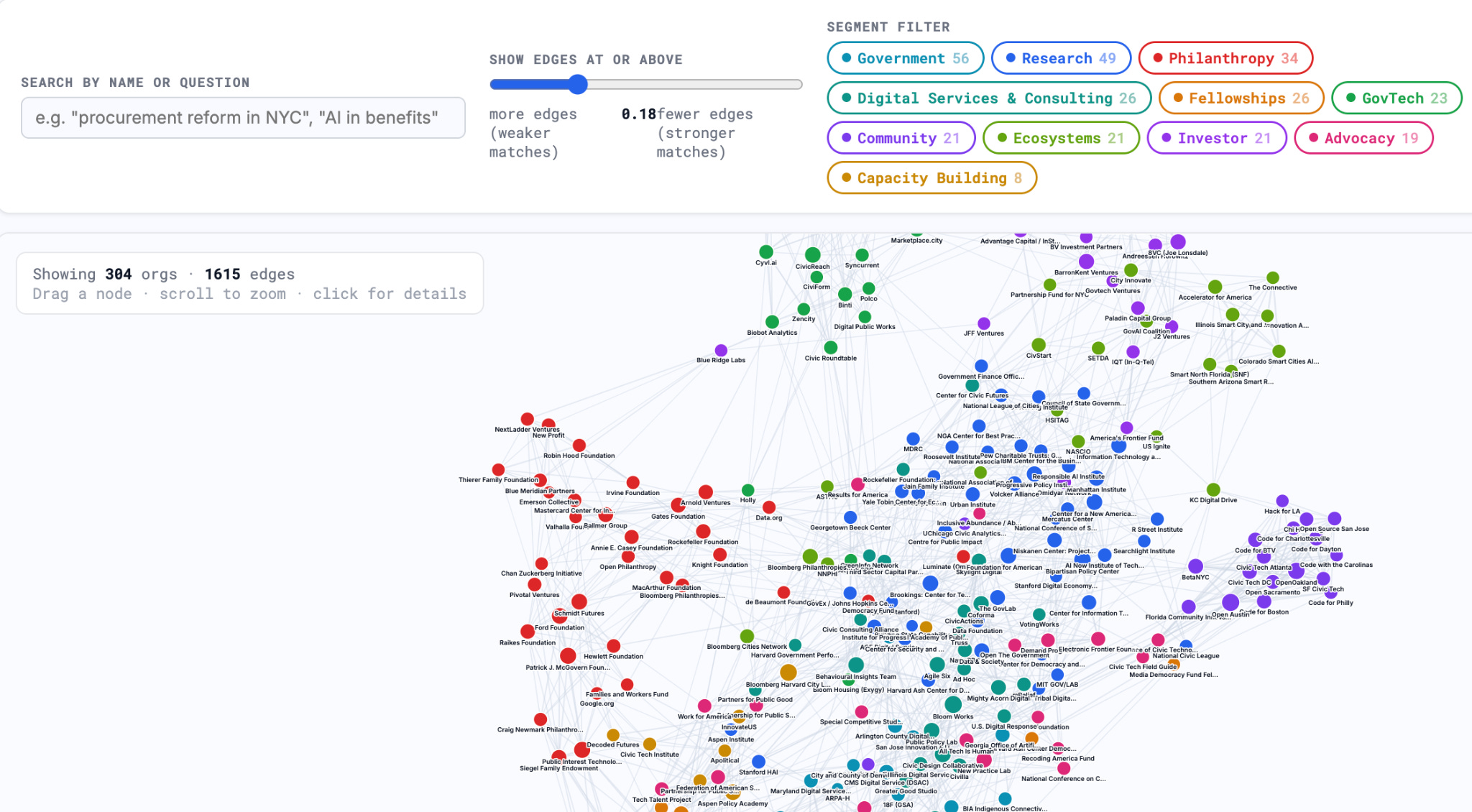
The good news is that there is a growing ecosystem of practitioners, technologists, researchers, funders, civic organizations, and public sector actors all working on adjacent aspects of institutional effectiveness and public sector innovation. Momentum has been growing to bring government institutions into the 21st-century and prepare it to tackle the problems of the future.
However, this ecosystem remains fragmented and each of the component actors are weakly connected. As a result, promising solutions are diffusing far too slowly.
Operational knowledge is not widely shared and organizations duplicate efforts needlessly. Extraordinary talent struggles to identify pathways into the work while local implementation capacity develops unevenly. Public institutions are unable to access or implement the solutions created by external actors. Private actors are unable to work directly with relevant public bodies.
This coordination problem is what inspired Henry, Jeremie, and me to create the State Capacity Ecosystem Hub. Our hope is that people will use our new tool to discover new opportunities to plug-in to the state capacity ecosystem, surface new connections to address major policy needs, and ultimately form a more cohesive network of actors that can coordinate and collaborate on their work and its uses in the public sphere.
The system is ripe for change
At our hackathon, over 20 teams of civic tech builders launched their own AI-driven solutions to various state capacity problems. As verified by the public sector experts present, many of these projects created valuable solutions to real needs that government has been unable to address itself for many years now.
Building tools that facilitate digital service delivery, information transparency, and allow for public advocacy is now easier than ever. The new bottleneck is in adoption: a fragmented ecosystem, and on the government side a broken procurement and implementation pipeline, mean that these valuable tools never reach the agencies that need them.
As Jennifer Pahlka writes in her piece here, we need faster and smarter procurement that preserves the necessary safeguards, so that new and changing technology applications, like using AI to fix websites and government tools, can actually be implemented instead of relying on vendors to make changes, which takes months and costs ridiculous amounts. Technology itself can even be used to fix procurement rules (such as by identifying where they are needlessly complex or redundant), but you need to update those rules in the first place to allow government to unlock the value of AI and new technologies.
The key to improving state capacity moving forward, then, is two-fold:
unshackling agencies and other government bodies to easily adopt and adapt tools built by outsiders (and to more easily develop and deploy their own tools)
designing these AI-driven, citizen-created tools to be implementable by public bodies, which includes ensuring they are carefully designed even as they are rapidly built
Whether it’s an agency adopting someone’s interactive dashboard built on open data or a legislative body integrating a meeting transcriber and summarizer into its archives, the new opportunities for crowd-sourced enhancements of government capabilities are energizing.
But to achieve this, we need an organized, concentrated push to reform government processes to allow them to speedily adopt modern solutions to long-standing problems. And we need more interaction and dialogue between civic tech builders and government practitioners. Only through this dialogue can we construct pathways for adopting AI-driven tools that handle the tricky questions of accountability and ownership of maintenance.
To figure out the proper answers to these questions, we need to experiment and learn and iterate. Our hackathon event and the SCE hub are only the beginnings of our work to bring about this new era of state capacity that will be defined by greater collaboration between civic technologists and government institutions.
In addition to expanding the hub, we are planning to host more events like the state capacity hackathon that create opportunities for technologists and government practitioners to directly share ideas and build solutions together.
If these possibilities are enticing to you, come join the movement and help us create more capable governments and more democratic institutions. Let’s grab coffee, connect virtually, swap ideas, or collaborate on projects. Let’s work together to make government work better.