



The soundtrack of West 4th starts before you even reach the platform. A drummer echoes through the mezzanine while, just above ground, the unmistakable thump of a basketball carries down from the West 4th courts. A few commuters break into a sprint at the sound of an express train arriving. Others drift toward the exits without any urgency at all, disappearing into the Village for a comedy show or a jazz set.
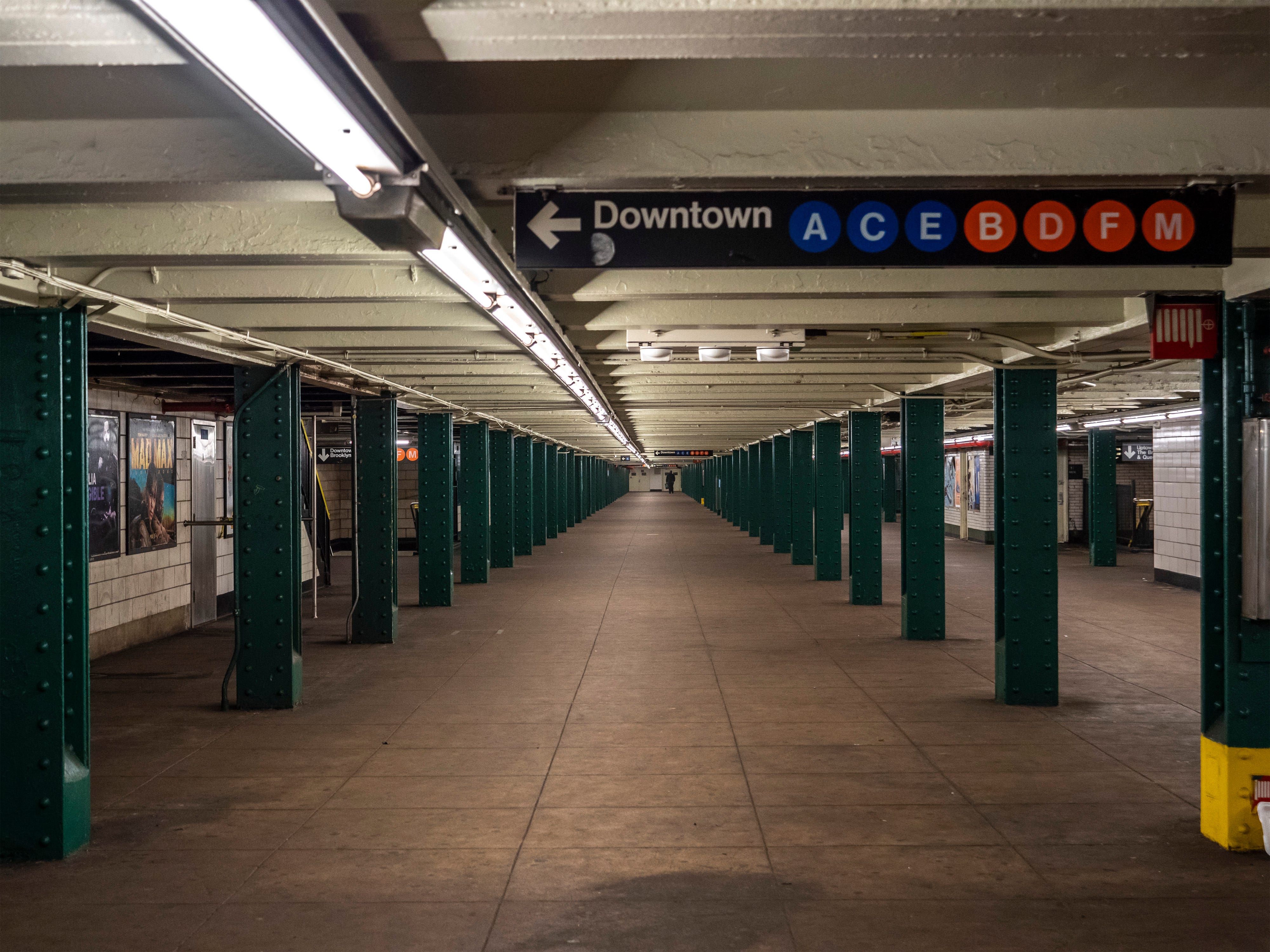
Entering West 4th Street–Washington Square station (West 4th) during rush hour is also a lesson in urban transportation planning. Eight tracks on two levels, with a spacious and mostly empty level between them (seriously, what is up with that liminal space?). Four island platforms hosting seven subway lines: the A, C, E, B, D, F, and M. Over 3,000 riders arrive per hour, with another 1,500-3,000 departing in the morning and evening rushes.
How is it that a station that opened nearly a century ago can handle such a volume of activity today? 94 years after opening, West 4th St station still achieves what its planners intended: it is the primary location where the old Independent Subway System’s (IND) two Manhattan trunk lines meet. This post is the story of that planning, how the station reached its current form, and how the New York of 2026 makes use of the space created by the New York of 1932.
First, I dig into how one of New York’s most complex subway stations was built decades ahead of demand. Then, Alexa Weiser of City Happenings heads above ground to see what all those riders are actually coming for.
Check out more of Alexa’s writings on what’s happening around NYC each week at her Substack here:

Every chart in this post, and the data behind it, lives at the NYCuriosity data hub.
West 4th’s History: capacity built ahead of demand
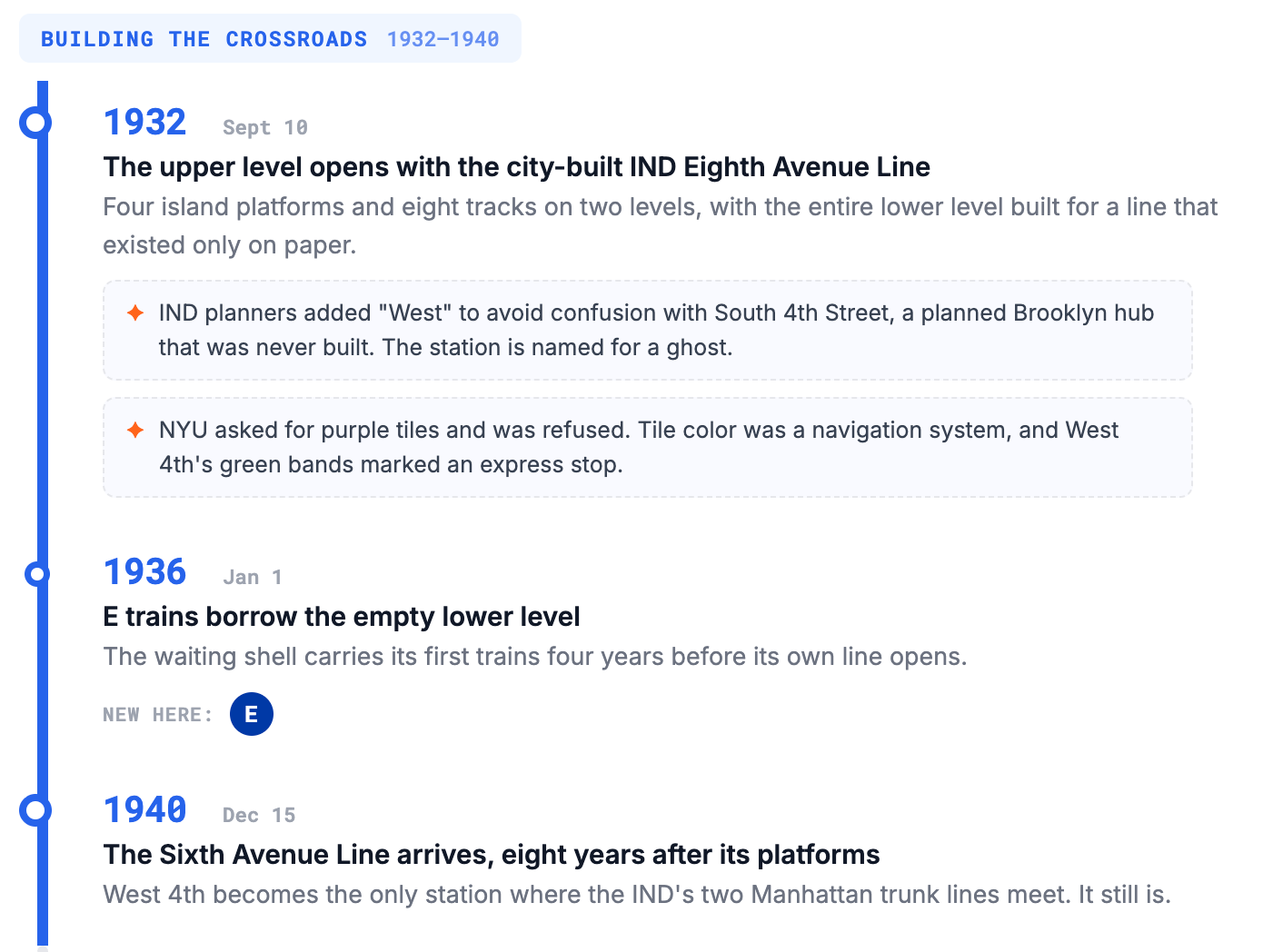
West 4th Street is a monument to building ahead of demand and to 20th-century urban transportation planning. The IND, the city-owned subway network (as opposed to the private BMT and IRT systems), opened the station in 1932 with the entire lower level already constructed for a Sixth Avenue Line that wouldn’t actually open until 1940.
The station’s name reveals another clue in its consideration of the future: the “West” in the name was added to avoid confusion with South 4th Street, a planned Williamsburg station of the never-built IND Second System. This may strike some as an unusual consideration, given the subway system’s many, many 23rd St stations that until recently all had the same name.
Similarly, when NYU asked for purple tiles to be added during construction, it was refused. Not for aesthetic reasons, but for navigation and consistency. IND stations relied on tile colors as a wayfinding system decades before digital maps were introduced, and the planners refused to depart from a functional style that could aid riders.
While the station opened with service only by local and express A trains, within a year C trains began operation through West 4th Street as well. By 1936, E trains began running through part of the station, and as mentioned, in 1940 the Sixth Avenue Line was added.
West 4th would then have to wait 27 more years for express tracks to 34th Street to be added, bringing B and D express service to this section. In 1961, ground broke on a $22M ($237 million in 2025 dollars) project to add those long-planned express tracks between W 4th and 34th Street. When the B and D express services began in 1967, it completed the 35 year journey from West 4th’s initial opening for the station’s full eight-track design to be realized.
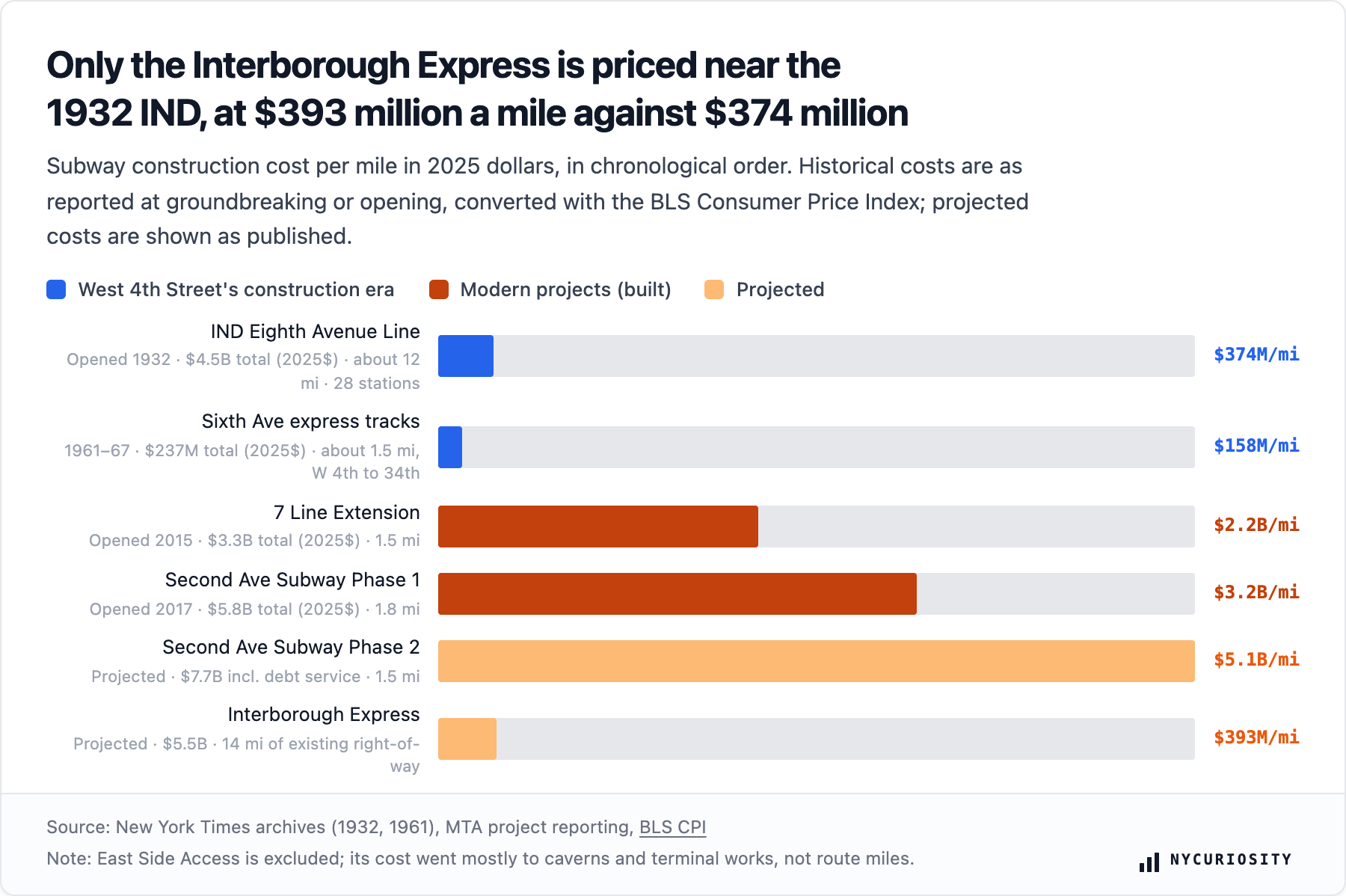
Overall, the IND built the Eighth Avenue Line at $374 million per mile and added express tracks at $158 million per mile (again in 2025 dollars). Compare this to the 2000’s 7 train extension, which cost $2.17 billion per mile. Even more recently, Second Avenue Subway Phase 1 cost $3.25 billion per mile, and Phase 2 is projected at $5.13 billion.
Of course, part of the reason for these vastly different costs per mile is there is now a whole lot more built environment to work around in modern day New York. Labor costs were also much lower in Depression-era NYC, and today’s environmental review and other regulations did not yet exist. I dig more into the many causes of today’s high costs for transportation projects here.
The one 21st-century project with a price tag per mile near IND’s 1930s transit expansions is the Interborough Express (IBX), currently projected at about $393 million per mile. The IBX achieves these lowered costs the same way the 1932 transit project did: by using right-of-way that already exists instead of boring fresh tunnel.
West 4th runs on a nightlife schedule
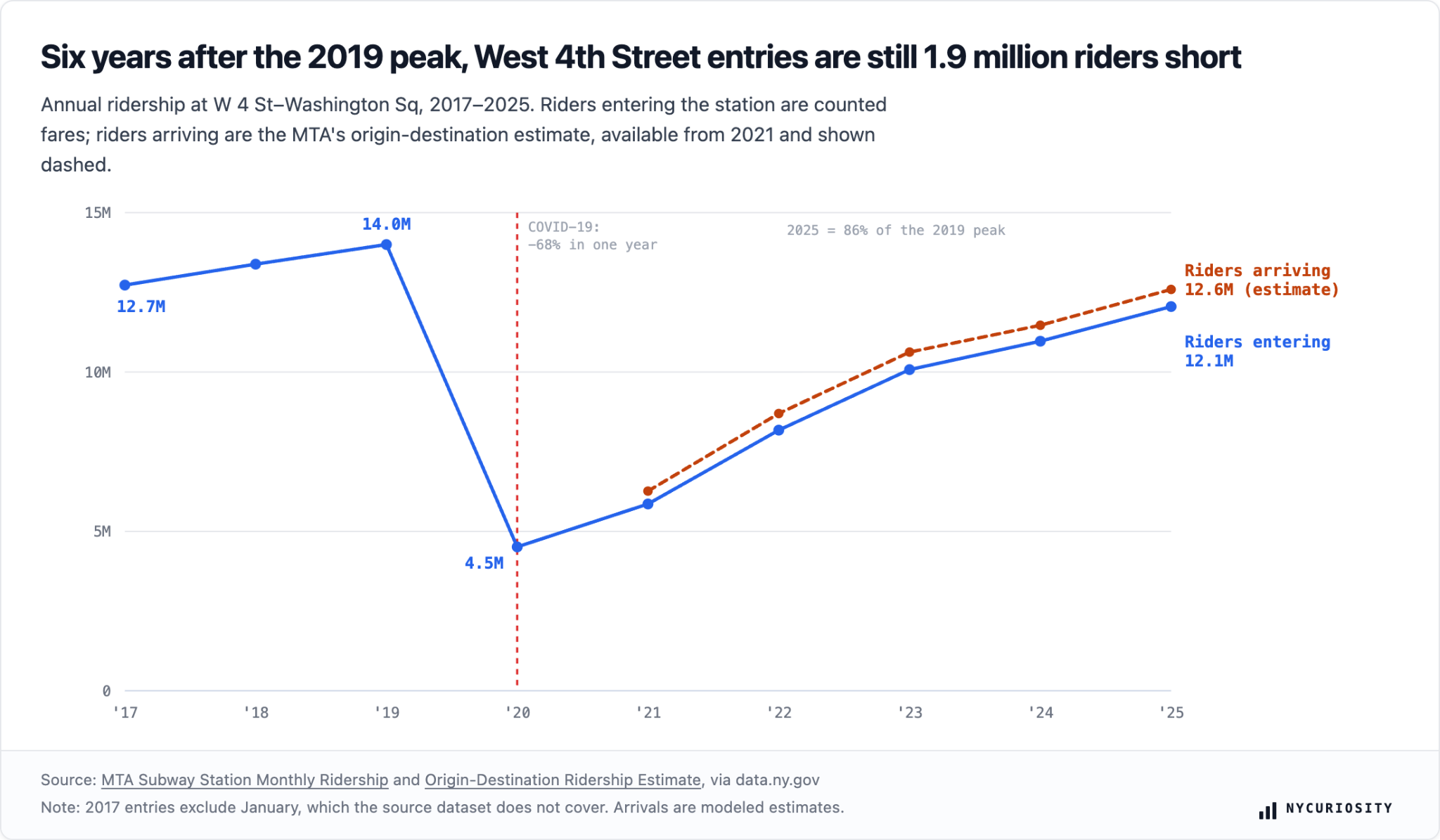
The MTA’s official 2024 count puts West 4th Street at 10,872,225 riders, the 18th busiest of the subway’s 423 stations, and up 8% over 2023. Since the pandemic drop-off, ridership has steadily increased, though it remains shy of the 2019 peak of 14 million annual riders.
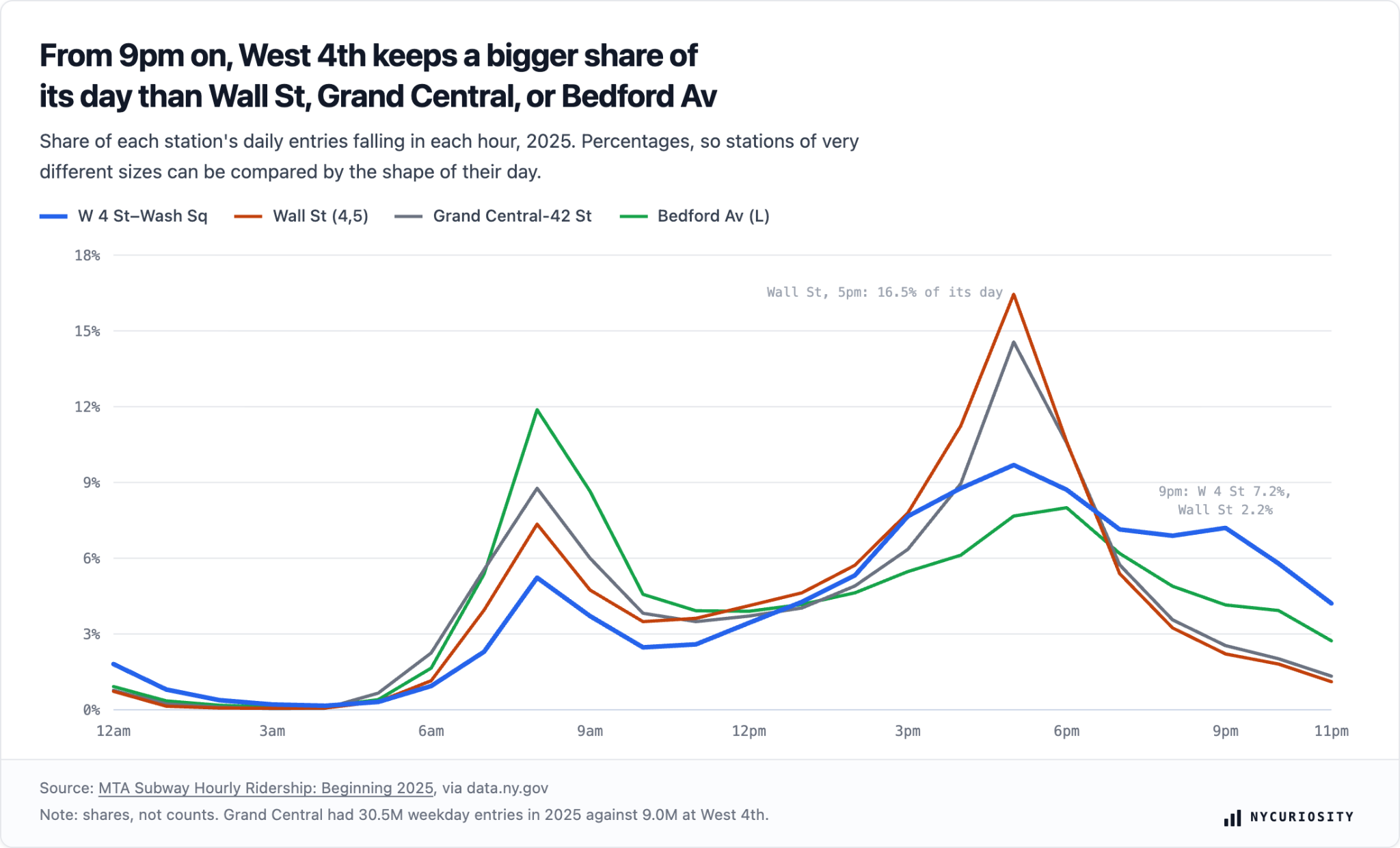
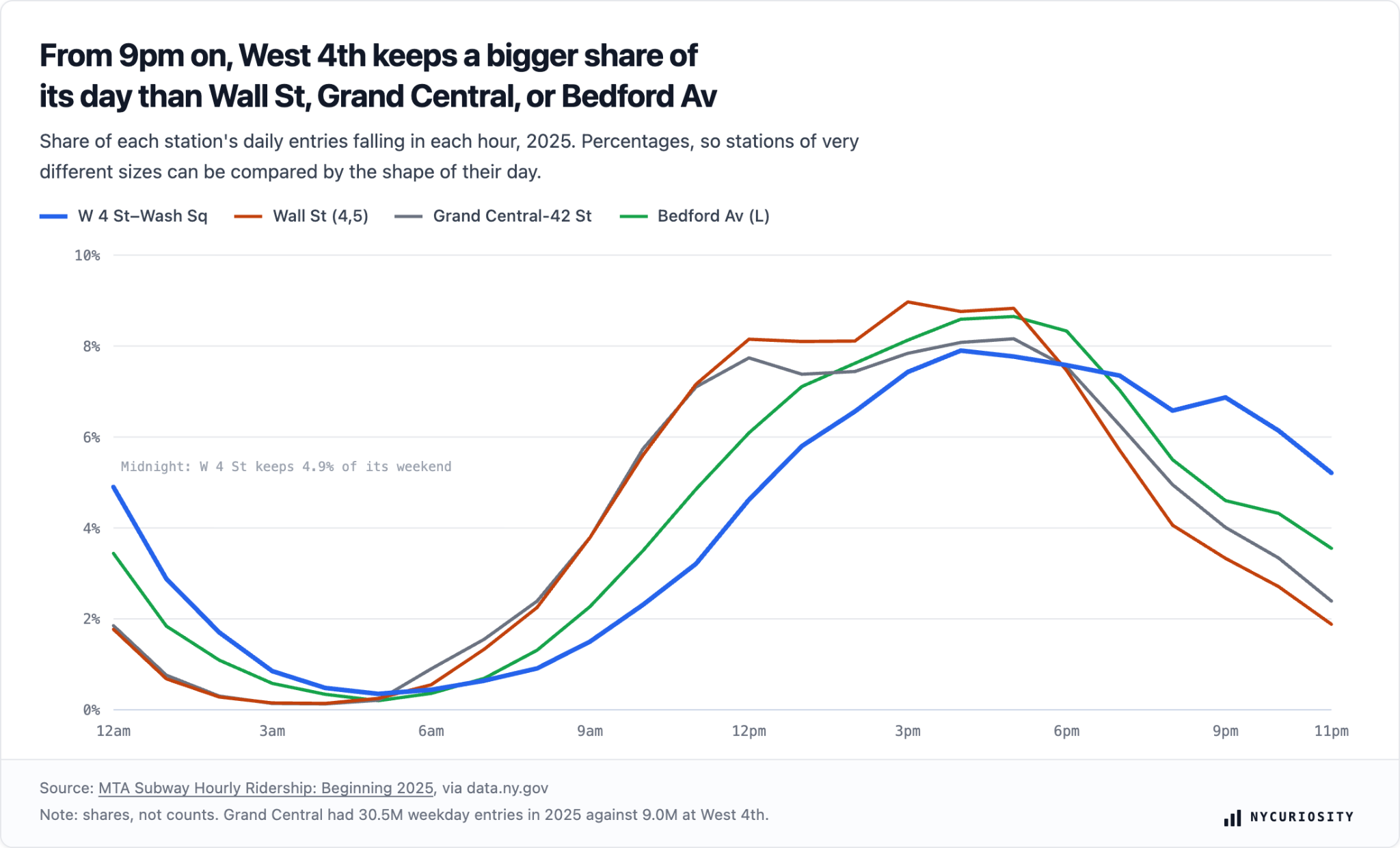
West 4th is also a unique station in its distinctly nightlife-district signature (i.e., strong evenings and weekends ridership) compared to the more typical 9-to-5 commuter station.
On an average 2025 weekday, West 4th held close to 7% of its daily riders per hour through the 7pm to 9pm stretch, while Wall Street station fell to 2% by 9pm. After midnight on weekends the comparison gets even better: in the 12am to 2am hours, West 4th’s share of daily entries is over 9%, ahead of even Bedford Avenue’s 6%, the L stop in which Williamsburg nightlife is centered.
West 4th Street is also a “net destination” station. In every year of the MTA’s origin-destination estimates, more riders arrive at West 4th than enter it, with a gap of roughly half a million riders annually. West 4th functions as a portal to the Village. From there, they get off and then walk, share a ride, or head home from somewhere else.
Pick your exit
For a station named West 4th Street, West 4th has a peculiar feature: you can’t actually exit onto West 4th Street. The station previously had entrances at West 4th and Washington Place, among others, but today its street exits are concentrated around Waverly Place to the north and West 3rd Street to the south.
That makes choosing your exit fairly consequential. At least if, like me, you resent walking an extra five minutes because of a wrong turn.
But whichever direction you choose, you emerge into a remarkably dense pocket of the city. Which brings us back to Tal’s ridership data: more people arrive at West 4th than start their subway trips here.
How much can happen within five minutes of one subway station?
That “net destination” finding didn’t surprise me. What I wanted to know was what exactly all of those people were arriving for.
So I decided to test it. I picked an ordinary Thursday (August 6th, 2026) and looked at what was happening within a five-minute walk of the station. I quickly realized there was far too much to include. So, in honor of the seven subway lines converging below ground, I narrowed it down to seven particularly New York ways you could spend that Thursday night above it.
Jazz legend Kenny Garrett was playing at Blue Note.
Jefferson Market Library screened The Lost World: Jurassic Park.
Murray’s Cheese held a Mediterranean Cheese & Wine Tasting.
The Players Theatre opened Marlise, a new murder-mystery musical.
Jane Hartsook Gallery was showing Ceramics Now, featuring work by Greenwich House Pottery artists in residence.
A local artist was leading a free, drop-in art studio in Washington Square Park.
Magic: The Gathering players gathered for Thursday Commander at board game café, The Uncommons.
Of course, we can’t recreate the exact evening of August 6th. Come back a week later and the seven picks would be completely different. But the sheer number of options wasn’t a fluke. Within a few blocks, seven subway lines deliver people to dozens of different New York subcultures.
Very fun to collaborate on this one!
I love it when writers I subscribe to team up because it makes me feel like I'm part of a pocket universe.
Very cool snapshot of W4! I wonder if its popularity peaks at night because it's a handy transfer station? The ACE and BDFM sort of split there with one heading west and the other more east, so it's kind of an underground nexus point.