


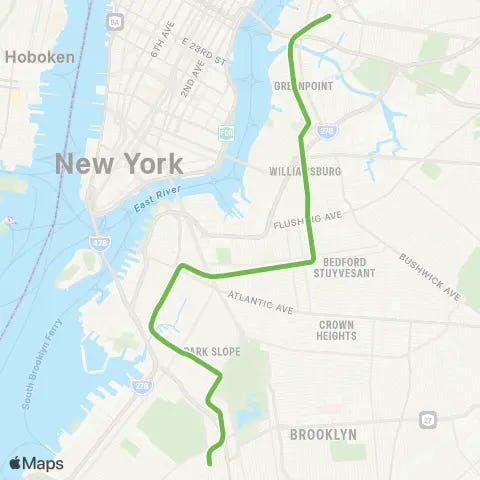
Until the Interborough Express (IBX) eventually opens, there is only a single (non-shuttle) subway line in New York that does not go through Manhattan: the G train. Unfortunately, since the summer of 2024, this unique Brooklyn-Queens Crosstown Local line has often been absent on weekends.

For riders hoping to travel between the waterfront regions of Brooklyn (2.65 million people) and Queens (2.36 million), two boroughs each with a larger population than Manhattan (1.66 million), the G is usually the most reliable method. It is the only subway option that does not require a transfer in Manhattan, which can add significant time to a typical journey.
Of course, the G is nowhere near the line with the highest ridership, nor do its regular weekend disappearances over the past years have significant effects on the city’s economy or tourism industry. The situation is nowhere near as bad as 2017’s “Summer of Hell” train failures that made major news headlines.
But the duration for which the G has experienced these service disruptions with seemingly no end in sight has hampered local businesses, confused and inconvenienced residents, and hurt the MTA’s reputation as a reliable service. And while the work causing the closures is justified, the lengthy project timeline and the manner in which the MTA has handled the shutdowns has been…less than ideal.
Fair to public agencies or not, it is in these less extreme but more frequent cases of transit project delays and confusion that residents form their impression of how much those agencies care about them. Shutdowns that last for years, lack of reliable alternative options, and schedules that keep changing all contribute to a mistrust in government services. The resulting loss of public buy-in can then lead to the election of politicians or shifts in funding that further harm the ability to deliver on future projects.
So what has caused the G’s service disruption to stretch on for years, what will be the eventual benefit of this work, and what could be done to improve (or even prevent) future subway closures?
What are riders actually getting for all these lost weekends?
The reason for the station closures is defensible and even exciting: the G is getting an upgraded signal system, the same as what the L and the 7 trains have been upgraded to in recent years that resulted in dramatic service improvements.
The new signal technology is called communications-based train control (CBTC), and it is much overdue for all of New York’s trains. The G’s current signals date to the 1930s, like many other lines, and work by dividing the track into fixed blocks. To ensure safety, a train cannot enter a block until the train ahead has fully left it. The new CBTC system replaces that antiquated method with radio: each train reports its exact position continuously, so trains can safely run closer together and the system recovers faster when something goes wrong.
The MTA awarded a $368 million design-build contract for these signal improvements in early 2023, expecting the job to take just under five years, concluding in late 2027. The full project also includes replacement of 30 miles of track, 17 switches, the Court Square interlocking and equipment at 10 stations, and carries a budget the MTA has put at about $624 million.
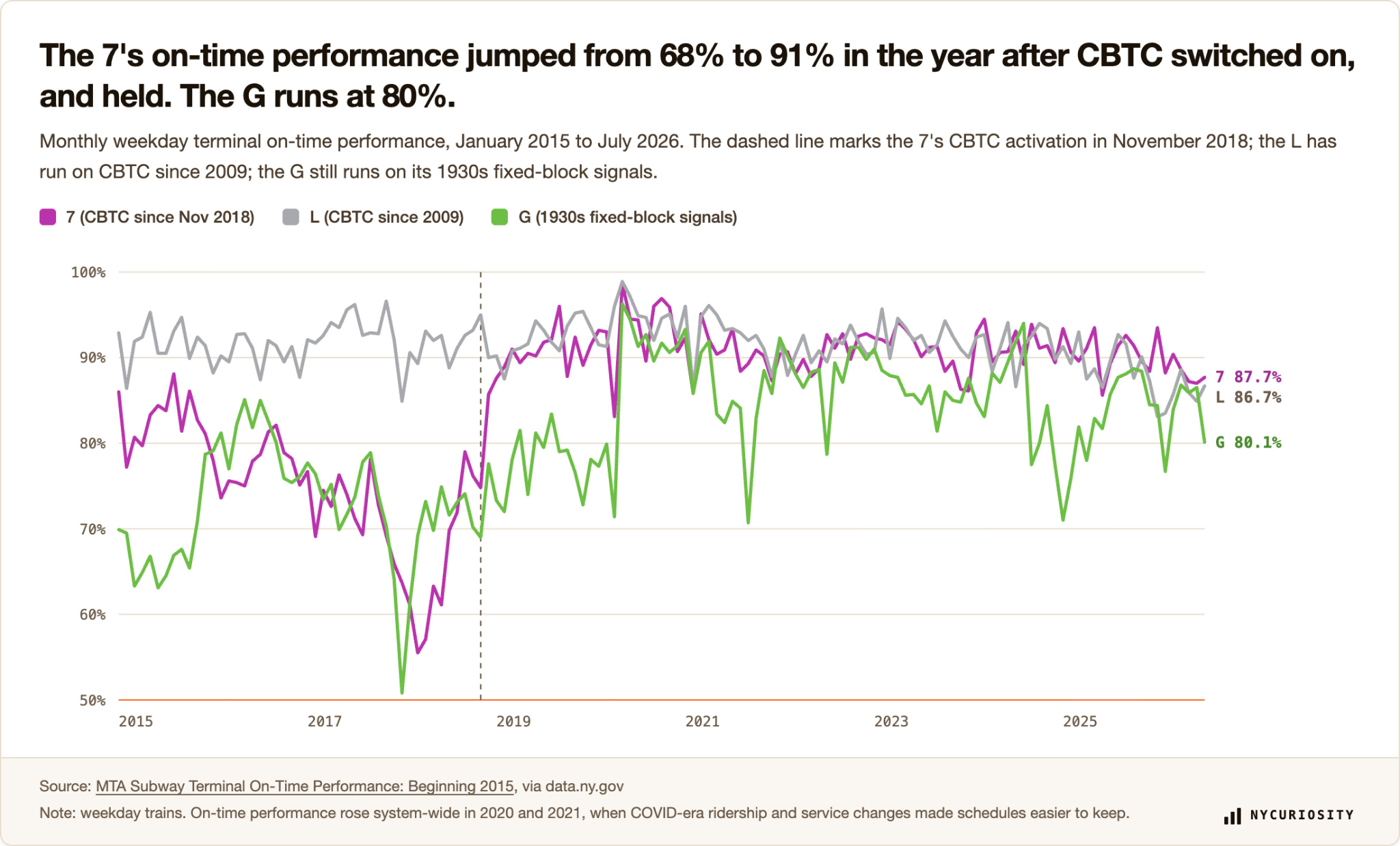
All these upgrades would make the G one of the most reliable services for its roughly 160,000 weekday riders. On the L, CBTC is what allowed the MTA to run 20 trains an hour through a two-track tunnel. On the 7, it brought weekday on-time performance from 68% to 91%. The new system is even “designed so it actually could accommodate longer trains” than the relatively short four-car sets the G runs today. When the work is done, riders on the G can expect trains that arrive on time, with fewer gaps between trains, and potential for added capacity as neighborhoods like Greenpoint and Williamsburg keep growing.
This work is exactly the kind that needs to be done to bring NYC’s transit system into the 21st-century. The service disruptions are, unfortunately, necessary on a 24/7 system and were always expected to take several years. A fair question to ask, however, is why the original project timeline ran five years, and why it has been extended even further out since then.
Every signal upgrade has run late, and the timelines were long to begin with
In June 2025, the MTA said the work would run “through Q3 2027.” Just one month later, the MTA said the new signals would not be activated until 2029, because the new R211 trains need new 5G radios to operate effectively. More recently, the MTA’s independent engineering consultant for some of the work put activation at July 2029.
This work is not the first or only example of already long project timelines being extended. To name several other examples:
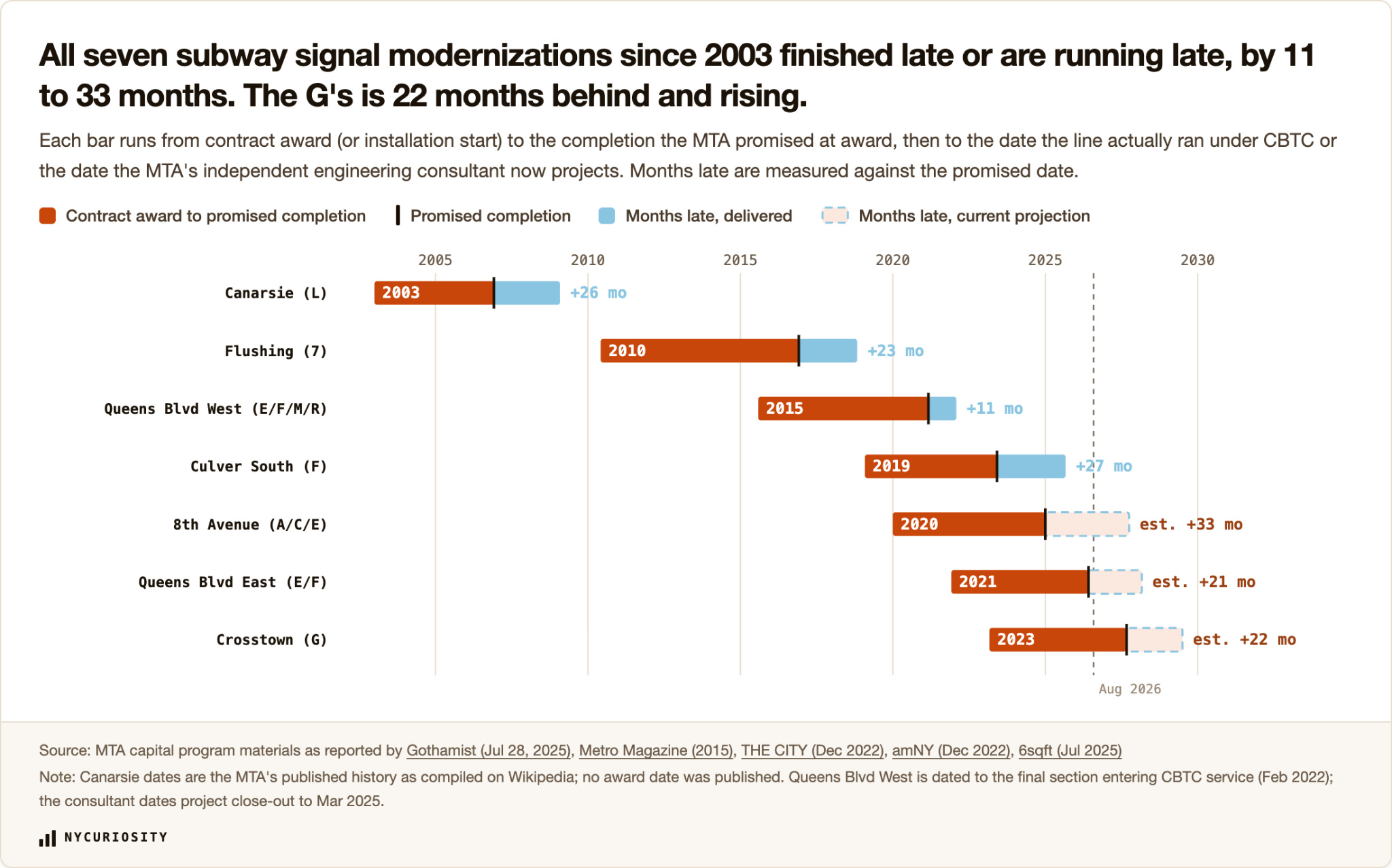
The 7’s signals were promised for 2016 and switched on in November 2018.
Queens Boulevard (E/F/M/R) was promised for March 2021 and entered service in February 2022.
Culver South (F) was promised for June 2023 and delivered in September 2025.
The three projects still running – 8th Avenue (A/C/E), Queens Boulevard East (E/F) and the Crosstown (G) – are currently all 21 to 33 months behind by one count.
A contributing factor to these long project timelines and delays is the sheer age and lack of maintenance of the system. Tracks and equipment over 100 years old, suffering from decades without investment, are finally being fixed or replaced. For example, during the G’s summer 2024 shutdown, work crews completed the following at ten G subway stations:
Scraping, priming and painting 233,645 square feet of platform, track and mezzanine ceiling
Replacing 9,495 tiles
Scraping, priming and painting 1,802 station columns
Converting 4,858 LED lamps
The MTA is taking the opportunity to use signal upgrade shutdowns to perform other overdue upgrades, like deep cleaning stations and fixing tracks and tiles. The necessity for doing this maintenance work is real, but it means that signal upgrade projects are actually involving much more work.
As MTA Construction & Development President Jamie Torres-Springer said in 2022,
“The problem is that we are trying to do too much, call it, heavy civil work, like replacing track ties as part of a signal modernization job that’s really technology heavy.”
Procurement issues also plague the project, as they seemingly do in all other domains of government services these days. The July 2025 MTA capital program report identified “delays due to procurement, design, installation and commissioning of a 5G radio (carborne) retrofit of the R211 and R179 fleets…In addition, the contractor is late to get the approval of the signal wayside block design.” This delay alone is expected to add $24 million to the total cost of the G train upgrades.
While the 5G radio issue is specific to the G’s upgrade delays, the reliance on lone private vendors for products and the failure to coordinate with and across multiple contractors is not. In fact, the MTA “blamed the agency’s contractors and a lack of engineering expertise for the delays” across all the signal upgrade projects. These issues occur across other transit projects too.
The L and 7’s signal upgrades each took about a decade, and the G may be on track for the same timeline. According to the RPA’s “Moving Forward” report in May 2014, if CBTC installation work continued at its current pace, “it would take the agency over 85 years to convert half the system to CBTC”. Given that the L’s CBTC signals are due to be replaced in 2028, this means the modern signals are aging much faster than the rate at which they can be installed or replaced.
While recommending procurement policy changes and other state capacity improvements is outside the scope of this article, that RPA report offers some excellent possibilities to consider. These include restructuring projects so that shutdowns are consolidated and modifying procurement rules, and more flexibility to work on the tracks throughout the day. The Transit Costs Project also has a section on New York that explains why NYC transit projects run sky-high expenses and extended timelines, with similar suggested reforms to contracting and procurement processes.
What the MTA and NYC DOT can still do about the years left
Tens of thousands of riders enter the subway at G train stops on a typical weekend day. Visitors and tourists traveling to popular stores in neighborhoods like Greenpoint rely on the G. But for nearly half of the weekends in 2026 so far, a significant portion of the route (Court Square to Bedford-Nostrand) has been shut down for track work.
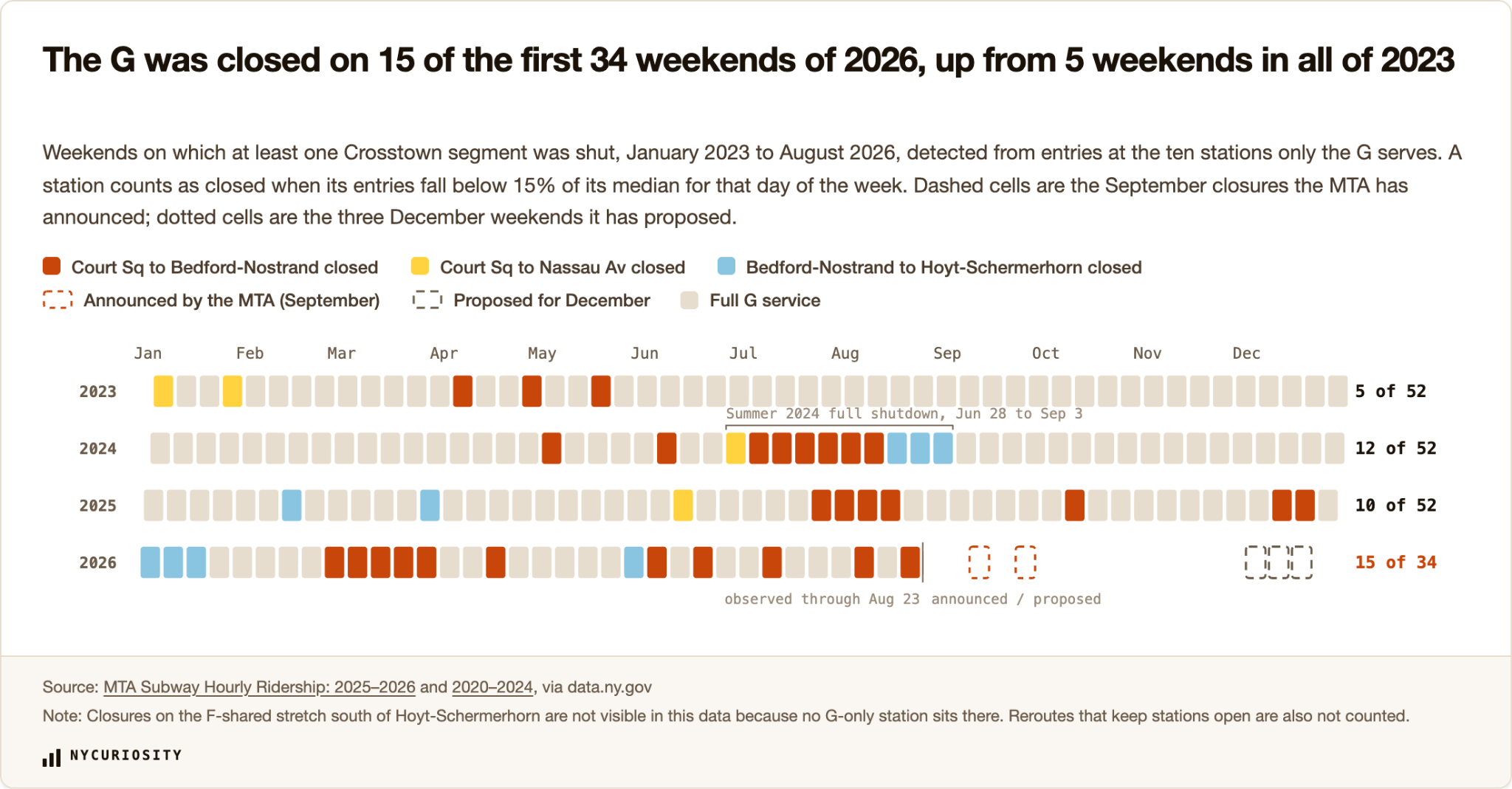
The stretched project timeline has now resulted in a full summer shutdown in 2024, 10 weekends in 2025, and 15 of the first 34 weekends in 2026. Since the summer 2024 shutdown began, riders have lost 35 of 113 weekends on at least one segment of the G. And service has not been trending better. Adding the remaining upcoming closures announced for September and proposed for the first three weekends of December, 2026 will end up with 20 of 52 weekends with no G service (38% of the year).
Alternative travel options when the G is down are just woefully insufficient. Those still hoping to travel along the G’s route are left with the following options:
MTA Bus: often unreliable, sparse service on weekends, and subject to slow traffic conditions
MTA-run G train shuttle replacement: subject to all the same issues as the buses
Walk/bike: while an excellent ride along the waterfront on a good-weather day, not an option for all folks and increasingly costly in dollars or time
Every weekend G closure has come with a free shuttle bus that runs on the same streets as the B62. Unfortunately, the four bus routes that parallel the G averaged 6 to 8 mph on weekends in the first half of 2026. Despite recent efforts by the MTA to improve bus speeds, this is the same average speed as in 2023. And, as Streetsblog has pointed out, any shuttle using these same roads will be subject to the same blocked bus stops and grinding weekend traffic.
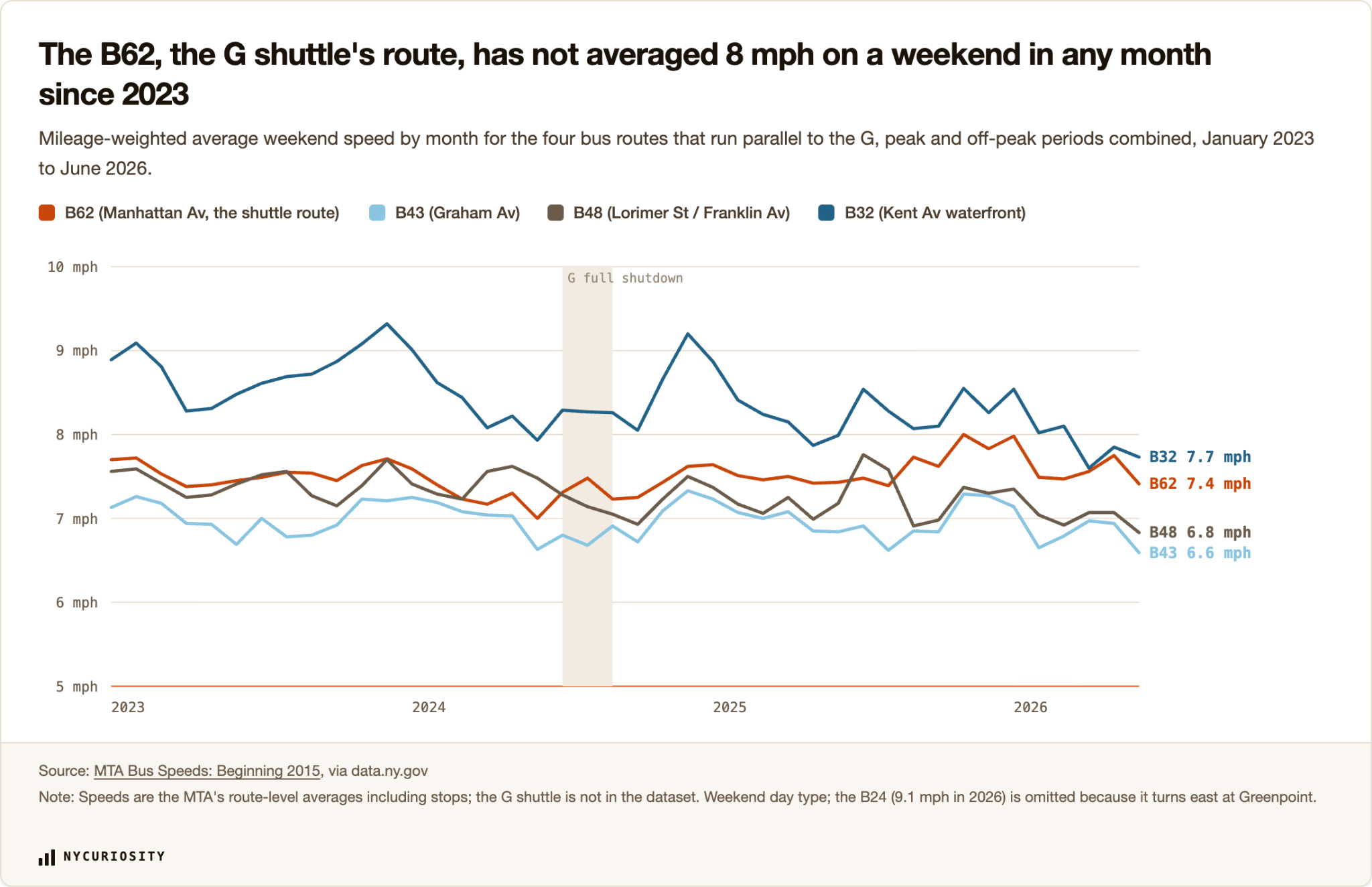
Court Sq to Bedford-Nostrand is 15 minutes on the G, but at the B62’s weekend speed it takes 40 minutes. Greenpoint Av to Hoyt-Schermerhorn is 18 minutes by train, 37 minutes by bus, and 93 minutes on foot. A Citi Bike easily beats shuttle and bus times, but at a price: a non-member on an e-bike pays $4.99 to unlock plus 41 cents a minute, which comes out to about $17.70 for that ride, if a bike is even available.
Evidence that the buses and G shuttle are not reliable replacements is in the survey data as well. Also in that Streetsblog article, a survey of Greenpoint shop owners reported weekend sales down an average of 20% on weekends without the train.
So what can the MTA, or in some cases the NYC Department of Transportation (DOT), do to make up for service disruptions that may continue for several more years? A free alternative shuttle is a good start, but clearly leaves some meaningful areas where more could be done to inform, assist, and win over affected riders. For example, during the L’s shutdown, the MTA and DOT added new bus routes, free out-of-system transfers, and we got the 14th Street busway.
The remaining closures run at least through 2028, so there is plenty of time to pursue more solutions. Some ideas:
DOT Commissioner Mike Flynn should install weekend bus lanes on the shuttle route for every remaining closure, on Manhattan Avenue, McGuinness Boulevard, and Bedford Avenue. Mayor Mamdani appointed the Commissioner on his first day with a mandate to move buses faster. A shuttle that covers Court Sq to Bedford-Nostrand in 25 minutes instead of 40 would be a great contribution to that effort.
MTA Construction and Development President Jamie Torres-Springer should publish the full closure calendar through activation, so that a Greenpoint business owner planning for December 2027 knows now, and put the shuttles in the MTA’s own app and in Google Maps, where riders currently cannot even find them. Free Citi Bike rides and extra dock capacity in Greenpoint on closure weekends cost a fraction of a $624 million project and would also aid affected residents.
The MTA should publish a post-CBTC service target for the G: trains per hour, on weekends as well as weekdays. The L got 20 trains an hour out of its upgrade. Riders who have lost service for 35 weekends and counting should know what they will be getting out of all this work. Better marketing and public awareness campaigns about what riders are getting from ongoing service disruptions would go far to earning buy-in.
Of course, all the above suggestions are just band-aids on the more chronic issue of transit project timelines being severely extended in NYC. To prevent future signal upgrades, of which there are many left to do, from taking a decade per line, New York needs to fix its broken procurement and contracting process.
Solutions that strike at the heart of the issue will involve state-level procurement reform, in-housing more transit expertise, implementing newer technologies like AI to assist both planning and implementation, and other systemic fixes which I covered here and which the excellent Transit Costs Project goes into detail here.

While such changes will not come easy, their potential to radically reduce project timelines (and costs) and restore trust in public service render them valuable and necessary.
It's ridiculous that a full shutdown in Summer 2024 wasn't enough time to finish this work, but I feel like that is still the best way to go about this. instead of frustrating riders with a "will they wont they" every weekend, just shut the whole thing down for as long as it takes and plan around that. Your suggested stop gap solutions are a good start, maybe build an elevated/exclusive bus lane too so that the speeds are more on par with the subway
I know they chickened out with the L train shutdown a few years back and that just led to more frustration IMO