


This month, NYC launched the pilot for its long-awaited program to mandate the use of city-designed trash bins. Since the initial announcement of the containerization program in October 2022, the new bins have only been rolled out to select streets in Harlem falling under Manhattan Community Board 9 - primarily the Hamilton Heights area1. Still, Mayor Adams’ administration has made a lot of noise about the potential for this program to finally solve the city’s notorious rat problem.
The city has invested a lot of time and money into designing and rolling out these bins, so hopes are high. But the battle between New York and trash in its streets is a long and discouraging one, full of new ideas and trials and failures. The success of this latest neighborhood pilot would be a massive step forward in the “Trash Revolution” that the city has fought over the past several years.
The City vs. Trash
Before New York was even known as New York, trash in the streets was a major issue. There is documented evidence from as early as 1657, when the city was still known as New Amsterdam, of piles of refuse affecting the community and rules being created to fight its accumulation. Of course, such waste management issues were historically commonplace in cities without modern sewage and disposal systems. Yet while most cities found solutions for their trash problems, including many in Europe that are just as dense or old, NYC remains notorious for the sight of rodents and the stink of garbage throughout the city to this day.
In the 1880s, as trash problems piled up, the New York City Department of Sanitation (DSNY) was formed to centralize and organize street cleaning2. Over the following decades, the DSNY would introduce programs including regular street sweeping, curbside trash pick-up, widespread litter baskets, recycling, and composting. The DSNY continues to grow along with the rest of the city, today boasting a fleet of over 2,000 garbage trucks and hundreds of specialized tools. And certainly the streets are cleaner than they were centuries, decades, or even mere years ago. But despiute each new weapon in the DSNY’s war against trash, the streets remain home to legions of rats and roaches at a scale not seen in most other world-class cities.
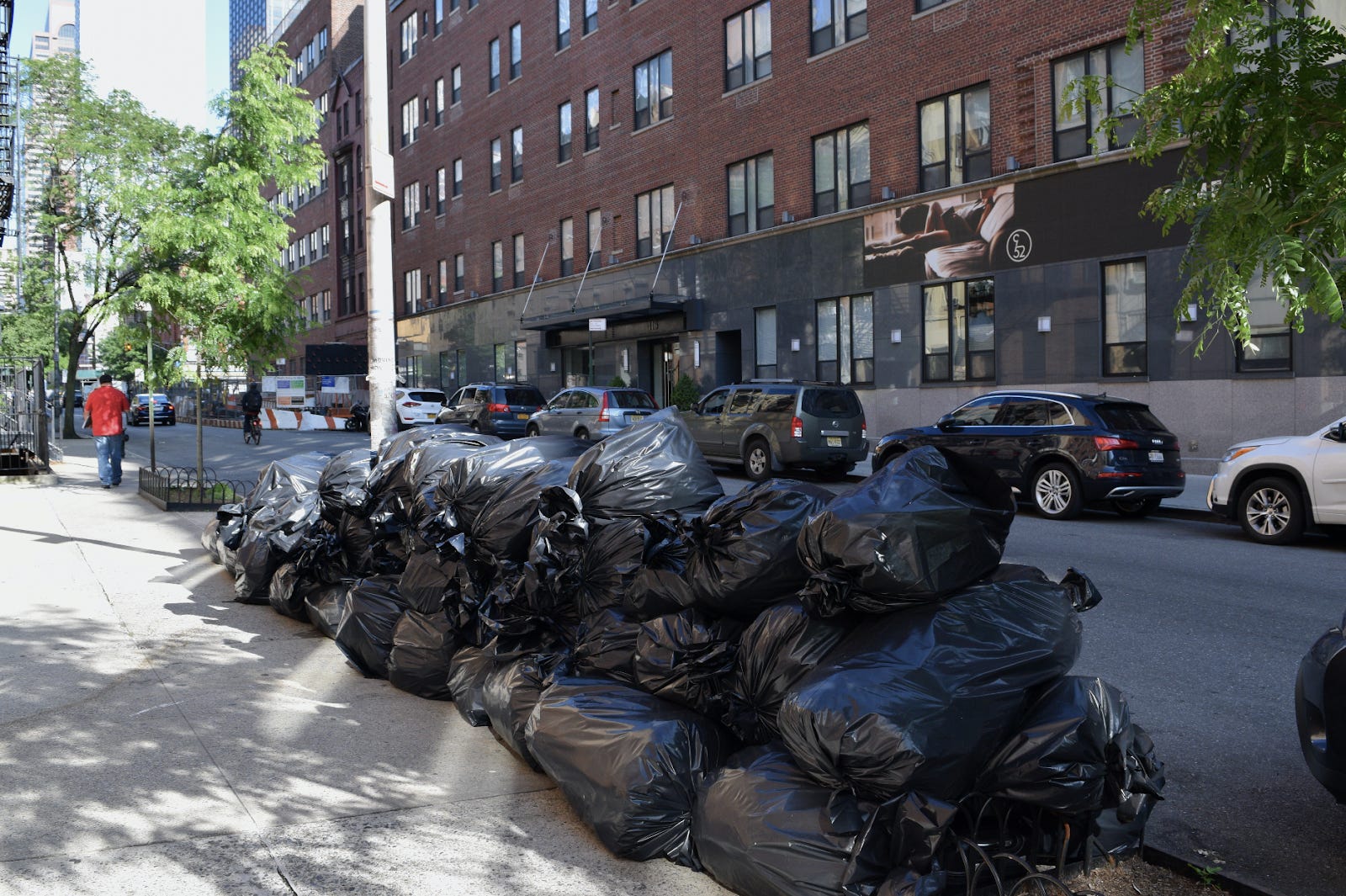
Soon after his election in 2021, Mayor Adams began his administration’s Trash Revolution, a new effort to finally reduce rodent numbers and clean up the streets. The first blow to trash came in October 2022, when the administration changed trash set-out times as well as the DSNY’s trash pick-up times to reduce the period in which trash would sit out on the street.
At the same time, the DSNY released its “Future of Trash” study, which detailed the methodical use of containers (see: trash bins with sealed lids) similar to those used in many European cities to better control and contain refuse on the streets. This marked the beginning of a new approach following decades of garbage bags sitting on curbs, spewing odors and sewage onto city streets.
The Latest Solution: Full and Standardized Containerization
NYC’s containerization program kicked off in March 2024, when the first rules went into effect for all businesses in the city to place their trash in secured bins. Around the same time, new side-loading garbage trucks and a data-driven strategy by the DSNY were unveiled to set the timeline for a full containerization timeline to be complete by June 2026.
Then, on November 12, 2024, new rules went into effect to mandate the use of any bins with secured lids and sized 55 gallons or less by all residential properties within the city containing 9 units or less. By June 2026, these properties are required to use a standardized, official NYC bin for trash storage34.
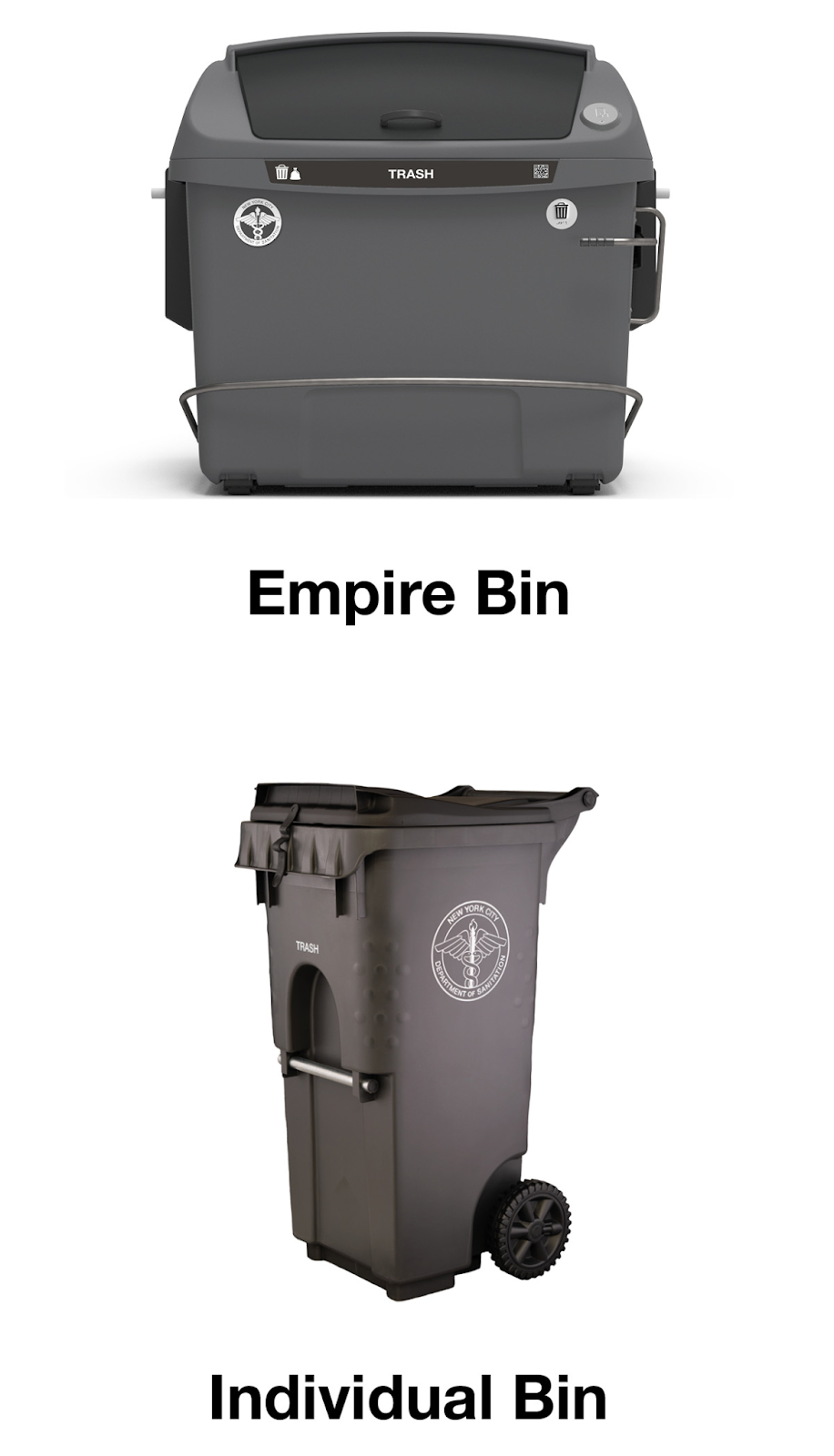
Similar rules are planned for residences of 10+ units, which will also be required to use official trash bins, though they will have more flexibility on which version of the bins they use5. In addition to the 1-9 residential unit properties, the DSNY has mandated that “City agencies, nonprofits, houses of worship, and professional offices in residential buildings are also required to use NYC Bins.” Properties that do not comply with the bin regulations have faced fines ranging from $50 to $200 per offense since January 3, 2025.
The bins themselves are the creation of an extensive study contracted by the DSNY to design European-style trash bins that are rat-resistant, cheap to purchase, and compatible with the new DSNY waste management vehicles. As stated by the DSNY:
“Empire Bins can hold approximately four cubic yards of waste, or 793 gallons. This is about 25 large 32-gallon trash bags or 61 small 13-gallon kitchen trash bags.”
Expect to see these “NYC bins” very frequently, as “residential properties in New York City with ten or more units represent 59% of all residential units”6. For more information on what determined the exact design, material, and sizing of these bins, I highly recommend reading through the DSNY’s RFP, which dives deep into every requirement and reasoning regarding the containers.
A Major Milestone: 100% Containerization in Hamilton Heights
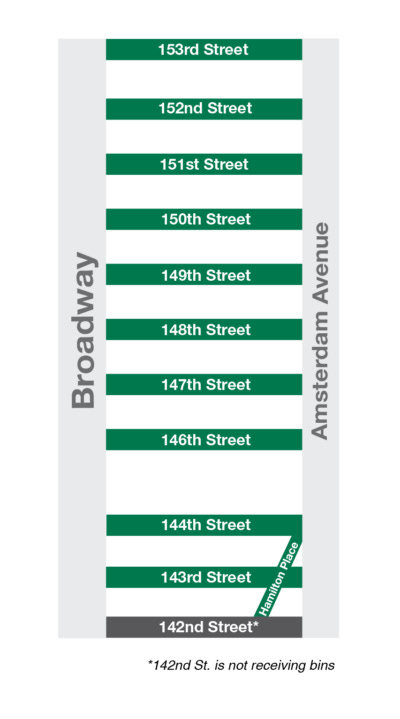
Finally, as of June 1, 2025, Manhattan Community Board 9 was the first to fully implement this containerization program. All properties in CB9 with 1-9 residential units must have their trash in some container with a secured lid; properties with 10-30 units may choose between the above Empire Bins or Individual Bins, and properties with 31+ units must use the Empire Bins. This pilot program will continue until May 31, 2026, after which the results of the pilot will determine when and how the container rules will roll out to other neighborhoods
Have we entered a new era for trash in NYC?
One area of backlash has already begun: Empire Bins are required to sit curbside, reducing the available street parking in the district. For the 10-block area of Hamilton Heights where the pilot has begun, 1,100 official bins have been placed on the streets. Despite the DSNY claiming the bins occupy less than 5% of available parking, residents have made numerous complaints.
According to the DSNY, approximately 19,700 buildings with 1,731,000 units citywide will be required to use the Empire Bins, with another approximately 23,700 buildings with 410,000 units citywide required to use either the Empire Bins or Individual Bins. That’s a whole lot of units placing a whole lot of bins on the street, many in neighborhoods where wars have long been waged over parking spots and other uses of the curbside space
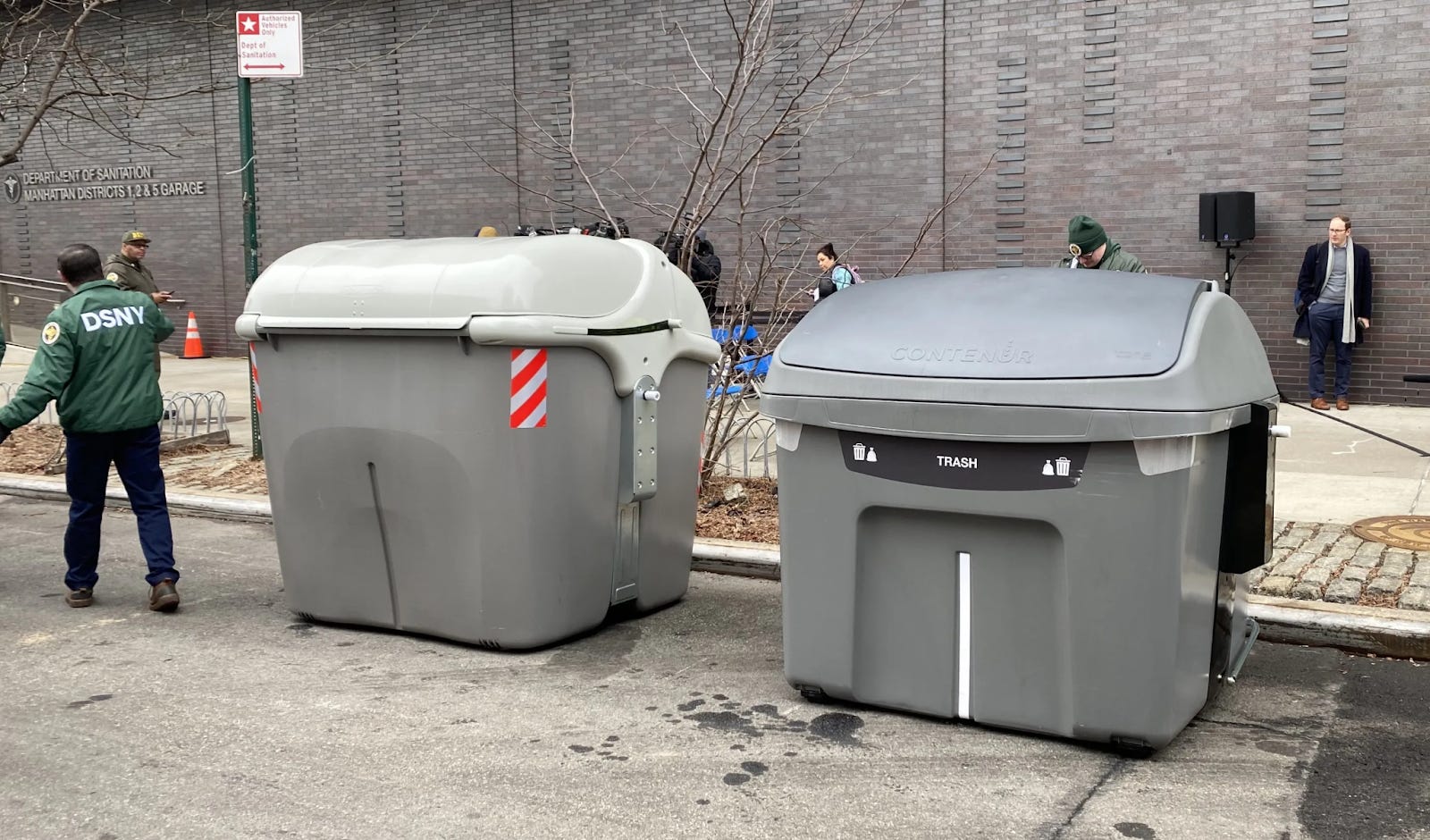
As the program continues to roll out on a larger scale, how residents and businesses will react to the reduced parking space will factor into the bins’ popularity and success. If residents insist on double-parking next to bins or fight the placement of such bins entirely, the DSNY’s trucks will be unable to effectively remove trash from the streets.
Rolling out the program on a citywide scale will also be expensive, with costs for new garbage trucks and bins potentially running into the hundreds of millions. If public backlash to the bins grows or a new mayoral administration takes control with less confidence in the program, the container requirements could be weakened or scrapped altogether.
Lastly, there are some limits to the bins that could diminish the overall impact of the containerization program on cleaning the streets. Residents and tourists may litter on the streets, providing enough fodder for rats and bugs to persist. Recycling is exempt from containerization and may continue to be placed on curbs in clear bags, as are items too large to fit in the bins, such as mattresses or furniture. In theory, these are all objects that should not attract rats or release odious smells, but the existence of any exceptions allows for possible abuses.
Still, there is much reason for hope. According to the Office of the Mayor,
“Since residential container requirements first went into effect six months ago, the number of rat sightings reported to 311 — when compared to the same month 12 months prior — has dropped.”
Additional funding has also been designated in the FY26 budget to the DSNY to support further initiatives like expanding wastebasket pick-up efforts and resourcing for more sanitation worker shifts. And most of the candidates leading in the polling for the upcoming mayoral race have voiced support for continuing the containerization program.
Further results of the containerization program will take time to be measured, but if the city can persist and residents are willing to sacrifice a small percentage of their parking spots for cleaner streets, improvement may be on the horizon.
This is the neighborhood corresponding to Sanitation District Manhattan 09.
Initially named the Department of Street Cleaning.
DSNY is offering these official bins for purchase over at https://www.bins.nyc/, where Individual Bins ranging from 25-45 gallons cost between $40-53.
And perhaps some green and blue bins as well, though not part of the DSNY’s new rules: “While the requirements of this new rule only cover trash and compostable material, matching green (paper) and blue (metal, glass, plastic, cartons) NYC Bins are also available for purchase for any property owner or manager who prefers a matched set”. https://www.nyc.gov/office-of-the-mayor/news/530-24/mayor-adams-sanitation-commissioner-tisch-first-ever-official-nyc-bin-trash-pick-up-#/0
Specifically, residential properties with 10-30 units can choose between use Individual Bins or Empire Bins. Properties with 31+ units will be required to use the Empire Bins.
Page 6 of DSNY’s RFP for the NYC bins provides this statistic, along with the fact 14 million pounds of waste are produced daily by these units! https://www.nyc.gov/assets/dsny/downloads/about/vendor-opportunities/rfp/stationary-on-street-containers-rfp-030824.pdf
awesome write up 🔥
Looking forward to full containerization to arrive in my neighborhood! I guess we’ll just have to wait until the pilot concludes…