


Today, we pay little attention to where our water comes from. Most New Yorkers take for granted our abundant supply of drinking water, besides misattributing it to the taste it gives our bagels. But for the first few centuries of New York’s existence, providing water safe for mass consumption was a massive struggle. Cholera and other disease outbreaks related to contaminated water were a regular feature in the city, claiming thousands of lives and leading to an exodus whenever new epidemics broke out.
The Croton Aqueduct was a paradigm shift, bringing a steady and safe supply of drinking water to New Yorkers and addressing the health crises that once defined life in the city. It is perhaps the most impressive infrastructure achievement of 19th-century New York City, a massive infrastructure project of a scale rarely seen at the time, and is perhaps topped only by the state’s Erie Canal project.
On a Sunday in November, I learned the full breadth of the aqueduct’s story while on a tour with Keith Taillon of @keithyorkcity, tracing its path from High Bridge down through Manhattan to Central Park. Below, I walk through how the City and State managed to build it despite the technological and administrative limitations of the era, what it delivered for a still-unestablished but quickly rising New York metropolis, and why our City and State governments need to take more big swings on public infrastructure projects like the Croton Aqueduct today.
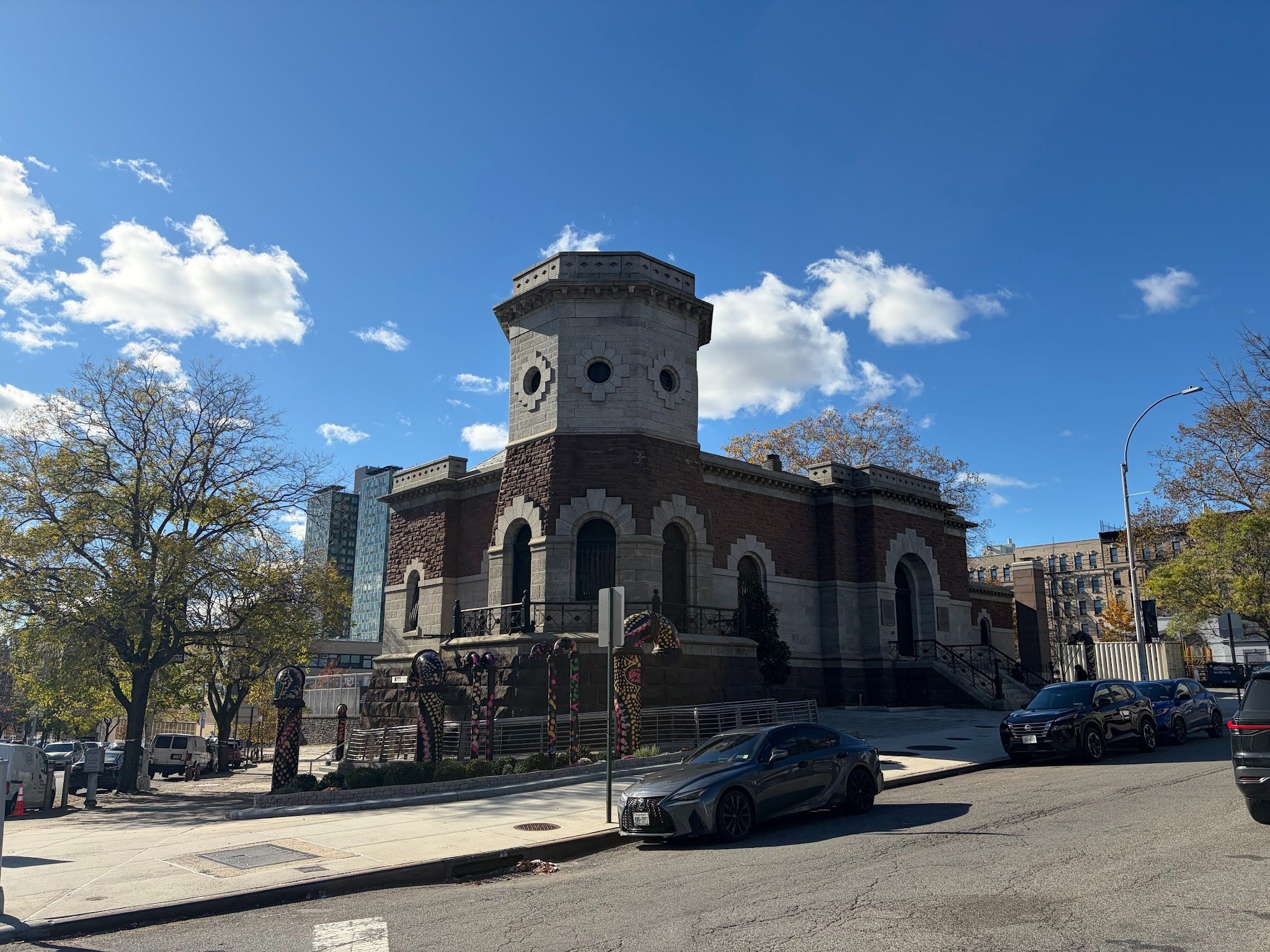
1. Before Croton, New York did not have enough clean water
Despite being an island entirely surrounded by bodies of water, all the water that surrounds Manhattan is brackish and can’t be drunk. Manhattan residents were instead forced to rely on local wells and unimpressive local streams for their drinking water.
As a result, at the turn of the century, New York was notorious for its lack of a clean water supply. While this always presented issues for the city’s residents, the resulting problems were kicked into overdrive beginning in the 1830s.
This is because of the opening of the Erie Canal in 1825 and the subsequent massive flow of trade and commerce the canal brought through New York’s harbor. The new business of transporting, buying and selling, and processing all the goods flowing between America’s interior and the Atlantic brought more than just wealth and opportunity to the city’s shores.
New York began being struck by worsening cholera epidemics, starting in July 1832. That year’s epidemic killed 3,500 people, or nearly 2% of New York’s total population at the time. Stopping these epidemics by building a clean water source to alleviate the suffering became a powerful incentive.
Fighting fires was another major motivation. When the city had to fight the Great Fire of December 1835, which started on Merchant Street and spread to Pearl Street, it also ran out of water to fight said fire, as the water froze in the hydrants. That fire would go on to burn 570 buildings, destroying a significant portion of Wall Street.
2. The City and State decided to build it, and voters approved it
To address these public crises, the City commissioned the Croton Aqueduct to bring a fresh water supply into Manhattan. The State Legislature authorized it in 1834, and city voters approved it in April 1835. The vote passed by a count of 17,330 to 6,963 – margins reminiscent of the recent Charter Revision Commission’s proposals, a connection we will return to shortly. The City would pay for the new aqueduct by issuing bonds, called the “Water Stock of the City of New York.”
Two men designed the Croton Aqueduct system: David Bates Douglass, who surveyed the route, and John B. Jervis, who replaced him as chief engineer in 1836 and finished the design. There’s some juicy historical drama behind this transition mid-project that we won’t get into here, but it is recommended reading.
The laborers who built the system were mostly Irish, who also composed a large portion of the overall labor force at the time. Close to 4,000 immigrants started work on the aqueduct in 1837, an unprecedented municipal project at a time when horses were still relied on for transportation, and Manhattan had barely been developed above Houston Street.
3. A 41-mile gravity aqueduct brought water into the city in 1842
The Croton Aqueduct is 41 miles of Roman-style aqueduct, with water being pulled from the upstate source to Manhattan almost entirely by gravity. It took 22 hours for water to leave the reservoirs and enter the city over that 41-mile journey. In Upper Manhattan, tons of rock had to be blasted to make a flatter route for the water to maintain a consistent gradient of 13 inches per mile, required to prevent freezing and other issues.
The last piece of the aqueduct to be constructed was High Bridge, located on the eastern cliff of Washington Heights. It is in this location that the Harlem River valley creates a precipitous dip and then rises in the landscape, necessitating a span to be built over the valley. This is also where the water from upstate enters Manhattan. The aqueduct system was turned on in 1842, although High Bridge itself wasn’t completed until 1848 (in the meantime, the water crossed the river in temporary pipes laid on a cofferdam at water level).
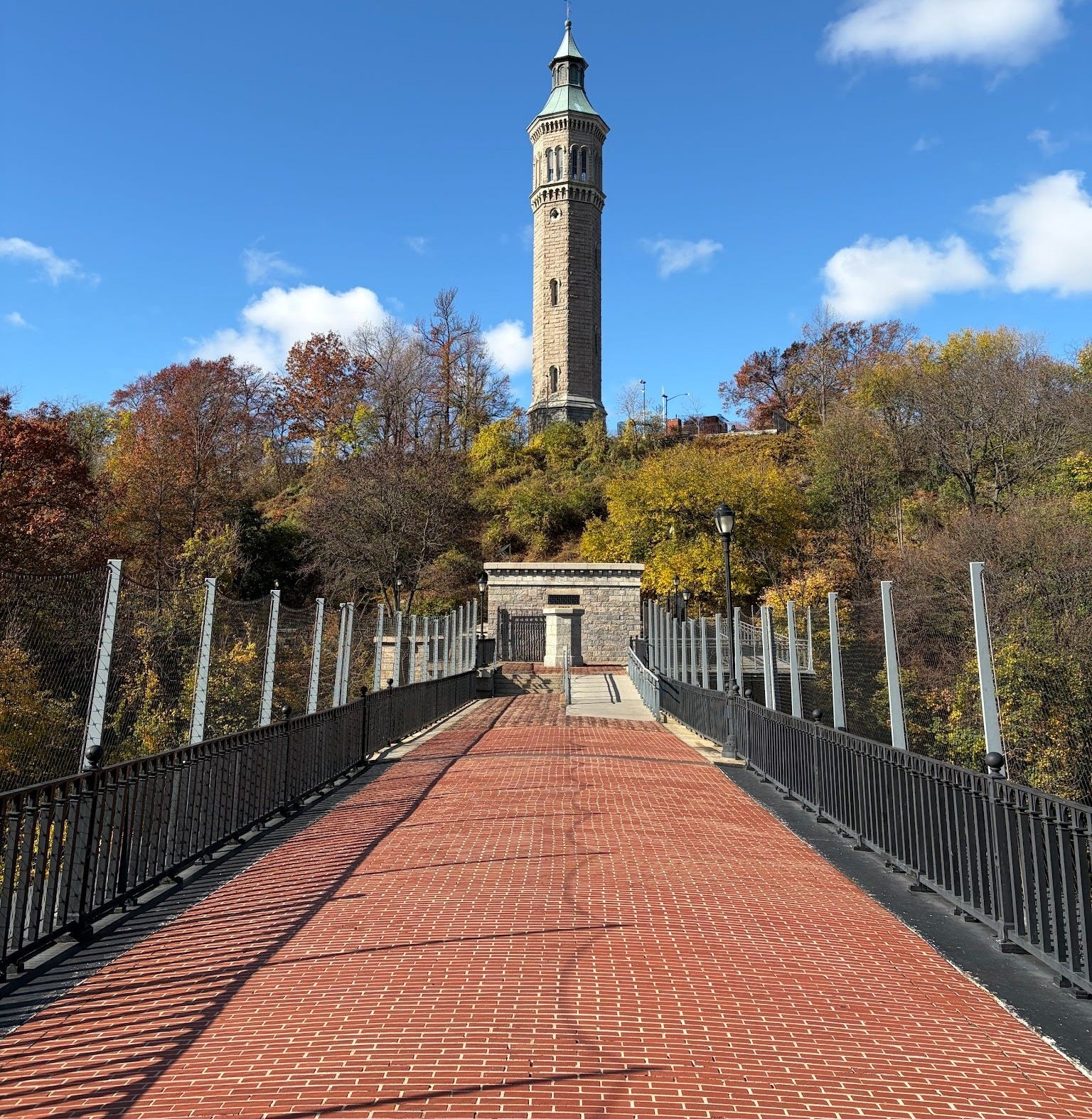
The collecting reservoir that all the aqueduct’s water arrived at was originally located in an area of New York with virtually no development. The water collected in two basins stretching from 79th to 86th Street, which together held approximately 150 million imperial gallons. From there, water was further distributed to the distributing reservoir on Fifth Avenue between 40th and 42nd Street – today, the location of the New York Public Library’s famous Stephen A. Schwarzman Building, and Bryant Park.
The 1834 act authorized $2.5 million for the construction of the Croton Aqueduct system. By 1843, the City had spent over $11 million (or about $500 million in today’s prices), including the creation of pipes in the city to carry the water to households and businesses.
4. Abundant water let New York grow and kept it safe
With the opening of the aqueduct, New York went from being notorious for having one of the worst and dirtiest water systems in the world to one of the best, cleanest, and most abundant supplies of drinking water. Crucially, the aqueduct made the many technological, financial, and scientific innovations to occur in New York possible by ending the water shortages contributing to its epidemics and the destruction from fire that had plagued the city. It enabled the growth of the city and safety for its population.
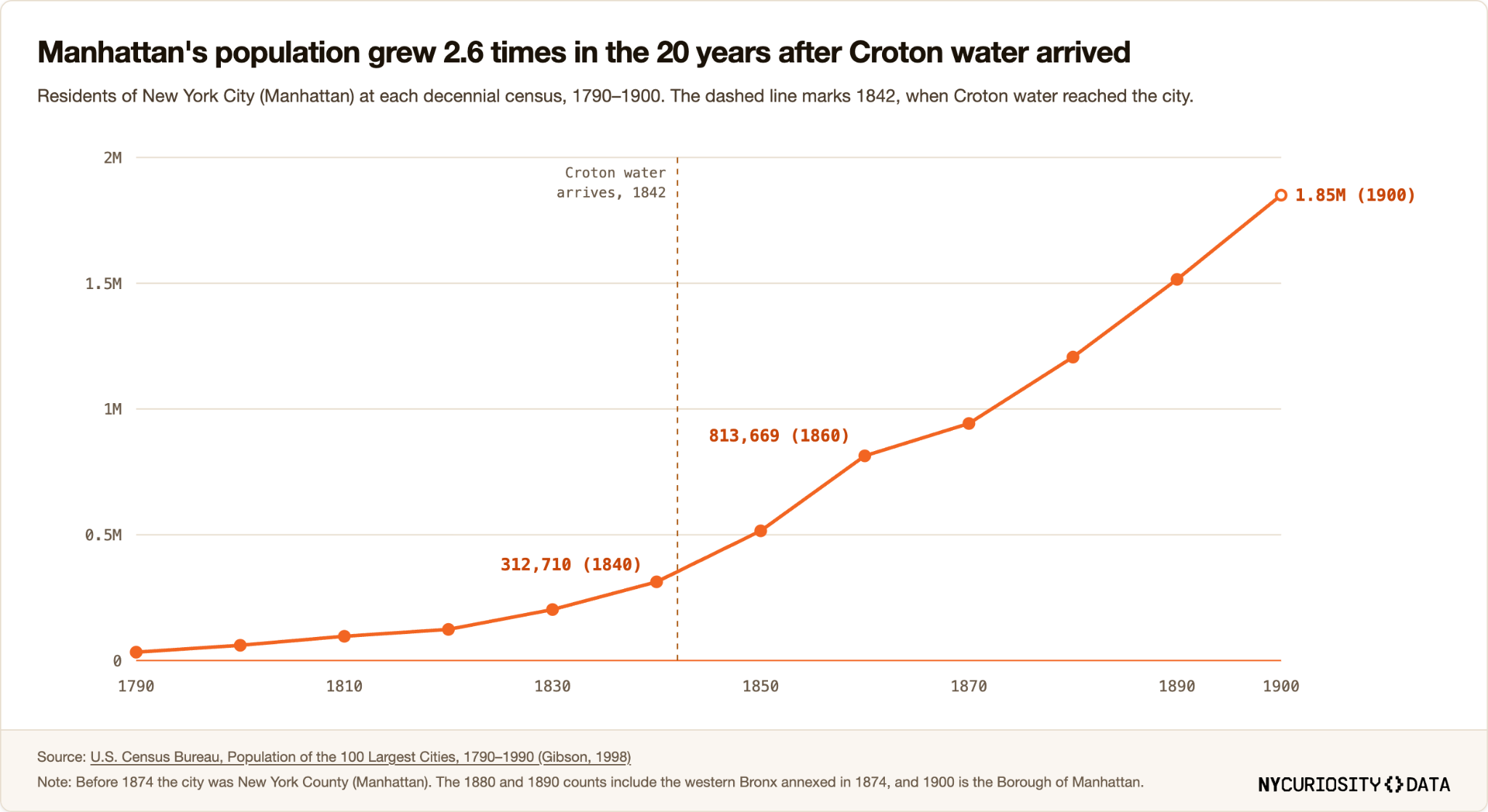
New York had 312,000 residents in 1840 and 813,000 in 1860, while daily water use rose from 12 million gallons in 1842 to 145 million by 1890. While new waves of cholera returned in subsequent decades (it would take the Metropolitan Board of Health, created in 1866, and the sewers that followed to finish the job), it is generally agreed that the clean water of the aqueduct saved many lives and began the process of creating a cleaner, safer city.
5. The aqueduct shaped uptown Manhattan and Central Park
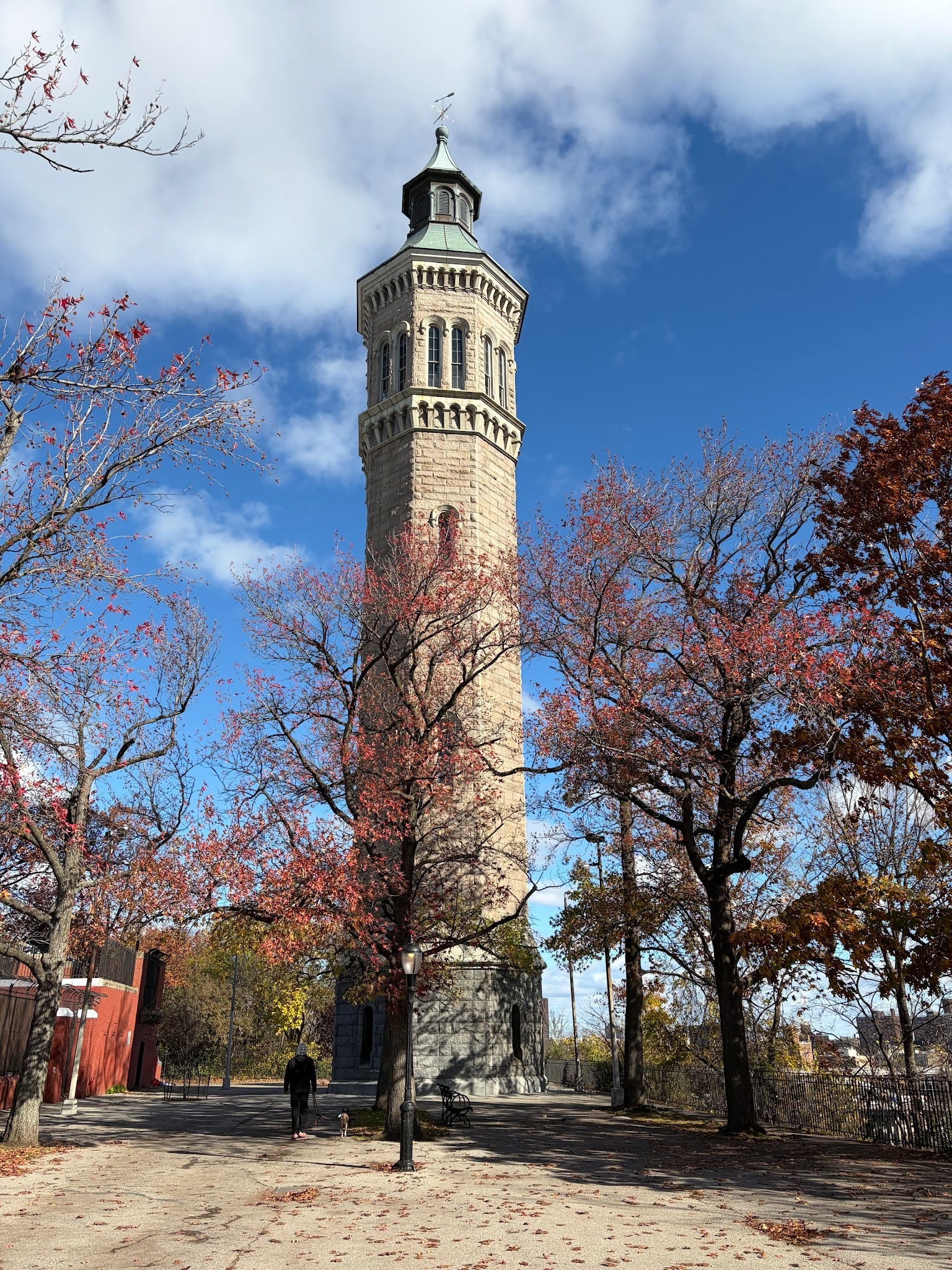
As the city grew north, the High Bridge Water Tower was built between 1866 and 1872 to pump up water from High Bridge and provide it to residents who now lived in this uptown part of Manhattan. High Bridge is the oldest surviving major bridge in the city and has only ever been open to pedestrian traffic.
Frederick Law Olmsted, the genius behind Central Park, had to plan around the reservoir in his design of the park, along with the new, larger reservoir built from 1858 to 1862 (now called the Jacqueline Kennedy Onassis Reservoir. During the Great Depression, the old basins were finally filled in and replaced by the present-day Great Lawn, completed in 1937.
In 1890, a new aqueduct system called the New Croton Aqueduct, almost three times the size of the old one, was built that largely superseded Croton. This was followed by the Catskill system in 1927 and the Delaware system in 1965, bringing ever larger supplies of clean water to an ever larger New York. In 1955, the Croton Aqueduct ceased to be used altogether.
6. Today’s big swings are too rare and take too long
Croton took 8 years from the 1834 act that authorized it to bring water to the city’s population. Meanwhile, a more recent project named Water Tunnel No. 3 began in 1970, and its Brooklyn-Queens shafts are due in 2032. That’s right: 56 years so far, and the project has not yet been completed. Second Avenue Subway Phase 1, a transit project arguably on a smaller scale than the Croton Aqueduct was in its era, opened in 2017 at a cost of $4.5 billion for 1.8 miles of track. The Gateway Hudson Tunnel, another major transit infrastructure project, is projected to be completed in 2035 for a cost of $16.1 billion.
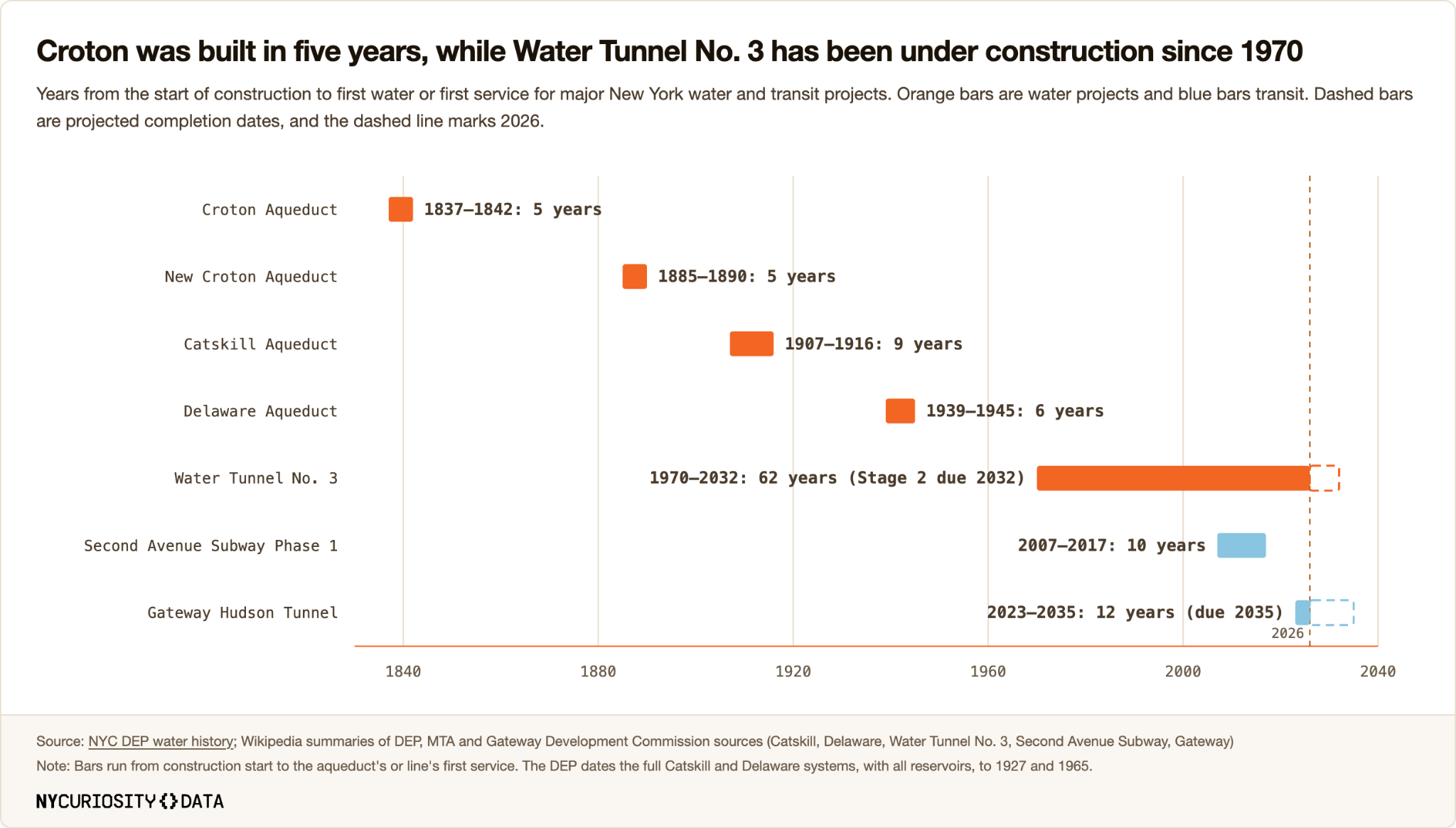
New York’s major public works projects have become too few, and when they do occur, they take much too long to construct and are too expensive. The Transit Costs Project does an excellent job of covering why New York’s costs have become so inflated. In my post on the IBX transit project, which itself is a rare and hopeful exception to the state’s typical cost-per-mile construction, I highlight how expensive other transit infrastructure projects have become.

Despite these high costs, which require an entirely separate post to cover, New York must continue to initiate and fund new public infrastructure on the scale of the Croton Aqueduct if it wishes to continue growing and maintain its status as a world-class city. So what can be done?
Charter revision commissions could put big projects to voters, the way Croton was. A charter revision commission can put any charter amendment to voters (Municipal Home Rule Law §36), so a more ambitious commission could ask voters to commit the City to a transit-expansion program, value capture districts or an EDC-style capital authority. The money itself, of course, still needs cooperation from Albany: the City’s borrowing is capped at 10% of its taxable property value by the State Constitution, and State borrowing already requires a public vote.
In the case of new transit infrastructure, the City already has the tools it needs to fund the work: it can use the State-authorized value capture tools to fund them. General Municipal Law §119-r lets the City create transit capital project districts and use tax-increment financing, special assessments or land value taxation, though that authority expires in April 2027 unless Albany renews it (it has been extended once already). The 7 train extension to Hudson Yards and Croton’s own Water Stock provide another possibility: use city-issued bonds to fund capital construction.
Building new subway lines and paying for them with the value they create can be achieved today, with existing authorities and permissions. In other areas of infrastructure, new rules and tools may need to be created.
But here we are in a moment of incredible political opportunity. Voters in both New York and nationally have delivered a clear mandate to politicians in the most recent election that the affordability crisis must be tackled, and quickly. Americans, and New Yorkers in particular, are struggling with an ever-higher cost of living driven in part by housing costs and scarcity in our national supply chain.
The answer to voters’ demands can and should be public projects of a scale similar to what the Croton Aqueduct was for the city and state two centuries ago. We need bold action and a rethinking of how the government currently operates public projects and processes to deliver a much greater supply of housing, transit, and energy. To do so will require government on all levels – local, state, and federal – to support and, in some cases, personally drive new levels of infrastructure at speeds not seen in decades or centuries.
Lastly, I cannot recommend Keith Taillon’s walking tours enough; for those interested in history or how New York came to look the way it does today, it is worth every penny.
Recommended Reading
I Walked Manhattan From Top To Bottom In A Day. Here’s What I Learned.

Last weekend, my girlfriend and I decided to walk Manhattan from its very north at Inwood Hill Park to its southern tip at the Battery. We’d seen several other friends do the journey - typically going down the western side of the island - and thought it would be a great way to explore more of the city. Particularly the upper Manhattan neighborhoods that…
New York Needs to Grow

New York City may be in its most pro-building era since the passage of the reigning zoning resolution in 1961.
The Interborough Express Might Be NYC’s Best Transit Investment in Decades

The Interborough Express (IBX) could be one of the most impactful transportation projects in NYC of the past several decades. The first new subway line, rather than an extension of an existing line, since the 1930s. The only line, besides the G, that would not connect to Manhattan, but would rather serve Brooklyn-Queens commuters.