


In all of Manhattan, and particularly in NYC’s Congestion Relief Zone (CRZ) which amounts to the area of Lower Manhattan below 60th Street, the city should charge a fee for every single street (curbside) parking spot.
This is some of the most valuable land in the world, in which businesses and residents pay an incredibly high premium to be located. Street space is extremely limited, with sidewalks and roads being contested by storefronts, pedestrians, cyclists, cars, and sidewalk cafes, among other things. In any other city - see LA or Chicago or SF - every parking spot would be metered and charged by the hour, particularly for the high-demand times. In recent years, these cities have even rolled out resident parking permit programs to reserve the limited space for locals. In New York City, no such permit program exists, and most curbside parking remains free.
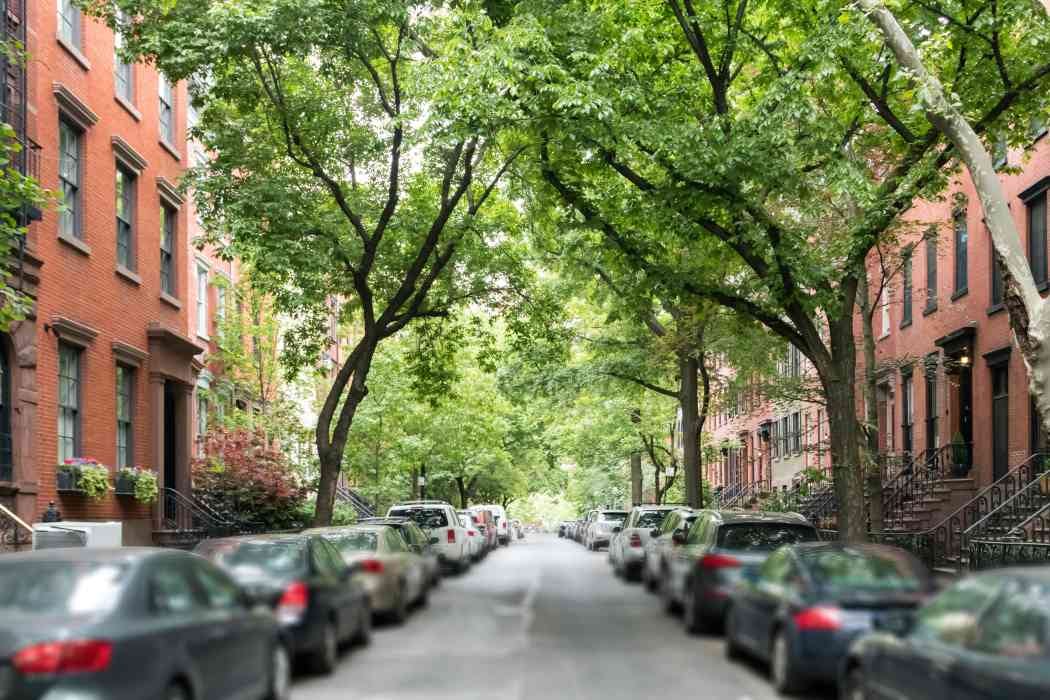
The Benefits of On-Street Parking Fees
The potential revenue from street parking fees - either through a permit program or parking meters - could be used to further pay for public transit improvements, run more trains and buses, and myriad other infrastructure improvements and city services that would improve life for all residents, car-free or not. Charging for street parking may even eliminate such parking in some cases, reducing pollution from cars that circle the block looking for spots and freeing up more space for residents to expand their pedestrian and cyclist sidewalk access. This creates more livable and walkable streets for both residents and visitors. Less space devoted to parking could also mean more space devoted to housing, businesses, restaurants, and parks.
So much of the City’s curb space being dominated by parked cars also interferes with the essential functioning of the city and the quality of life of its residents. Parked cars and parking spaces are currently a major blocker of universal daylighting, leading to increased accidents and pedestrian casualties. Unless street parking is taken back by the City, programs like the trash bin pilot cannot be rolled out on a wider scale and will be unsuccessful in cleaning up the streets.
As a report from the Department of Sanitation in April 2023 states,
“In total, the City allocates 80% of all available curb space to on-street parking, and a combined area equivalent to 12 Central Parks. Around half of these spaces, or 1.5 million total, are on residential streets that would be affected by containerization.”
For the concern of residents who rely on cars to get around (such as the elderly or disabled), the city can provide subsidized or even free on-street parking permits. This would effectively shift the burden of parking fees to commuters (i.e., non-residents) and those who choose to drive for the convenience and are therefore more willing to pay for the pleasure, a similar concept to the successful and increasingly popular congestion pricing fee.
In a 2019 City Council Committee on Transportation hearing, DOT Commissioner Polly Trottenberg claimed that NYC had 3 million street parking spots1. A report by the City Comptroller at the time found that of all those parking spaces, only 85,000 were metered2 - the rest being free. From just this small selection of metered parking spaces, however, NYC collected “approximately $214 million in parking meter revenues in Fiscal Year 2017 and $228 million in Fiscal Year 2018”.
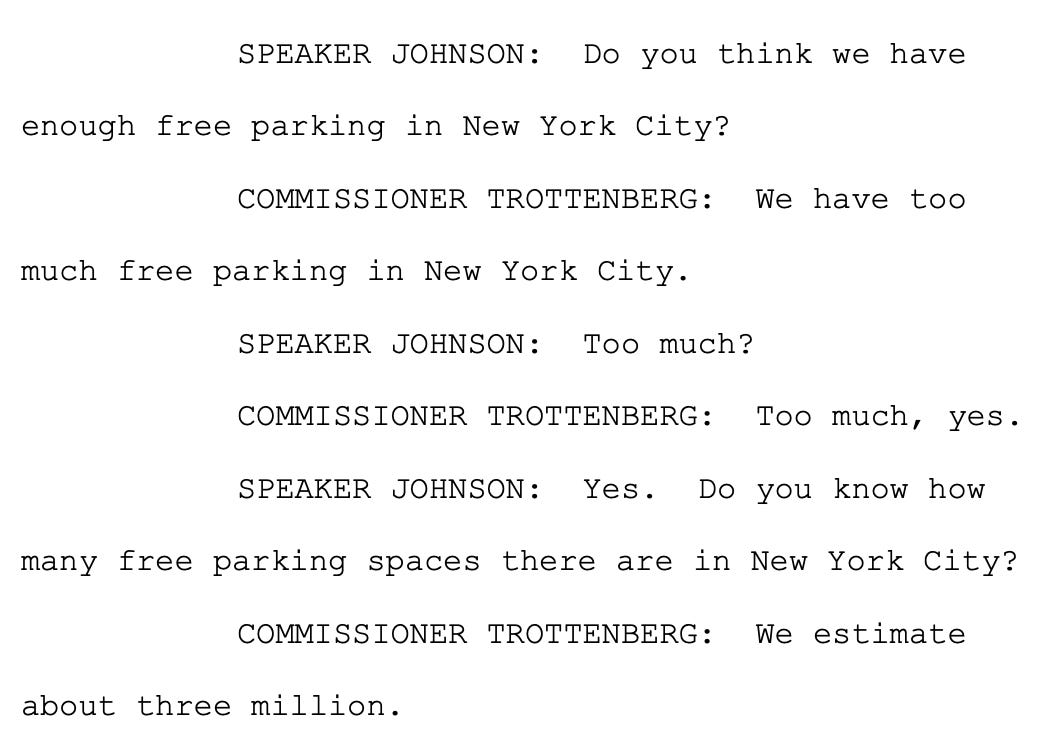
If the city required a parking permit for all those free spaces citywide, and charged $200 per year for such a permit (which would fall right around the middle of the monthly fee other major cities currently charge), that would instantly be $600 million in yearly revenue3. There would be some costs associated too - additional traffic cops to look for permit tags while out on patrol, administrative overhead to manage the program - but it’s hard to imagine those costs coming anywhere remotely close to the revenue. Assuming that only half of the parking spots are issued permits, and administrative costs equal a quarter of the revenue brought in, this program could still bring in $225 million annually.
Restricting parking charges to just Manhattan or the Manhattan CRZ would still incur significant revenue for the city. Some estimates put the number of free curbside parking spots in Manhattan itself at around 190,000. Using the above numbers, if the city metered every one of those spaces, it would bring in around $478 million in annual revenue4.
If the city instead proceeded with a parking permit program of $200 per year, providing as many permits as there are free curbside parking spots would generate around $38 million in annual revenue5. Given that a comprehensive program would include a mix of residential parking permits and meters in business corridors, we can assume the true annual revenue would land somewhere between the estimates.
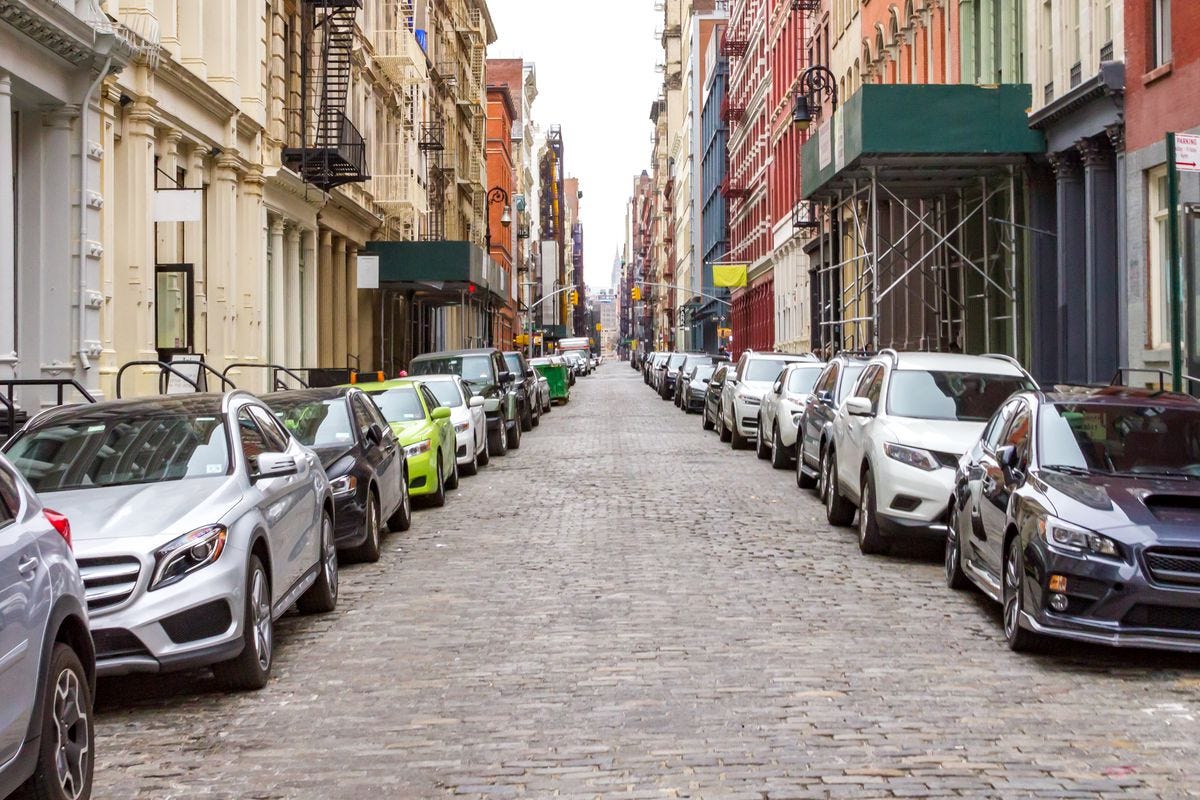
Another way to look at it is that in the location of some of the world’s most valuable real estate, there is a lot of space being given out for free. The median asking price per square foot for homes in Manhattan in January 2022 was $1,612. The NYC Zoning Resolution defines the minimum parking space as 200 square feet. Applying this value to the street parking sitting right in front of these properties, the value of all these Manhattan free parking spaces comes out to around $61 billion6. Of course, empty curbspace would not demand the same price per square foot as built homes, nor could all streetspace be turned into housing. But even imagining that just 5% of the parking spots could be converted into homes, this amounts to $3 billion worth of land being given by the city, for free, to idle cars sitting empty.
As DOT Commissioner Trottenberg said herself in that 2019 City Council hearing (page 56), “There is no question that our curb is very underpriced”.
Free Parking Outpaces Resident Demand
According to a report from Hunter Urban, between 2018-2022 only 22% of households in Manhattan owned a car. Similarly, a 2011 report from the Department of City Planning Transportation Division found that “Approximately 23 percent of Manhattan Core [the Manhattan CRZ] households own a car (compared with 46 percent Citywide), and only about one-fifth of those households commute to work by car.”
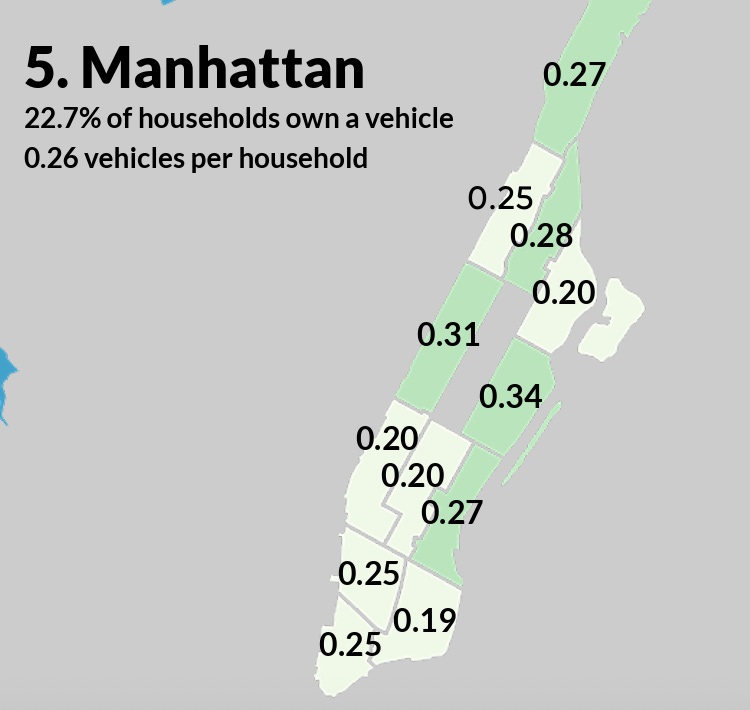
So to start with, most Manhattan residents do not need street parking. Among those who do own cars, average income is also about twice as high. Charging these car owners for street parking would thus only affect a minority of residents, and would be targeted at higher-earning residents if at all. Meanwhile, it is the taxes of all residents who are paying for the maintenance of the streets in which these cars sit idle.
The rest of the charges would be applied to non-residents, who are driving into Manhattan neighborhoods and contributing to roadway congestion, pollution, noise, and other negative externalities for locals. There are currently more free parking spots (3 million) than NYC registered cars (2.2 million). This either means that NYC residents have registered their cars in other locations - depriving the City of its rightful registration fees - or that a significant portion of the parking spaces are utilized by commuters from other cities/states.
Applying a fee for such behaviors, through metered parking, could have the dual effect of reducing the harmful consequences of non-resident vehicle miles traveled and raising funds to offset the effects among those who choose to pay the fee to park. Alternatively, a residents-only parking permit program could similarly raise funds from those who actually use the roads while also providing residents priority over the space in front of their homes. A parking permit program could actually improve life for local car-owners by reducing time wasted circling the block to look for an open spot. This would also result in the downstream effects of improving air quality and reducing traffic congestion.
Prior Attempts to Establish A Parking Program
Manhattan Community Board 7’s transportation committee broached the topic of charging for curbside parking in 2019 and received, as expected, significant pushback, but also found key supporters. A resolution was passed in favor of ending free parking and implementing a combined system of residential permits and meters with surge pricing, but the effort went no further.
Following the success of congestion pricing, Manhattan Borough President Mark Levine and Councilmember Carmen De La Rosa pushed for the City Council to pass legislation introduced in 2024 that would require parking permits in Manhattan north of 60th Street. One motivation for this renewed effort is to counteract potential commuters who may attempt to drive into Upper Manhattan and then park north of the CRZ to avoid paying the congestion fee. The City Council bill follows an earlier bill introduced in the NY State Senate in 2023 to create a parking permit program charging residents $30 per month.
“The Senate bill would allow New York City to begin charging for street parking, but not on blocks zoned for commercial or retail use, or where there are already metered parking spaces…Lawmakers estimated it could’ve generated $400 million a year, all of which would have been used to fund the MTA.”.
Despite receiving widespread support from both NYC residents and transportation experts, the legislation has not moved forward. Some critics have pointed out that enforcement would not be easy. Certainly, it would take some work to set up the appropriate permitting system, process applications, and hire or train traffic cops to look for permits on parked cars. But if nearly every other major city can do it, why can’t New York? It begins to sound like the excuse for the city’s garbage bin problem, for which the success of the ongoing pilot program has shown to be a flimsy one.
Another potential alternative to charging for street parking universally is to charge only for spots within a certain radius of public transit. While I believe that most of Manhattan would already fall under the definition of being a transit-served area, exemptions could be carved out for certain neighborhoods that are relatively transit deserts. This would enable residents who require cars to continue using their vehicles at the same cost, while areas that have transit options can better optimize their space. It would also incentivize residents in transit-served areas to utilize the public transit options, bringing in more revenue.
Given the low rates of car ownership in such neighborhoods, demand for parking is already quite low and not an optimal use of street space. The bill introduced by the State Senate may result in a mix of free and permitted on-street parking zones, since it gives each City Councilmember the power to decide whether parking permits would be required in their district or not. However, given the relatively high level of public transit throughout Lower Manhattan and the opportunity cost of using Manhattan land for street parking, I would still prefer a universal fee for parking across the entire CRZ.
Conclusion
Given how many New Yorkers do not own cars, and how many are affected by the cars passing through their neighborhoods, one begins to question why we should have street parking throughout most of Manhattan. Paris recently banned cars from 500 streets in its core, and found profound improvements in the livability of those streets. Barcelona’s superblocks have been universally praised as models of urban renewal. The conversion of the section of Broadway above 14th Street into a car-free avenue has brought street cafes to life and opened space for pedestrian traffic. And the growing popularity and success of Open Streets proves there is significant demand for taking back street space from cars. My preference would be to one day achieve a car-free Manhattan, with the streets devoted to pedestrians, cyclists, parks, and cafes above all else.
Until that day comes, it is common sense to at least charge the cars that dominate the streets today for their usage of them, even (and especially) when sitting parked and empty. Increasing the cost of driving a car through Manhattan will reduce usage of such cars, leading to improved air quality, traffic conditions, and pedestrian safety. The implementation of a residential parking permit program would provide an equitable solution that prioritizes residents’ needs and improves their quality of life as well, by reducing out-of-town traffic and reserving space for locals. Concurrently, expanding metered parking would further boost DOT revenue and provide funding for street improvements.
I highly encourage DOT to pursue both efforts, perhaps beginning with a pilot permit program to test initial effects and gather public feedback. The playbook offered by the Parking Reform Network for setting up a Parking Benefit District would be another option for designing an equitable transition to end free on-street parking7.
It is a topic for another article, but a natural extension of charging for parking is to also eliminate parking requirements in new housing developments. NYC began this process through the passage of City of Yes, which eliminated parking minimums in Manhattan below 96th Street. This is a great start, but parking minimums should be removed for the rest of the city as well, especially in the rest of Manhattan. All the reasons listed above for why street parking should not be free, and all the benefits from fewer street parking spots, such as more space for housing and less traffic and pollution, apply to removing parking minimums as well. Cities that have already done so, like Chicago, have also shown an increase in the number of units per building. The common thread between the two is the prioritization of people and people-oriented space over cars. In a space like Manhattan, with its extensive public transit network and majority non-car-owning residents, putting people first is a no-brainer.
And to end things on a lighter note:
I've tried to track down the specific DOT internal study that formulated this number. Despite finding this claim repeated in the NYTimes and other publications (including official reports by City agencies), I have been unable to track down the specific source/evidence past the hearing transcript in which Commissioner Trottenberg cites the 3 million number. If anyone is aware of where the DOT study is located or a source for the number, please send it my way! In the meantime, I have submitted a FOIL request to NYC DOT for the study and await a response.
The NYC OpenData portal has a map and table of parking meters maintained by DOT. This table, which is updated daily, lists 15,554 meters, of which 2,460 (or 15%) are currently inactive. Therefore this estimate of metered spaces and revenue per metered space is likely an undercount.
https://data.cityofnewyork.us/Transportation/Parking-Meters-Locations-and-Status/693u-uax6/about_data
$200 per year * 3 million free parking spots
This is using the $214 million in fiscal year 2017 parking meter revenues. I then multiply this number by the proportion of meters that could be added to free Manhattan street parking spaces - 190,000/85,000 - to generate this estimated revenue. Note that this was a dip in revenue compared to other years, and given inflation since 2017, the number would likely be even higher today.
My math here involved taking the 190,000 free spots and multiplying by $200 per year.
The math here is 190,000 free parking spots * 200 square feet per spot * $1,612 median PPF in Manhattan
Thank you Neil Miller for bringing this resource to my attention!
Where I live on the UWS, the monthly garage parking pushes $20-$25k annually. I don't know who can afford that, but apparently too many people.
I think an annual residential parking pass is more than 1% of the value of a garage spot, why not auction them off, could probably get like $1500 per pass around here
Manhattan always seems to be caught between it's identity as a place 1.6 million people live and it's role as a hub of business and commerce (and often just seems to forget it's a place people live.) Having so much of the streets designated for parking instead of larger side walks or greenery is clearly supposed to support those who don't actually live there. I think finding ways to charge non-Manhattanites for their disproportionate use of the space when they might not be paying city income taxes feels like both sound policy to maximize use the space, but also spread the tax base more equitably among all users.