


Thank you to Sebastian Hallum Clarke, a member of Manhattan Community Board 8, for his contributions to the ideas in this article.
The need for [Community Board] representation remains clear, although the boards’ functioning, as with many government agencies, has struggled to adapt in the 21st century.
At a recent meeting of Manhattan Community Board 3, we received some exciting news: the NYC Civic Engagement Commission (CEC) announced it was studying, in partnership with the National Civic League and Perfect City, how it can “help the community improve how public meetings are experienced by residents, elected officials, and municipal staff”.
While the CEC’s work will cover more than community boards, the impact on local governance through improving community board operations in particular has immense potential for public perceptions of government effectiveness. Community boards (CBs) are the base layer of local government in New York, intended to be a primary conduit for neighborhoods to communicate with City agencies and elected officials and vice versa.
Acting as this neighborhood-government connector, CBs are a key actor in bringing community concerns to the attention of those in power and in acting as the voice of the community.
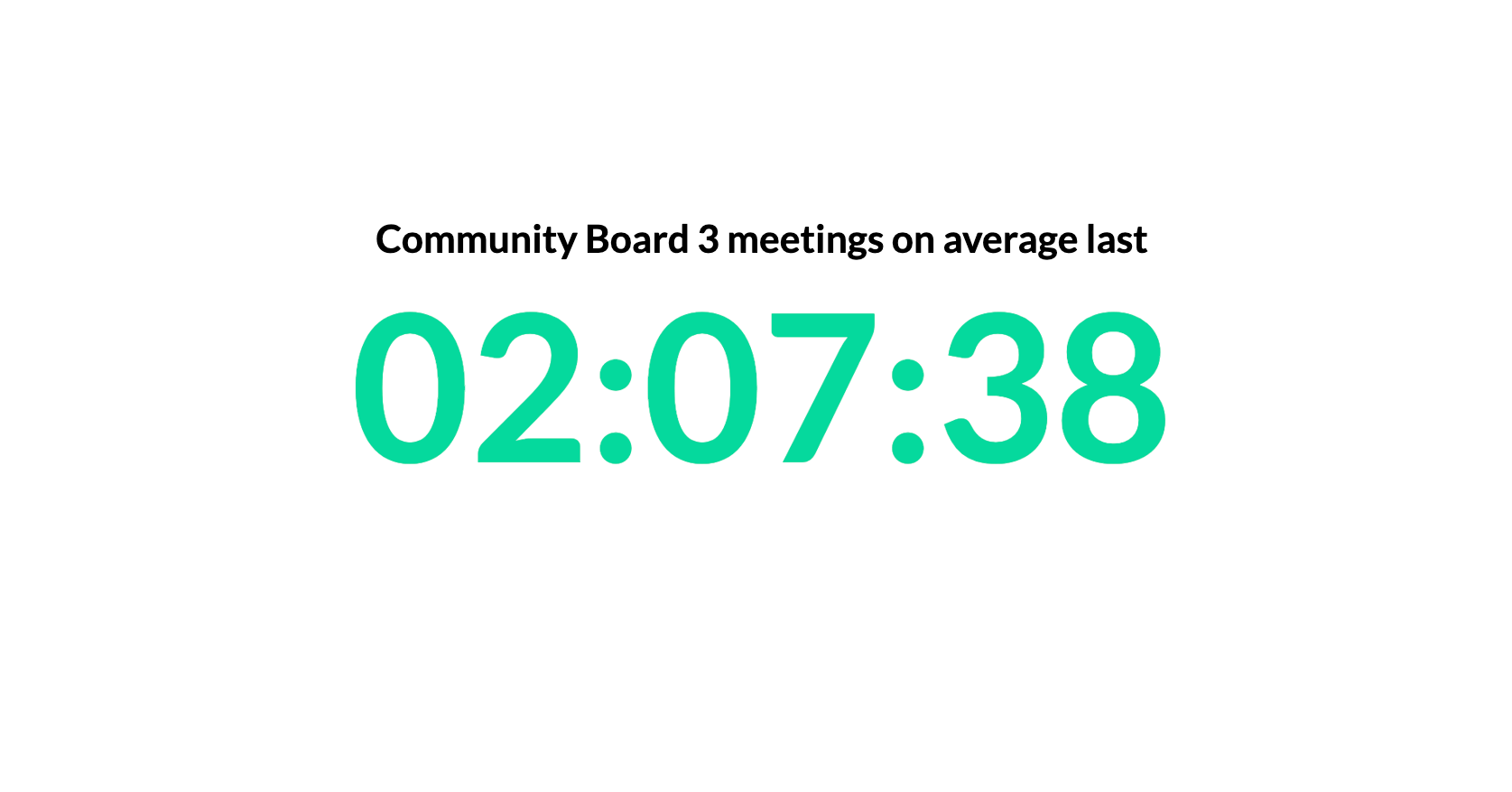
However, CBs are also notorious for their long, inefficient meetings, where members argue over minutiae with no results and discussions on a single topic can drag on for hours. The length of meetings and difficulty in reaching consensus is a frequent complaint I hear from community board members, public attendees, and the agency representatives that present at meetings. CBs are also chronically underfunded; they lack administrative support and professional expertise, and their operations are too often dispersed and ad hoc.1
As a result, CBs often become blockers on much-needed public and private developments, or are simply ignored and worked around as much as possible.
A system in which a key actor is treated as an inconvenience and dreaded or avoided by both public and private actors is not a healthy system. It is in the best interest of the Mayor’s Office, city agencies, and the CBs themselves for the CBs to function better, so that they may better serve the interests of the neighborhood they represent and be a value-adding player in local government.
Given the opportunity of the Civic Engagement Commission’s ongoing study, I would like to present my recommendations for improving community board operations and making them more effective public bodies.
Suggestions to Improve NYC Community Boards
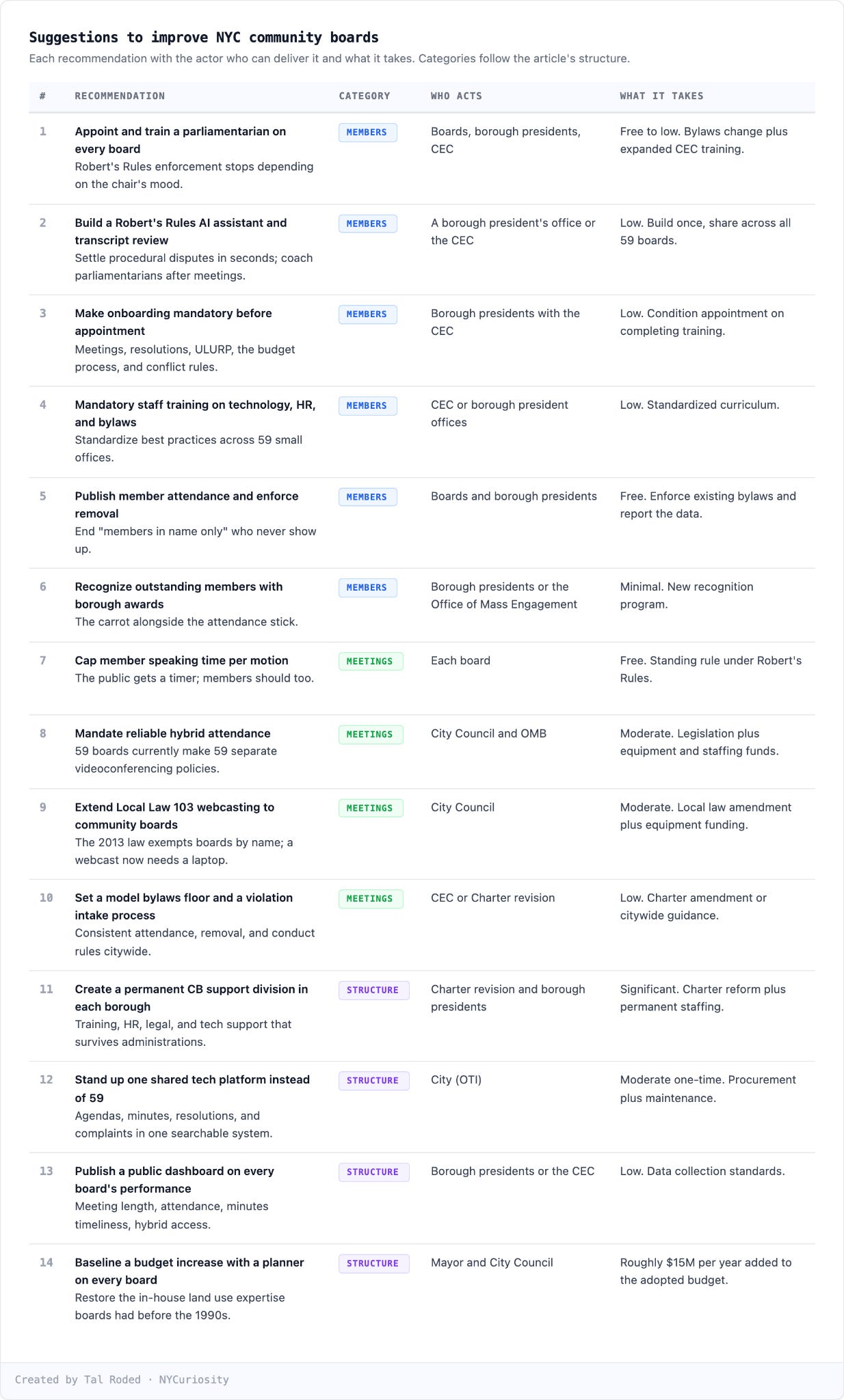
I have organized all the below recommendations into three categories: ensuring community board members are effective, making meetings work more efficiently, and building the structural support that makes both possible.
1. Step up expectations and support for members
Enforce parliamentary procedure, with a trained person responsible for it in an executive position on every board. Most boards nominally operate under Robert’s Rules of Order, but enforcement varies wildly by CB Chairs, and meetings drift when it lapses. I wrote a full guide to how Robert’s Rules works at CB meetings because parliamentary fluency is the difference between a meeting that decides things and a meeting that circles endlessly. Boards should be required to appoint a parliamentarian from among their members, and the CEC, which already offers parliamentary procedure training to boards, should provide additional and mandatory training to both parliamentarians and chairs. Current CEC trainings should also be evaluated for effectiveness and new trainings and resources updated to suit members’ needs.
A complementary tool should be built by the CEC: an AI assistant trained on Robert’s Rules that chairs and parliamentarians can query mid-meeting to resolve procedural disputes in seconds instead of ten-minute detours. This is a tool any one city office could build once for use by all boards.
Further, a properly trained AI agent like this could analyze meeting transcripts to assess compliance with Robert’s Rules and the boards’ bylaws and provide coaching or additional support for the CBs most in need. This can help board parliamentarians to learn from mistakes and improve enforcement, ensuring more efficient meetings.
Make onboarding mandatory. New members currently learn bylaws and procedures on-the-job, with no training prior to appointment or first meetings. The 2018 charter amendment already tasks the CEC with providing boards urban planning and technical assistance, and the CEC offers trainings on parliamentary procedure, zoning, and language access. What is missing is any requirement to take them. Borough presidents should condition appointment on completing a standard onboarding: how a meeting runs, what a resolution is, how ULURP and the budget process work, and the conflict-of-interest rules.
Similarly, CB staff should be provided with both mandatory and surplus optional training on relevant technology, human resources, and development of bylaws and meeting procedures. Centralized training provided through Borough President (BP) Offices or the CEC would standardize best practices across CBs and upskill the limited resources CBs do have.
Publicly track member attendance and engagement. Mandate that all CBs report members’ attendance at full board and committee meetings, and publicly display attendance rates by member and per board to make tracking easier. Provide resources and support to help CBs quickly remove and replace members who stop attending meetings.
The Comptroller’s October 2024 audit of board appointments found borough presidents reappointing members who missed most meetings; a training requirement paired with attendance standards would raise the floor on member engagement.
For a carrot to accompany this stick, publicly recognize and award CB members who go above and beyond. Either BP Offices, the CEC, or even the Mayor’s Office of Mass Engagement should set up awards that CB members can be nominated for in a number of categories like best innovation, community leader, public advocate. Incentivize CB engagement and recognize those who use the position to be pillars of their community.
2. Run meetings like the public’s time matters
Time all speakers, including board members. Public session speakers at most boards get two or three minutes with a timer. Board members debating a motion often get unlimited time. Robert’s Rules contains the fix, since it allows bodies to set debate limits by standing rule. Boards should cap member speaking time per motion and empower the chair (or a parliamentarian) to enforce it. The Better Public Meetings project’s research argues that state laws governing local meetings offer more procedural flexibility than most bodies realize; boards are freer to redesign their own meetings than they assume.
Make hybrid attendance permanent and easy. Since 2022, New York’s Open Meetings Law has allowed public bodies to run hybrid meetings, and the statute explicitly lets each community board in NYC make its own determination on videoconferencing. The result is 59 separate policies. Some boards run excellent hybrid meetings while others offer no remote option at all. For working parents, disabled residents, and anyone who cannot give up several hours on a weeknight, remote access is the difference between participating and not.
Every board should be mandated to offer virtual attendance options, and the City should fund the equipment and staffing to make it reliable rather than leaving it to each board’s improvisation. A centralized IT/communications team that provides tech support and training to CB staff would go a long way here.
Local Law 103 of 2013, which requires City bodies to webcast their meetings live and archive recordings within 72 hours, contains an explicit carve-out stating the law “shall not apply to community boards.” The Charter requires only that boards make meetings “available for” broadcasting. Twelve years later, the exemption has outlived whatever justification it had, since a webcast now requires only a laptop and some microphones with minimal tech setup. The Council should extend Local Law 103 to community boards and pair the requirement with funding for the equipment and training.
Centralize community board bylaws and create enforcement mechanisms for when they are violated. Currently, every board maintains its own bylaws, leading to a wide variance in how meetings are conducted and a lack of knowledge in appropriate procedure. Centralizing bylaws at the City Charter level would provide consistency with how CBs operate, simplify training and knowledge sharing of best practices, and allow the City to more easily track violations of CB policy.
The CEC should also set up an intake process for CB members to report bylaw violations or submit questions for help with figuring out proper procedure. Community boards are city agencies, and just like any other agency, there must be pathways for enforcing the rules and holding members accountable.
3. Give boards the shared infrastructure they have never had
Build permanent CB support divisions in each borough president’s office. Borough presidents appoint board members and are the closest thing boards have to an oversight body, but support is inconsistent across boroughs and administrations. The Manhattan Borough President’s office runs a training series for board members; other boroughs offer less. Los Angeles shows what institutionalized support looks like: its 99 Neighborhood Councils are backed by a permanent city agency, the Department of Neighborhood Empowerment, which handles training, funding administration, and elections citywide, and every member takes state-mandated training on managing public funds. New York should charter the equivalent: a permanent division in each borough president’s office responsible for board oversight, training, and shared services, so that support survives changes in administration.
Alternatively, create a Central Staff team in the new Mayor’s Office of Mass Engagement, or a dedicated (in complement to the appointed) staff at the CEC, that assists the boards and District Managers with matters ranging from human resources to onboarding new board members. As the FCBWG report says, “The boards also need consistent access to technology, functional office space, and expertise in land use and zoning.” A dedicated team in the BPs’ or Mayor’s office could standardize such support while also providing oversight.
Social media training, funding, and support should also be added to the existing catalog of trainings. CBs could better engage with the public if they utilized social media platforms, but CB staff need training in order to do so.
Stand up one tech platform instead of 59. The City Council runs its entire legislative operations, votes, and bill text on one shared Legistar system. Community boards each improvise their own stack of websites, mailing lists, and spreadsheets. The Future of Community Boards Working Group reported in December 2021 that all 59 boards relied on a single person for IT support, and one district manager spent roughly $185,000 over five years piecing together technology for a single board. A centralized platform for agendas, minutes, resolutions, and complaint tracking, built once and maintained by the City, would cost a fraction of 59 separate efforts and make every board’s records searchable in one place.2
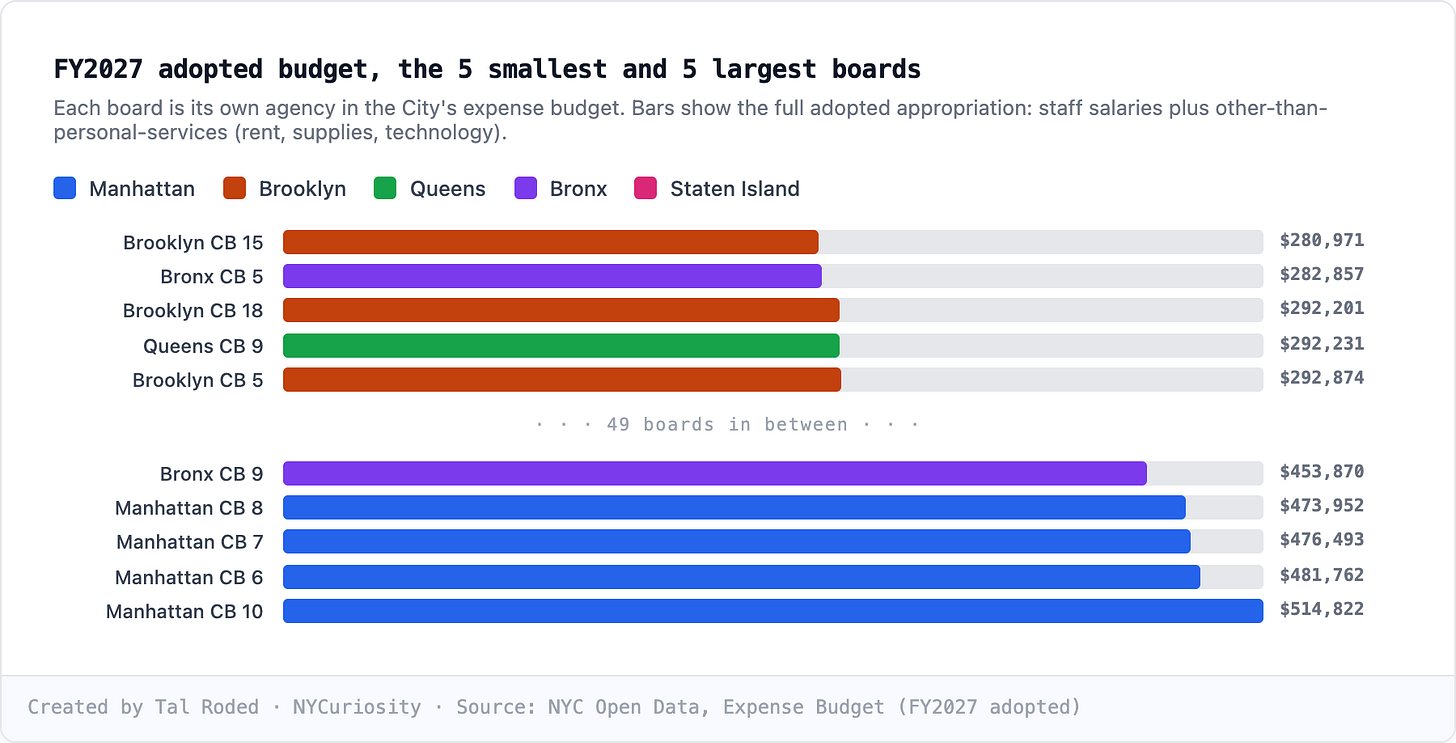
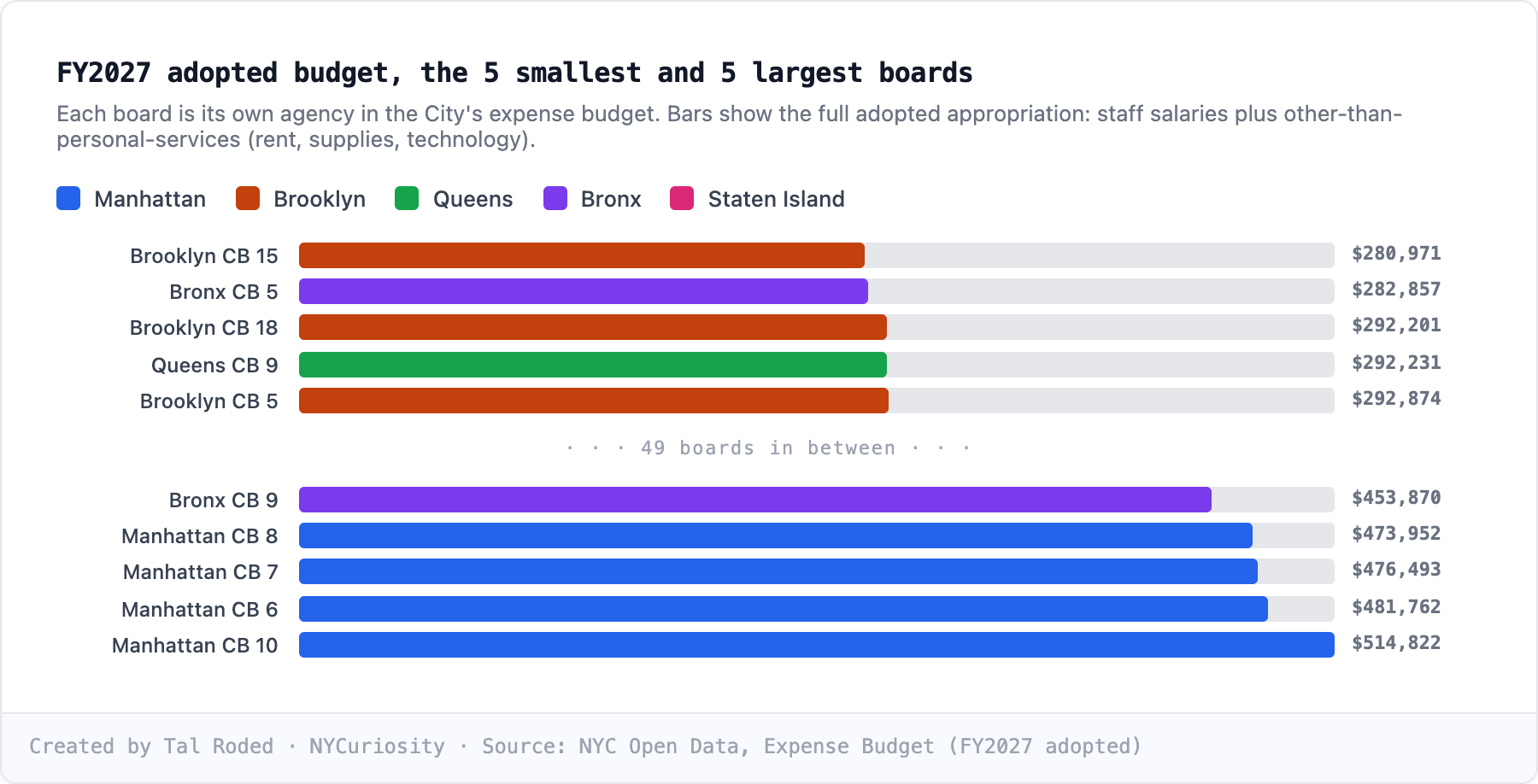
CBs have a large variance in budgets due to different staffing levels and other costs. Consolidating resources and centralizing staff would improve operations and save budget. [source]
Publish a public dashboard on how every board is doing. The City Charter requires each board to maintain a website with meeting notices and twelve months of minutes, and the Open Meetings Law requires minutes within two weeks of a meeting. But these requirements are only the bare minimum, and more information should be posted. A public dashboard, run by the borough presidents or the CEC, should track for every board: average meeting length, member attendance, whether minutes are posted on time, whether resolutions are accessible online, and whether the board offers hybrid attendance. The metrics should be anchored to goals each borough president sets for their boards, such as how many members of the public attend meetings.
Another extension of this recommendation would be for the CEC or each BP’s office to distill insights from this dashboard and other data collected from CBs as best practices shared with every CB staff and members. Top performing CBs should be recognized and their successes copied. Another opportunity for awards!
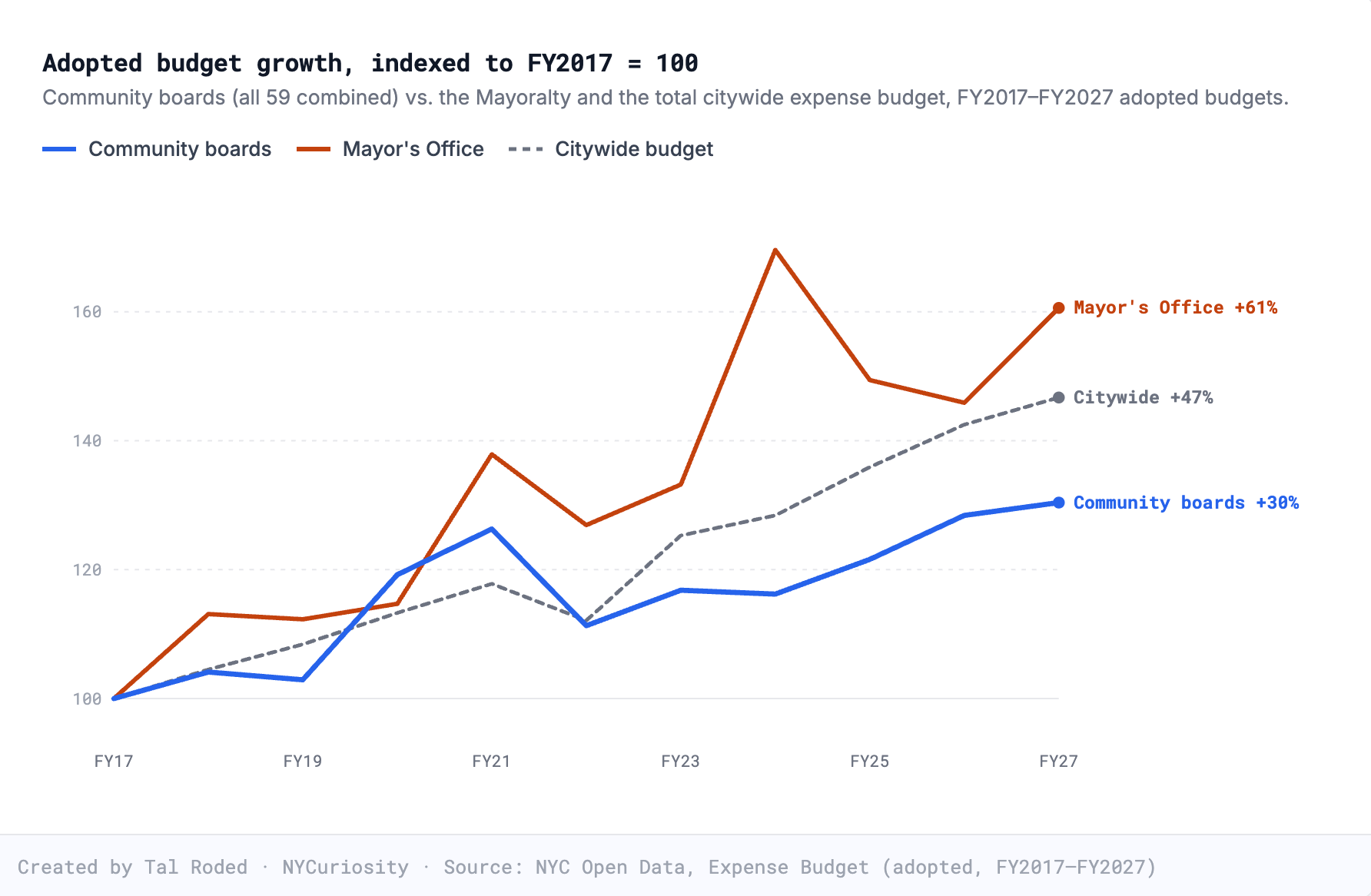
Fund the boards so they can actually operate and improve. Every structural fix above runs into the same constraint: In FY2026, the 59 boards’ budgets total $21.9 million, a median of $370,150 per board, with the lowest at $276,449. That works out to roughly $2.50 per district resident per year for the body charged with representing them, about two hundredths of one percent of the city budget. The Future of Community Boards Working Group reported that boards had not received a significant baseline budget increase since 2014, with a typical board allocated $231,100 for its entire staff. The Charter allows boards to hire planners and professional staff, but only “within the budgetary appropriations therefor,” which in practice means most boards weigh in on complex land use applications with no planner on staff. A meaningful baseline increase, enough for every board to employ a full-time urban planner or other expert alongside its district manager, would cost the City less than $15 million a year and transform the quality of the advice boards give on the land use decisions the Charter assigns them.
Conclusion
Despite the many inefficiencies, chronic underfunding, and ignorance of their existence by the majority of NYC residents, community boards remain important elements of local governance. The State relies on community boards to process liquor license applications, City agencies rely on community boards to signal community support or rejection of proposed changes to be made to streets and parks and landmarks, and residents rely on community boards to direct and amplify complaints and requests to the appropriate city officials.
Without a doubt, community boards play an essential role in connecting residents and communities to the many complex organs of City and State government. However, their lack of transparency to those same communities and their unstandardized, inconsistent mode of operation hinder their value.
Adopting any of the above recommendations, done through a mix of City Charter reform (a great opportunity for the Mayor to create another Charter Revision Commission) and Borough Presidents’ backing, could have massive benefits to the operations of the city government at the most local level. Even with community boards’ small, advisory role in government, their perception by the communities they represent plays an outsized role in the public’s perceived effectiveness of the City. A government that can be better trusted and relied upon to serve its citizens is one that will experience more success in implementing policies overall.
Lastly, as mentioned above, the CEC is currently conducting a public survey and research process on how to improve public meetings in NYC. For those who would like to share their own thoughts, here is guidance from the CEC on how to get involved:
Our work is not done. Here’s how you can shape what comes next.
Community Survey: We are still taking responses through our Community Survey, which broadly examines local civic life. You can take the survey, powered by our partner ActiVote, here:
Share your best practices: Do you work closely with a community board and want to share specific promising practices that other boards should adopt? Submit them to our promising practice form here: https://docs.google.com/forms/d/e/1FAIpQLSfmx7gp8RawFMZ76GfY_VQN6pI_k6-Qf9iPAIBCmETDz5hddQ/viewform?usp=dialog
Lastly, if you want to bring this work, including future pilot project recommendations, to your community board, please contact us! Please reach out to [email protected] to learn more.
For the many, many data points and stories backing up these claims, see the Future of Community Boards Working Group report, co-written by a group of CB district managers.
In addition to this, BetaNYC has previously published a report full of many excellent and specific recommendations for improving CBs’ tech infrastructure.
I think these recommendations make a lot of sense, but I do still question how we can make the public input process more representative of NYC. While there has been a focus in recent years on the demographic makeup of community boards, the process is still not representative of most communities. Community board members are more likely to be older, to own a car and a house, to have higher educational attainment and to be white, than the typical city resident.
City agencies need to rethink how they gather input and feedback throughout a project lifecycle, in a way that encourages all types of New Yorkers to participate while respecting the professional expertise of city employees, particularly with safety-related projects. While they legally may not have the ability to veto projects, the city has operated for years like CBs have final say.
If CBs are going to continue to be part of the public input process, they need to be easier for more city residents to engage in. Education and professional expertise is key, but I would also encourage considering stipends for participation to respect lived expertise, child care available at every meeting, transit vouchers available for attendees, paid translation services and more.