


Welcome to Part III of NYCuriosity’s NYC Community Board guide! In this part, I will explain the core principles of Robert’s Rules of Order, a form of parliamentary procedure that governs how community board members can act and interact in meetings.
If you are a New Yorker wishing to “get involved” in local politics or desiring to gain a better understanding of the political developments both in your neighborhood and citywide, there is no better place to start than attending community board meetings. All full board meetings, and most committee meetings, are open to the public and allow anyone to speak up in their meetings (to varying degrees and often during pre-specified intervals, as will be explained below).
For previous parts of this guide, see the articles below:


At the conclusion of the series, I will make a final, comprehensive post including all the above guides so that future readers can have an easily accessible, all-in-one guide. If you find this series is missing anything, or you wish to learn more or chat about community boards, please reach out to me here or at my email!
Note: The below guide is tailored to Manhattan Community Board 3 (MCB3), of which I am a member and most familiar with their meeting procedures and rules. Other community boards have their own bylaws and procedures, and while there is significant overlap, they will likely have some differences in how meetings are run and when and how the public can participate. Please talk to your local community board members for guidance and check your community board’s website for resources if you are interested in getting involved!
If you happen to live in Community District 3, reach out to me and check out my running CB3 Reports series to get caught up:


Lastly, before we dive into the next part, here is more information if you are interested in applying to your community board this year:
Bronx Community Boards - applications not yet open
Brooklyn Community Boards - apply by February 6, 2026
Manhattan Community Boards - applications not yet open
Staten Island Community Boards - rolling application open year-round
Other boroughs will open their applications later in January, and links will be added here as portals open.
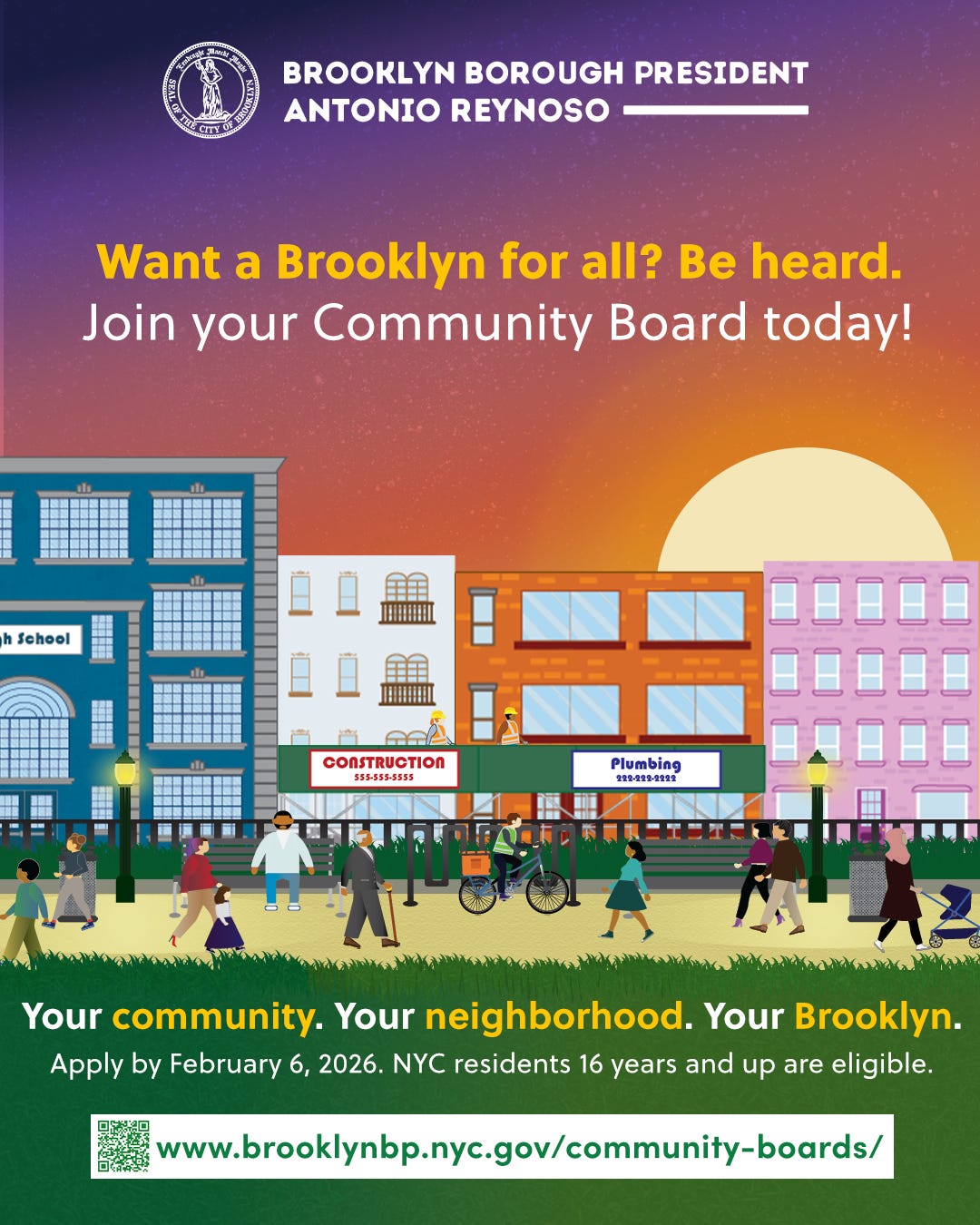
If you are planning to apply or are interested in applying, please reach out to me, and I would be more than happy to share my experience or connect you to CB members in your community district.
III. Robert’s Rules of Order and Parliamentary Procedure
Community Board (CB) meetings are formally governed by Robert’s Rules of Order (RRO) for parliamentary procedure.1 RRO is a long-established system designed to provide a clear structure so that all members understand how meetings are run and how decisions are made. The main goal is to allow majority rule while protecting the rights of the minority, ensuring that everyone has a fair chance to speak, propose ideas, and question proposals before votes are taken. RRO is used across public bodies nationwide, and is what keeps meetings fair, organized, and democratic.
And yet, my experience on my CB so far, which mirrors the experience of most other CB members I have spoken to across the City, is that few people are actually familiar with RRO. The lack of training and understanding for parliamentary procedure is a major contributor to the overly lengthy meetings and occasional lack of appropriate decorum in CB interactions. It also concentrates power in the hands of those who already know how to work the room, unfairly favoring the loudest individuals.
Conversely, learning the basics of Robert’s Rules will enable you to more effectively participate in and influence community board meetings. Simply being familiar with how meetings should be run can also be a major advantage for CB members wishing to step into leadership positions. At the very least, more members knowing RRO could prevent the circular debates and out-of-order speaking that so often unnecessarily causes meetings to drag on.
To cover all of RRO is outside the scope of this guide and would likely take a series of articles, which I may tackle at some point. For now, I will provide some of the main takeaways below and refer interested readers to the guide to parliamentary procedure for NYC Community Boards handbook. Everything you need to know about RRO and its application to CBs is likely found in here, and if I was granted a wish from a genie, I would ask that every NYC resident become intimately familiar with this handbook.
The Basics of Robert’s Rules of Order
A quick rundown of key parliamentary procedure basics for CBs:
A majority of the CB’s appointed members must be present to conduct business
Board members address only the Chair or each other through the Chair
Board members must first be recognized by the Chair before speaking
Any Board member obtaining the floor can introduce any legitimate matter
Business brought before the Board should be in the form of a motion (more on this below)
Board members should allow others to speak before they speak again
The Chairperson should insure that all sides of an issue are heard
Why this matters:
In previous parts of this guide, I mentioned that CB Chairs are incredibly powerful because they can appoint committee chairs and run board meetings. Now we see how running the meetings makes the Chairs the most influential person on the CB: they decide who gets to speak, in what order members will speak, how many speakers they will allow on one side of an issue, and generally all discussion is conducted through them. Simply by deciding who to call on, Chairs have tremendous power to control the discussion!
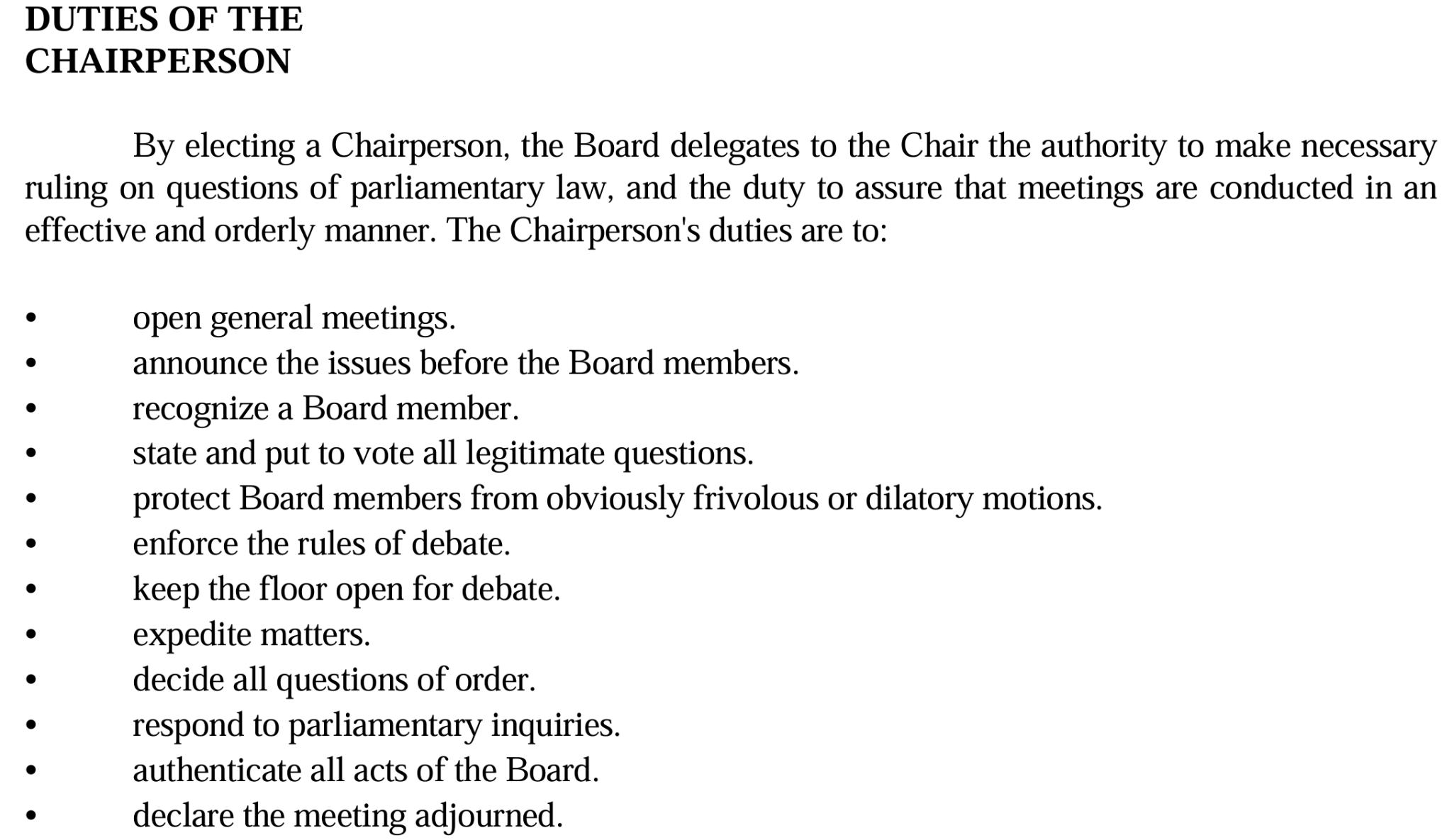
The rights of non-Chair CB members mostly involve the ability to “obtain the floor, introduce motions, enter discussions, oppose, amend, and vote on motions.”2 These are the tools of the trade for speaking, making arguments, and influence official CB actions.
Motions: The Trusty Tools of CB Actions and Debates
CB debates and discussion thus center around motions, the basic unit of decision-making. When a board member wants to take an official position - say, to support a street redesign or oppose a liquor license - they “make a motion.” Another member must then “second” it, signaling that at least two people believe the idea deserves discussion. From there, debate begins. The chairperson recognizes speakers one at a time, alternating between those for and against when possible, and makes sure the conversation stays on topic. When the discussion seems complete, the chair “calls the question,” meaning it’s time to vote. Most votes are by voice (“all in favor, say aye”), but significant or contested items may go to a show of hands or roll call.
Robert’s Rules also define how motions can be adjusted or delayed. A motion to amend allows members to tweak the proposal’s wording before the vote. A motion to table temporarily (or potentially permanently) pauses discussion of an issue, which is useful if more information is needed or time is short. Members can also raise a point of order if they think the meeting isn’t following proper procedure, or appeal a ruling if they disagree with the chair’s interpretation of the rules. These tools might sound procedural, but they protect the rights of minority voices and keep the process transparent.
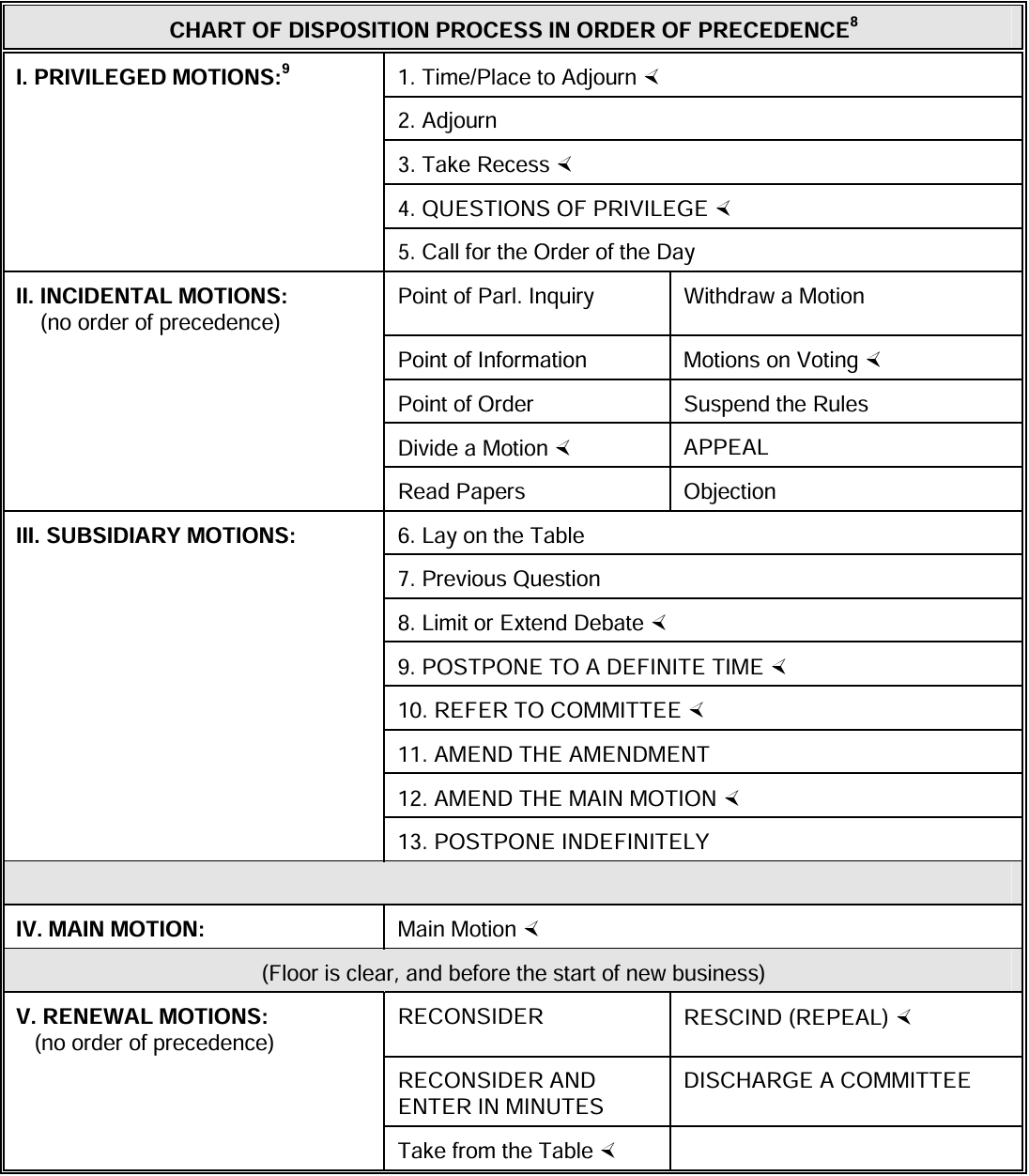
There are other types of motions available to CB members than those listed above, providing pathways for limiting debate, extending discussion of a motion, amending motions, and more. One useful motion not discussed here is the point of privilege, which members can use to protect their rights or the interests of the CB. CB members and public members attending CB meetings should familiarize themselves with these secondary motions in order to participate and guide discussion to their full potential.
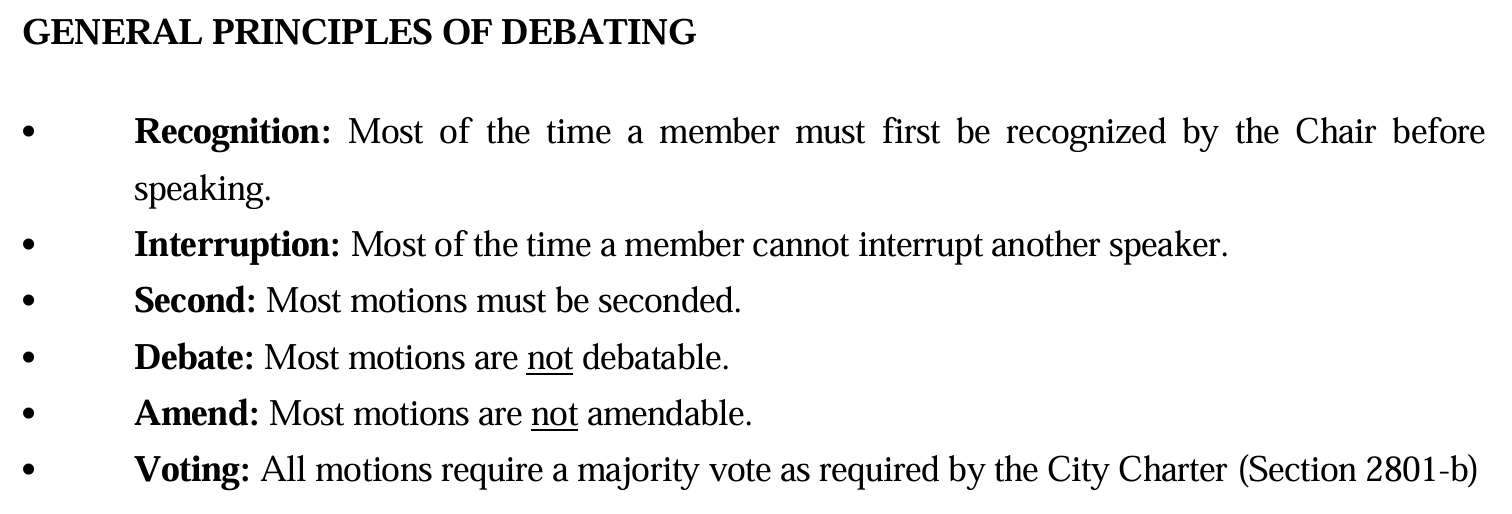
The general flow of discussion is:
The Chair recognizes a member to speak
The member introduces a motion, the choice of which defines how the discussion will proceed (whether debate or amendments will be allowed, for example). The motion is seconded by another member.
If debate is allowed, other members are recognized by the Chair to speak on the motion that is on the floor
If amendments are allowed, members can propose such motions to amend the primary motion, with votes taken on these amendments
The Chair puts the questions to the members for a vote and the motion is passed (or rejected) by a majority vote of the CB members present
Other important parliamentary procedure rules to know
When a vote is taken, all Board members who are present and entitled to vote must either vote or abstain
Absentee ballots, proxies and telephone votes are not permitted
There must be more “yes” votes than the total of “no” votes and abstentions combined in order for a motion to pass
All Community Board votes, including the election of officers, must be conducted by open ballot - that is, CBs must record each member’s vote and make the record available to the public by including it in the minutes of the meeting
Community Boards are mandated to meet at least once a month, except during July and August
Boards are required to conduct two public hearings during the budget process, and one during their review of the Citywide Statement of Needs
The mandate to hear from the public at every public meeting requires that a public session be conducted even if a Community Board has held a public hearing on a specific issue that month
Community Boards are defined as public bodies and governmental agencies subject to the applicable provisions of the City Charter and the New York State Open Meetings Law
Final Note
The procedures described above are Robert’s Rules of Order as formally written down. Attend just a single Community Board meeting and you will quickly notice that many RRO guidelines are not followed or have been adjusted. This is partially due to general lack of understanding of RRO, but also because CBs have leeway to disregard RRO as they see fit. As the above cited handbook itself states, “Robert’s Rules are meant to be a means to an end and not an end in themselves” - and so CBs are allowed and encouraged to “adopt written rules of procedures which confirm, add to, or deviate from parliamentary law itself”.
Understanding parliamentary procedure for CBs helps explain how community boards could run best more than how they are actually run. Ultimately, better adherence to RRO would likely shorten lengthy CB meetings and improve equity in participation. But that’s a discussion for another time.
However, as noted in the Community Board parliamentary procedures guide, “Robert’s Rules are superseded by a Community Board’s by-laws, New York City Charter, and the New York State Open Meetings and Freedom of Information Laws.”
The Chair’s power is not absolute either, though. All CB members have the right to appeal a Chairperson’s decision. If an appeal is seconded, the entire CB votes on the appeal (with the appeal itself being debatable) and by majority vote can overturn the Chair’s decision. Note: One appeals a Chairperson’s decision and objects to a motion.