


Welcome to Part IV of NYCuriosity’s NYC Community Board guide! In this part, I will cover everything else not previously discussed in this series: how to read and write resolutions, the importance of District Needs Statements and budget priorities, and other advice for community board members and those looking to join.
If you are a New Yorker wishing to “get involved” in local politics or desiring to gain a better understanding of the political developments both in your neighborhood and citywide, there is no better place to start than attending community board meetings. All full board meetings, and most committee meetings, are open to the public and allow anyone to speak up in their meetings (to varying degrees and often during pre-specified intervals, as will be explained below).
For previous parts of this guide, see the articles below:


This is the final part of the CB series. At the conclusion of the series, I will make a final, comprehensive post including all the above guides so that future readers can have an easily accessible, all-in-one guide. If you find this series is missing anything, or you wish to learn more or chat about community boards, please reach out to me here or at my email!
Note: The below guide is tailored to Manhattan Community Board 3 (MCB3), of which I am a member and most familiar with their meeting procedures and rules. Other community boards have their own bylaws and procedures, and while there is significant overlap, they will likely have some differences in how meetings are run and when and how the public can participate. Please talk to your local community board members for guidance and check your community board’s website for resources if you are interested in getting involved!
If you happen to live in Community District 3, reach out to me or check out my running CB3 Reports series to get caught up:


Lastly, before we dive into the next part, here is more information if you are interested in applying to your community board this year:
Bronx Community Boards - apply by March 9, 2026
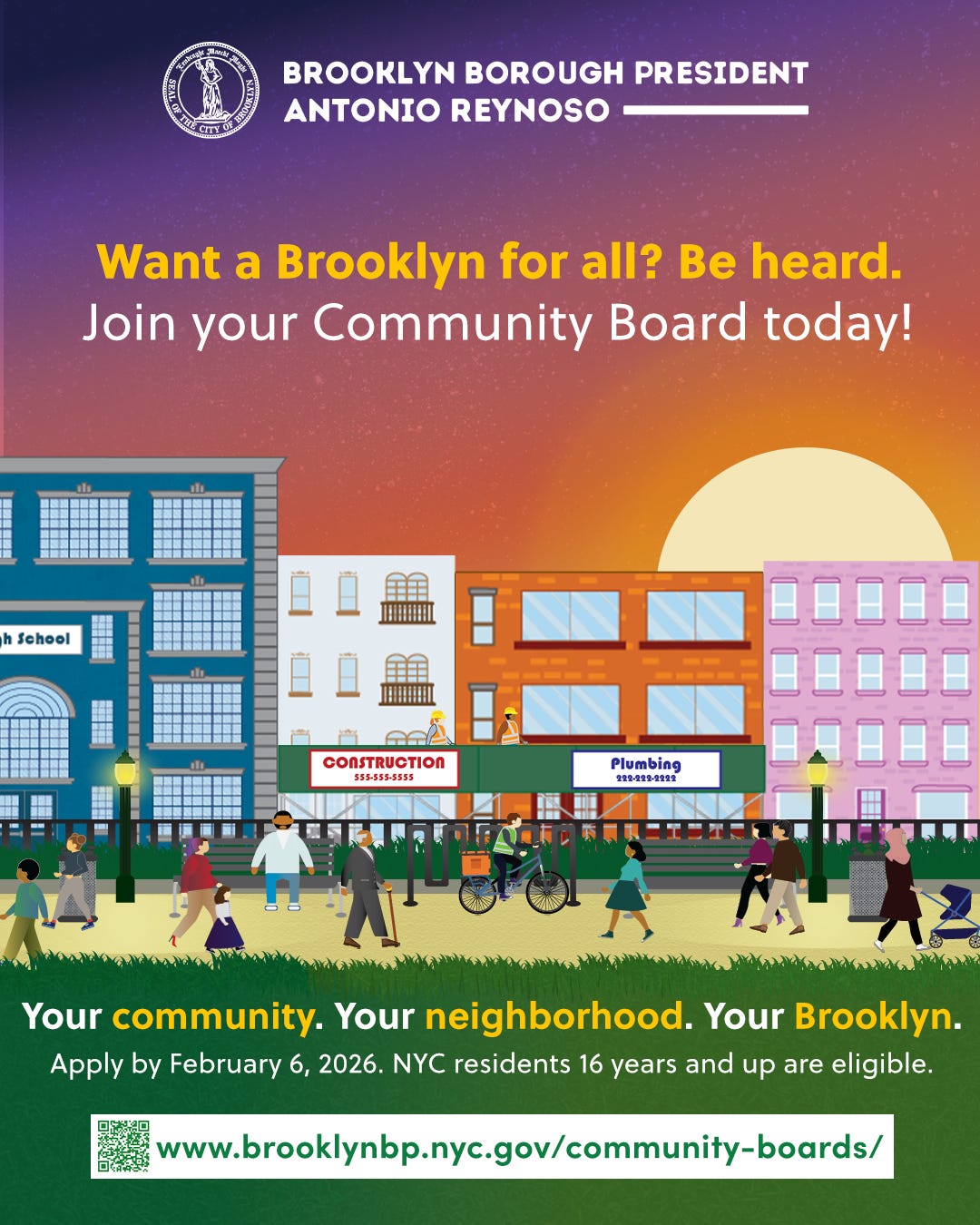
Brooklyn Community Boards - apply by February 6, 2026
Manhattan Community Boards - apply by February 27, 2026
Staten Island Community Boards - rolling application open year-round
If you are planning to apply or are interested in applying, please reach out to me; I would be more than happy to share my experience or connect you with CB members in your community district.
IV. Advice for Community Board Members & Other Topics
For those who are already community board (CB) members, and to the newly appointed (welcome!), I wanted to provide some additional guidance and resources. When I first joined my own CB in April 2025, I was plunged headfirst into the world of local politics with no training whatsoever. While the materials are out there if you know where to look and who to ask, it is likely that no one is going to hold your hand and walk you through parliamentary procedure, resolution writing, or coalition building. Yet these are the tools that make a CB member an effective community representative and policymaker.
The previous parts of this series covered the building blocks of CBs and their structure and operation. But there are still some major topics to know about, and many little things to be aware of if you wish to be an agent of change in your community. Let’s dive into them.
Resolutions: the Swiss Army Knife of the Community Board
Resolutions are the Community Board’s primary means of fulfilling its advisory role and typically the outcome of any full board or committee discussion/debate. This means that knowing how to write a resolution can make you a more influential CB member. For that reason, I want to dedicate space to covering what exactly they are, how to read them, how to write them, and why they can matter.
As I noted in Part I of this guide, most of the work to debate and shape a resolution happens in the committee meetings. By the time resolutions reach full board, they are often voted on and passed with minimal discussion, if any. What this effectively means is that the way to influence a resolution, i.e. your community board’s stance on an issue, is to show up to committee meetings and participate in the discussion there. As an added benefit, you’ll likely witness committee members orally drafting or editing resolutions in real-time. Sometimes resolutions are pre-written ahead of the committee meeting, or provided by the committee chair, but many times members need to brainstorm one that resolves an issue or request brought up in committee.
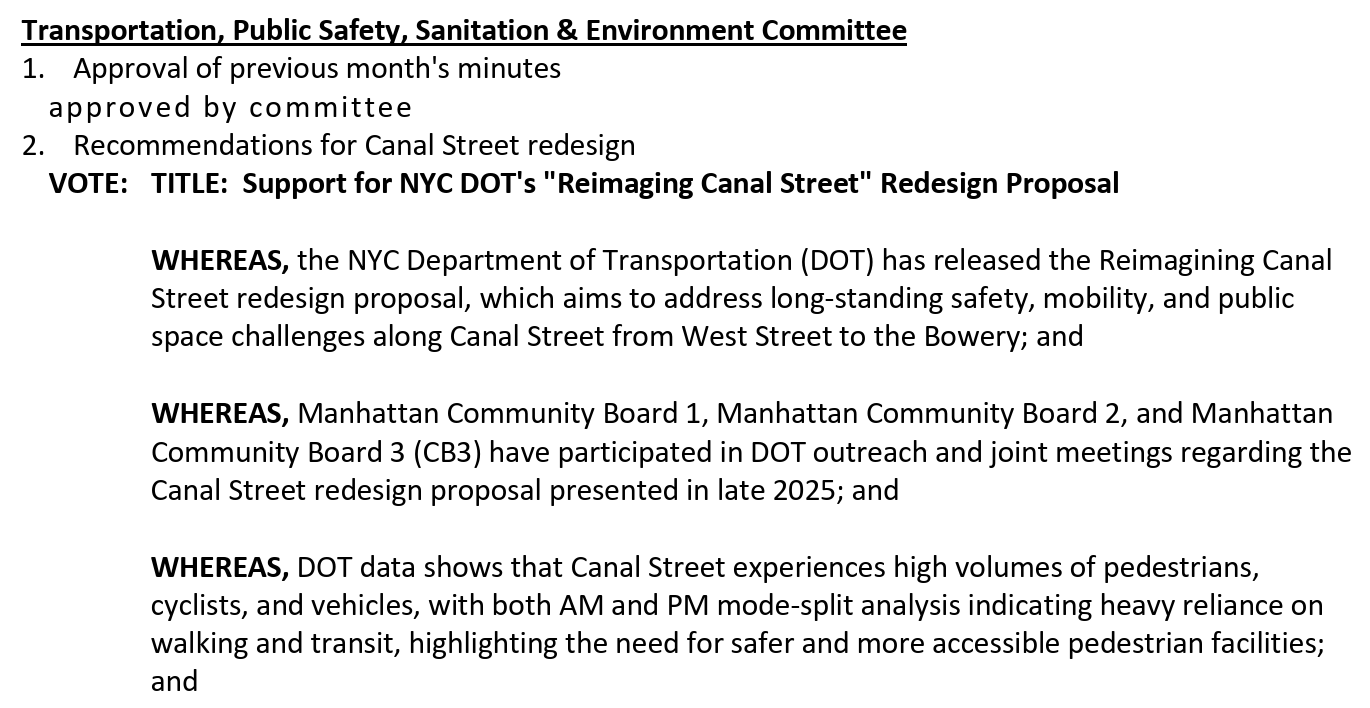
Reading your CB’s previous resolutions can help you quickly familiarize with the general structure and tone of relevant resolutions. Manhattan CB3 posts minutes from all its previous meetings here, and the text of resolutions can be found in each PDF (search for the keyword “VOTE” and check out the bolded text). Resolutions tend to follow the same structure, especially within committees when they are addressing the same subject matter, and so previous resolutions can even be directly reused with wording updated or adjusted where needed.
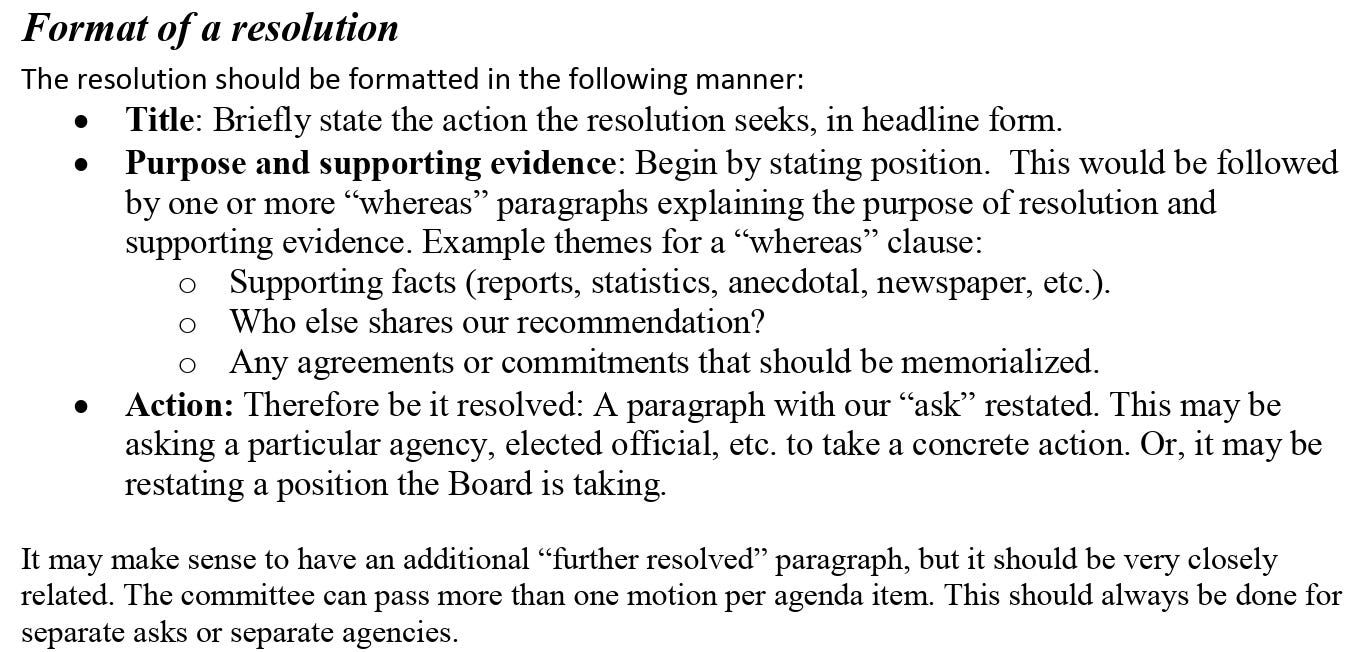
The basic structure of a resolution:
TITLE: one sentence summary of the resolution’s content and proposed action
WHEREAS: A series of clauses, each beginning with the word “whereas” and making a statement that may provide context, background, or reasoning as to the resolution’s proposed action. There can be as many whereas clauses in a resolution as the drafter would like, and I have seen resolutions with pages of whereas clauses.
THEREFORE, BE IT RESOLVED: The proposed action/actions, itself formatted as its own paragraph beginning with the phrase “Therefore, be it resolved, …”. This is where the position of the CB is stated, or the request to an agency is made, or whatever the purpose of the resolution may be. Typically there is only one of these clauses, concluding the resolution, but where there are multiple proposed actions there can be multiple of these clauses as well.
Other helpful resolution writing advice and good/bad examples from MCB3 can be found here. One big tip: Include in the resolution context, background, rationale and agreements memorialized.
One last note on resolutions: public members can also have an outsized impact on CB policies, because many CBs allow non-board public members to vote on committee resolutions. On some committees, like CB3’s SLA committee, there are nearly as many public members as board members. Since committees in general are smaller than the full board, a public member’s vote is powerful and can be enough to swing the outcome.
The District Needs Statement: an under-appreciated but powerful CB tool
While resolutions are the primary tool for CBs to act and to communicate their desires, they are not the only tool. Every year, no later than August, each community board must also publish a district needs statement (DNS) that outlines what the priorities for the community district are and where City funding should go towards. This is an opportunity for the CB to make a symbolic stance on what issues it thinks are most important, require the City’s prioritization to address, and why they matter for the community.
This statement is also not entirely rhetorical - it can influence discretionary funding available to City Councilmembers or the Borough President. Critically, City agencies must respond to community board budget requests in the City’s annual budget. Thus, determining the priorities listed in the DNS is another tool that directly influences the funding provided and projects chosen for development in the district.
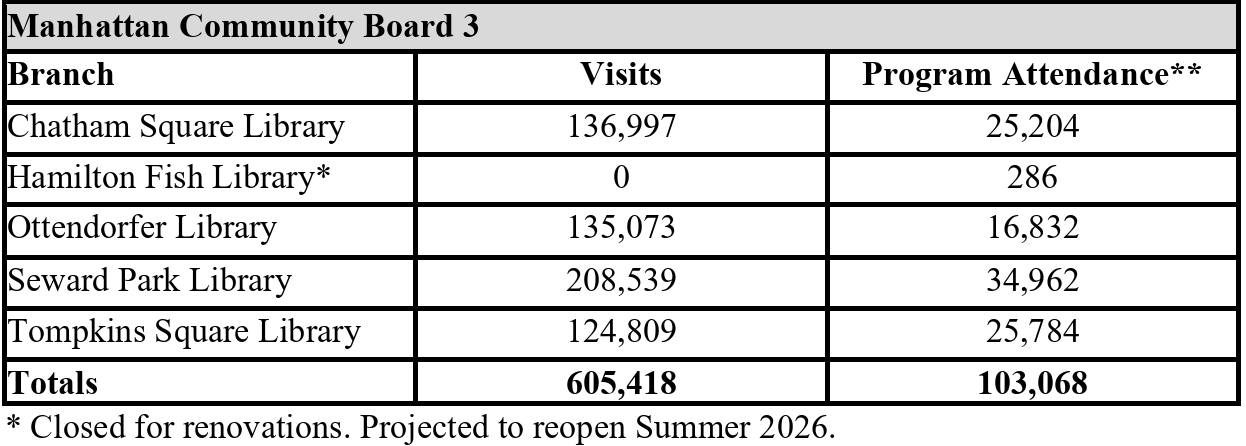
In Manhattan CB3, we begin work on the DNS in May, and the entire board votes on the DNS in July. Committees usually determine and vote on their portion of the DNS, covering priorities and projects related to their subject matter, in June. This timeline is meant to match with the City’s fiscal year budget timeline, which itself begins in July for the coming year’s budget. Following the full board vote, the CB then sends the DNS to the NYC Department of City Planning in October.
Being actively involved in the DNS formulation process is one way to have a direct impact on the allocated funding and greenlit projects by City agencies for your community. Similar to resolutions, participating in discussion, particularly in committee, is key to influencing DNS priorities prior to their finalization. This is another area where being a committee chair is powerful, as chairs lead the discussion and meet with the relevant City agencies to align on budget priorities. However, even those who aren’t chairs can play a large role by participating in the discussion and voting on both the DNS and budget priorities.
How to be an effective member
For current CB members, I recommended considering carefully what policy areas you would like to shape (land use? roadways? new business openings?) and talk to the relevant Committee Chairs and Board Chair to ensure you get placed on your desired committees (most CBs put members on two committees).
This leads to a larger point that in order to have an actual impact on your CB’s policies, you need to participate in the discussions. There are a number of strategies to take:
Talk to your fellow CB and committee members, get to know them and their political leanings, and build coalitions. Ally with the ones aligned with you to support or even introduce resolutions pushing the policies you care about. Find out who is on the fence or less passionate about certain issues, and tailor your arguments to them and their interests to win their vote. And remain friendly with those you are politically opposed to, both because it is good manners and because you never know when someone might change their mind. Ultimately politicking is a more pleasant experience when you treat others with dignity.
Get to know your community district’s representatives and agency leads. Developing relationships with these key political actors will allow you to score policy wins outside the limited CB procedures/tools and go direct to the holders of power to influence change. City Councilmembers also hold the keys to discretionary funding (see below) and can directly implement your policy suggestions.
Speak up and present. At the end of the day, speaking your thoughts on an issue is the only lever you control besides your own vote. Even in cases where you end up on the losing side of a vote, what you said will go down on the record for others to read and see. Other CB members, elected officials, and the public will take notice when you speak eloquently and passionately about a topic. While you may not change minds or win in the short-term, repeated participation will grow your profile and your opinions visibility and respect.1
CBs are the ground floor of NYC politics, and many City Councilmembers began their careers as CB members. Sachi also provides additional reasons to consider applying to your community board in this great article, including:
“In my time on Manhattan CB5, I’ve voted on issues from Manhattan congestion pricing to Penn Station redevelopment to local casino policy. I read up on topics before the vote, and in the process, I learn a lot about the way the city works. I also learn about how the world works.”

APPENDIX & FURTHER READINGS
For anyone interested in the details of community boards’ structure, history, and the exact laws governing their procedures, see the extensive Handbook for Community Board Members, last revised 2014. Much of the above guide was drawn from this handbook, but a large amount of detail had to be left out.
Equally fundamental to Community Board procedures is the Bloomberg administration’s A GUIDE TO PARLIAMENTARY PROCEDURE FOR NEW YORK CITY COMMUNITY BOARDS. The CB members I know who respect parliamentary procedure treat this PDF as the CB Bible. Further recommended readings on Robert’s Rules of Order here.
For an overall deeper dive into all the issues a community board typically faces, I have to plug Manhattan Community Board 3’s excellent Resources page. It is full of links to guides and reports that cover critical CB processes and training on how things are typically done. Note the date of any resource however as some have become quite aged and have outdated information.
The NYC Civic Engagement Commission website also has a great backlog of recorded community board trainings and is scheduling new online trainings all the time. Very useful recordings on parliamentary procedure, how the City budget works, and other subjects that CB members often interact with in their roles and responsibilities!
Always be aware of Conflict of Interest Concerns: Community board members must abide by the New York City’s conflicts of interest law (Chapter 68 of the New York City Charter) and all relevant guidance from the Conflicts of Interest Board, including but not limited to the requirement that a member must disclose a conflict and abstain from voting on a matter that impacts the member’s private interest, as well as the prohibition on the use of a city title or resources for political activity.
Note: Any opinions expressed below are solely my own and do not represent the views of Manhattan Community Board 3.
While when and how much you can speak is more limited for public members, all this holds true for public participants as well. CB members and electeds will take your views seriously, and you can still present your ideas or work with CB members on resolutions!