


Welcome to Part II of NYCuriosity’s NYC Community Board guide! In this part, I will walk through a typical CB agenda and show what a Manhattan CB3 meeting covered, step-by-step. While browsing a meeting agenda seems straightforward, there is much to read between the lines. Knowing how to read a CB agenda is the difference between being a passive observer and understanding where the actual decisions are made.
If you are a New Yorker wishing to “get involved” in local politics or desiring to gain a better understanding of the political developments both in your neighborhood and citywide, there is no better place to start than attending community board meetings. All full board meetings, and most committee meetings, are open to the public and allow anyone to speak up in their meetings (to varying degrees and often during pre-specified intervals, as will be explained below).
For Part I of this guide, see the article below:
Demystifying NYC Community Boards, Part I

Thank you to Sachi Takahashi-Rial and Sebastian Hallum Clarke for their contributions to this guide. Check out their Substacks for more helpful and informative NYC policy content!
At the conclusion of the series, I will make a final, comprehensive post including all the above guides so that future readers can have an easily accessible, all-in-one guide. If you find this series is missing anything, or you wish to learn more or chat about community boards, please reach out to me here or at my email!
Note: The below guide is tailored to Manhattan Community Board 3 (MCB3), of which I am a member and most familiar with their meeting procedures and rules. Other community boards have their own bylaws and procedures, and while there is significant overlap, they will likely have some differences in how meetings are run and when and how the public can participate. Please talk to your local community board members for guidance and check your community board’s website for resources if you are interested in getting involved! If you happen to live in Community District 3, reach out to me and check out my running CB3 Reports series to get caught up.


Lastly, before we dive into the next part, here is more information if you are interested in applying to your community board this year:
Bronx Community Boards - applications not yet open
Brooklyn Community Boards - apply by February 6, 2026
Manhattan Community Boards - applications not yet open
Staten Island Community Boards - rolling application open year-round
Queens Community Boards - applications not yet open
Other boroughs will open their applications in January, links will be added here as portals open
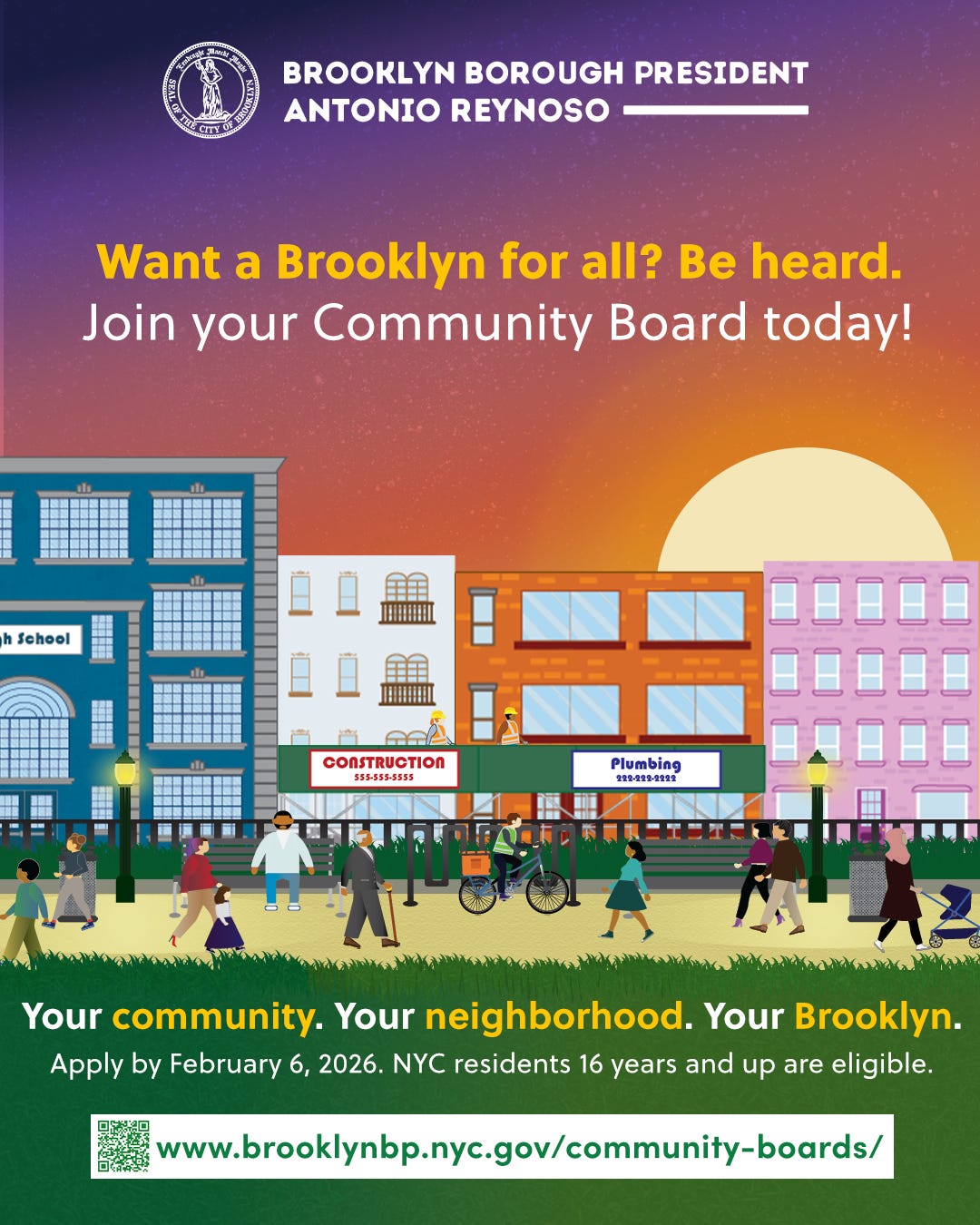
If you are planning to apply or are interested in applying, please reach out to me, and I would be more than happy to share my experience or connect you to CB members in your community district.
II. Walking through a typical CB agenda
Every district’s community board structures its meetings differently and may include different agenda elements or use different terminology. The best way to get familiar with how your CB is run is to attend meetings yourself and observe, and to browse previous meeting minutes/agendas if available online. Some CBs even record their meetings and post them to their website or YouTube!
However, there are also many similarities between these full board meetings. Given the similarities and the opportunity to learn from the differences, I will walk through a typical Manhattan CB3 full board meeting. For more details on these meetings, see my past MCB3 reports.
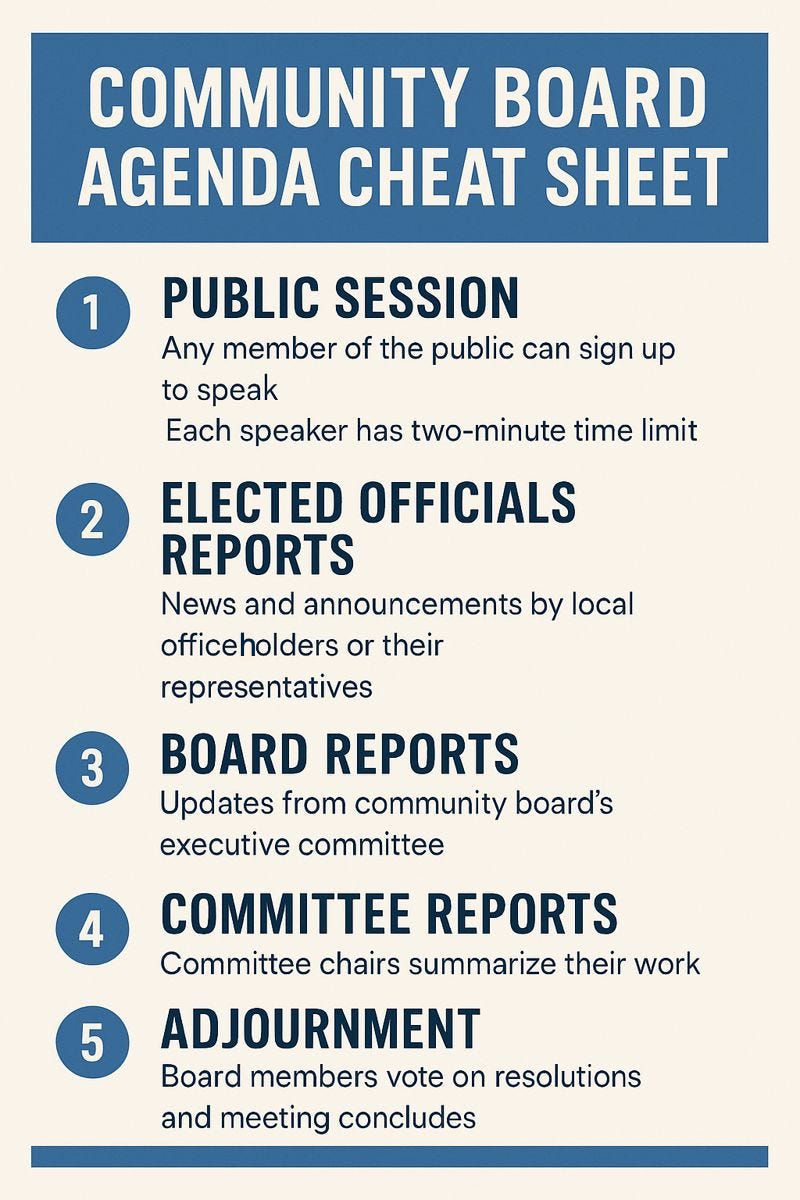
1. Public Session - the best chance to speak up!
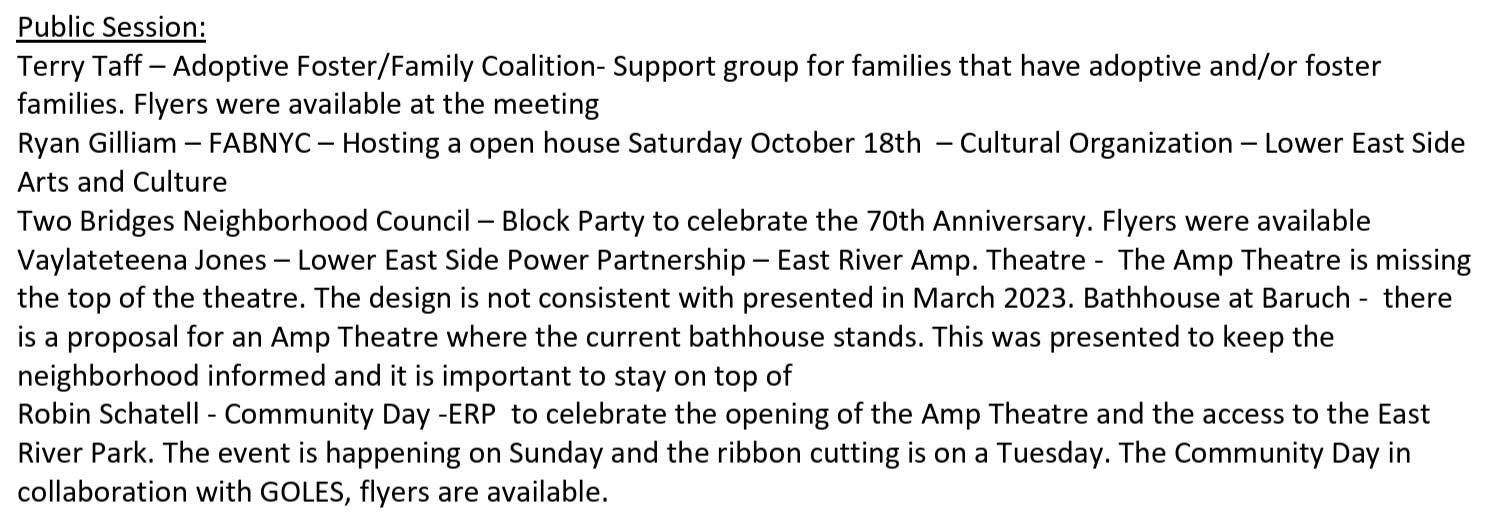
MCB3 full board meetings open with a public session. Any member of the public can speak during this time, given that they added their name to the speaker sign-up sheet before the start of the meeting (for which we place a physical piece of paper at the entrance to the meeting room that the public can fill out with name and speaking topic on the spot if they wish - other CBs may have you sign-up by filling out a digital form in advance of the meeting).
In MCB3, public session speakers have a time limit of two minutes.
Why this matters:
The public session is your chance to bring to the attention of the community board, and any local representatives who may be in attendance, issues relevant to your district or the City. I have seen past public speakers come in to complain about traffic issues on their street, request CB support for a public services program, announce community events, or even to chew out their elected representative (in person!).1
This two-minute time limit will be enforced. I recommend interested public speakers to launch straight into their main point, speak clearly, and be concise. Many a speaker has spent the majority of their allotted time prefacing and meandering, only to be cut off right as they began to address what they wanted us to know.
Also - practice projecting your voice! While microphones are usually provided, they do not always function well. Speaking loudly and clearly will draw the room’s eyes to you, providing special attention to what you wish to share.
Generally, I would recommend trying not to come off as excessively angry or cynical. Well-spoken public speakers often get the chance to speak to elected officials in attendance - or a representative from the elected official’s office - about the topic they brought forth. If you come off as a passionate individual who cares about the issue you are speaking to, your representatives will be more likely to approach you after you speak or more receptive to you approaching them. Yelling or derogatory remarks tend to have the opposite effect than desired.
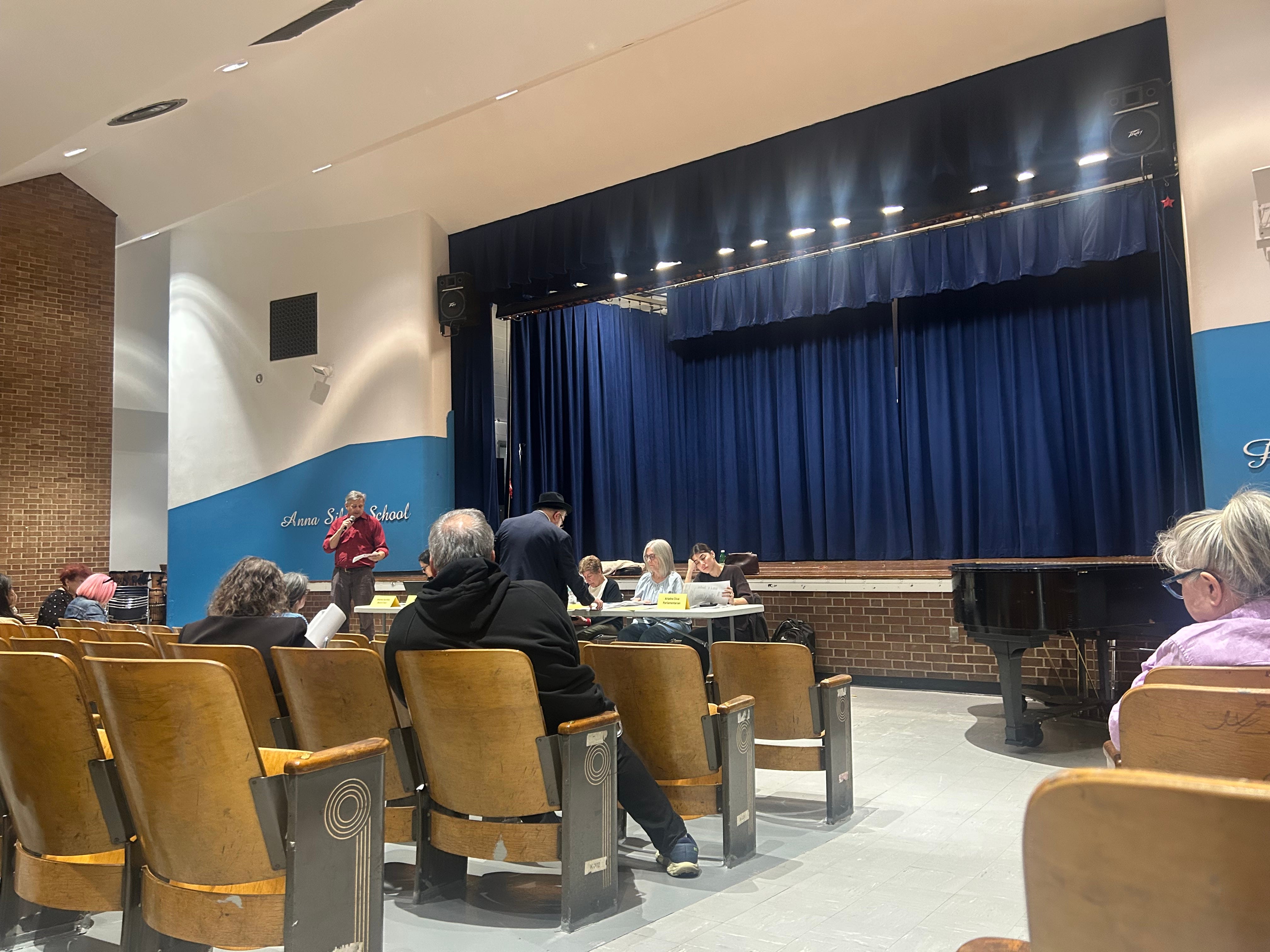
There are few better ways to access your local representatives than attending (and speaking!) at community board meetings. This is a rare opportunity to speak directly to them, with few other people in attendance. While signing up for a public speaking session is not mandatory to speak to these representatives, it does guarantee you will receive time to speak your mind.
Which leads to the next component of the MCB3 agenda…
2. Elected Officials Reports
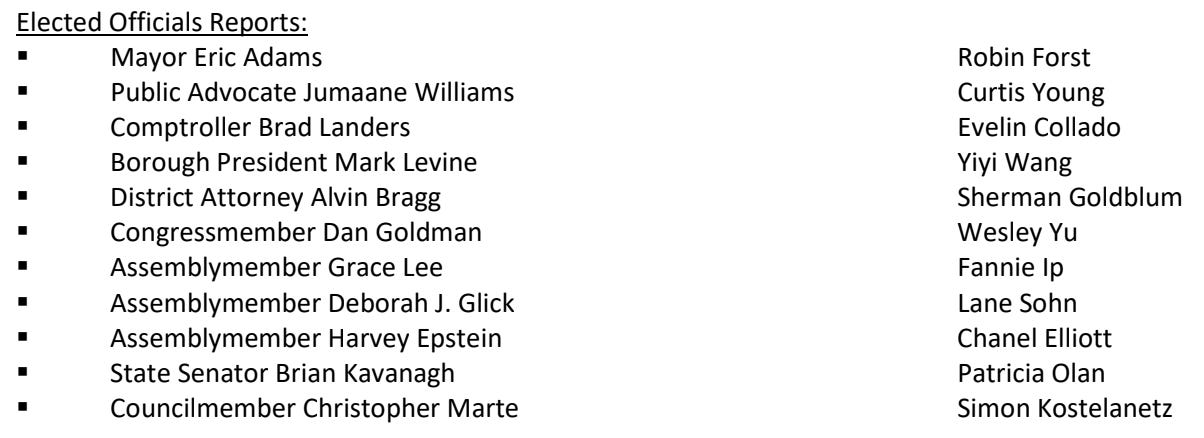
Following the public session, the floor is then given to elected officials or, more often, a representative from their office, to make any announcements they wish. This is the time when elected officials will share news on bills that they introduced, sponsored, or contributed to moving forward or passing.
Representatives often also share updates about events or resources they are offering, or where support related to recent events can be found. While this sometimes means listening to politicians toot their own horn and parade their wins, this is also the best way to stay on top of political developments in the legislative bodies and progress on new legislation.
Why this matters:
For Community Board members, this is an excellent opportunity to directly ask elected officials or their representatives questions or provide comments. In MCB3, the public is not allowed to speak during this segment of the meeting. However, for both board members and the public who wait around after the meeting, there is often a chance to catch an elected official before they leave and speak to them directly.
Being a CB member is an immediate boost to your ability to both speak to and develop relationships with representatives. Particularly for Executive Committee members, the district’s representatives often get to know them personally and will take the time to chat with them when they attend meetings. Similarly, CB members often make requests directly to elected officials to look into matters they care about during this portion of the meeting.
3. Board Reports
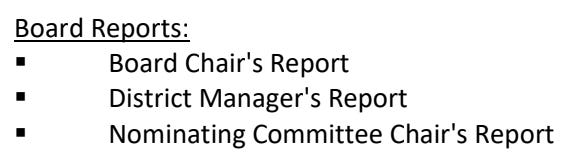
Self-explanatory, this is a chance for the Chair, District Manager, or other Executive Committee members to make announcements or present resolutions from the Executive Committee. While shorter than the other sections of the meeting, this portion may cover some of the CB’s most important and public work, like budget prioritization, District Needs statements, and borough-wide initiatives.
This is also when CB staff, such as the District Manager (DM), are given an opportunity to speak. While not mentioned explicitly on the agenda, MCB3’s DM is constantly help run the show throughout our full board meetings. Being a CB DM can be both a powerful and thankless job.
This is also when operational decisions are presented, such as a resolution to use CB funds to hire new CB staff or for a project, or announcements about CB elections.
4. Committee Reports
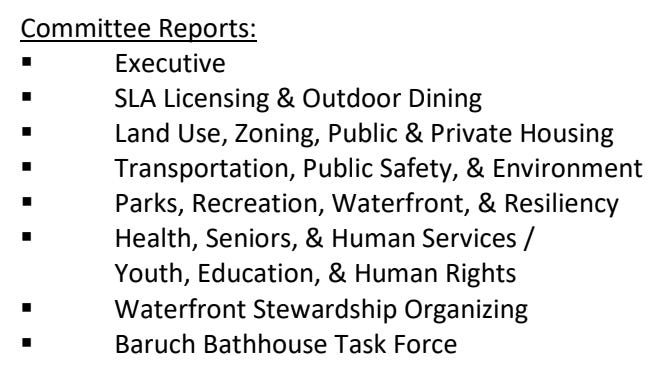
As mentioned above, every Community Board has its own set of committees that hold meetings separate from the full board meeting. In MCB3, the final section of full board meetings covers what happened at that month’s committee meetings (full board meetings occur at the end of the month, typically after all the committee meetings for the month).
Committee Chairs provide high-level overviews summarizing what was discussed and providing any additional context on resolutions that were drawn up by the committee. This may be supporting/opposing projects and proposals by agencies in the district, lists of approvals/denials for land use applications and/or SLA licenses, or more symbolic statements of support/opposition to city policies or political events.
At the end of the meeting, all MCB3 members present provide a vocal vote on all the resolutions with one of three options: Yes, No, and Abstain (effectively counts as No). To save time, MCB3 uses a process in which members can vote Yes on all resolutions with a simple “Yes” or stipulate which resolutions they vote “No” and/or “Abstain” on, with “Yes” granted to all non-specified resolutions.
Resolutions receiving a simple majority of “Yes” votes by those present pass, and those that do not are not adopted by the board. Since potential critiques to a resolution are discussed prior to this vote, a resolution that does not pass gets sent back to committee and can be revised and voted on again at the following full board meeting.
Why this matters:
To be informed about the topic a resolution is addressing or how the resolution was written, you will need to attend the relevant committee meeting. Often, most of the resolutions on the agenda at a full board meeting are not even discussed, receiving Yes votes from the CB members who trust that matters were handled in committee. Controversial or more complicated topics, like resolutions for or against zoning reform or major housing developments, are more likely to be discussed in full board meetings.
For a sample of what committee meetings may cover, I recommend checking out Zachary Thomas’ running series reporting on MCB3's Parks Committee meetings:


The full text of resolutions being voted on in the full board meeting is provided as printed handouts at the start of the meeting. Grabbing one of these, or pulling up the digital meeting agenda emailed out beforehand (subscribe to MCB3’s newsletter here to receive meeting agendas ahead of time), is a necessity to know what is being voted on.
Resolution text is rarely read out loud, and discussion as to how the resolution was written or why it includes certain clauses usually does not occur at full board meetings. Attending committee meetings can give some insight. For a full explanation of how to read and write resolutions, look out for a later part of this series.
5. Adjournment
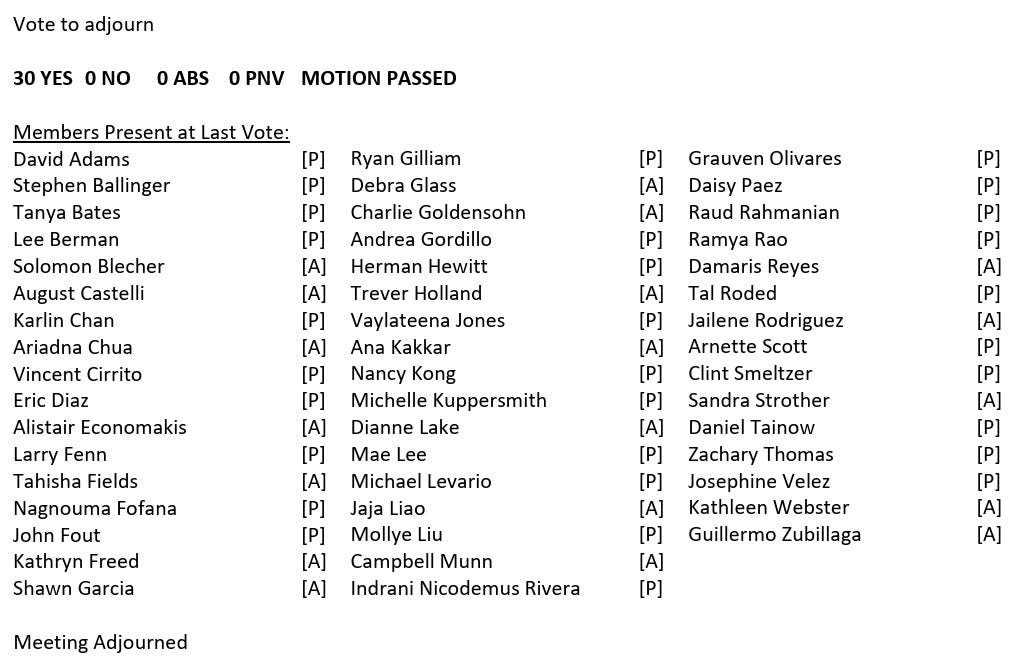
Following a full roll call and votes of all present members, the meeting is then adjourned.
Stick around and talk to your local CB members or elected officials/liaisons to voice your opinions, or head home while basking in the glory of witnessing the ground floor of NYC local governance.2
Thank you to Sachi Takahashi-Rial and Sebastian Hallum Clarke for their contributions to this guide. Check out their Substacks for more helpful and informative NYC policy content!
Note: Any opinions expressed below are solely my own and do not represent the views of Manhattan Community Board 3.
Yes, this really happens. And surprisingly, representatives will often acknowledge the chewing out and converse with said chewer-outer afterwards. This is where you can witness the interpersonal skills of politicians really shine (or fail).
I asked ChatGPT to critique this article and it said, “You often express a balanced, good-governance tone. But CB meetings can be:
messy
political
contentious
personality-driven“
Which is all entirely true! So I hope your takeaway from this article, dear reader, is not that CB meetings are perfectly run or as orderly as this article may make them seem. Left out of this agenda walkthrough is the arguing, parliamentary procedure missteps, awkward silences and even more awkward cajoling, and all the other fun interactions of local government captured well by the TV show “Parks and Recreation”.