



Cross-posting this article from Henry Grunzweig’s Substack, one of my collaborators on this project.
TL;DR:
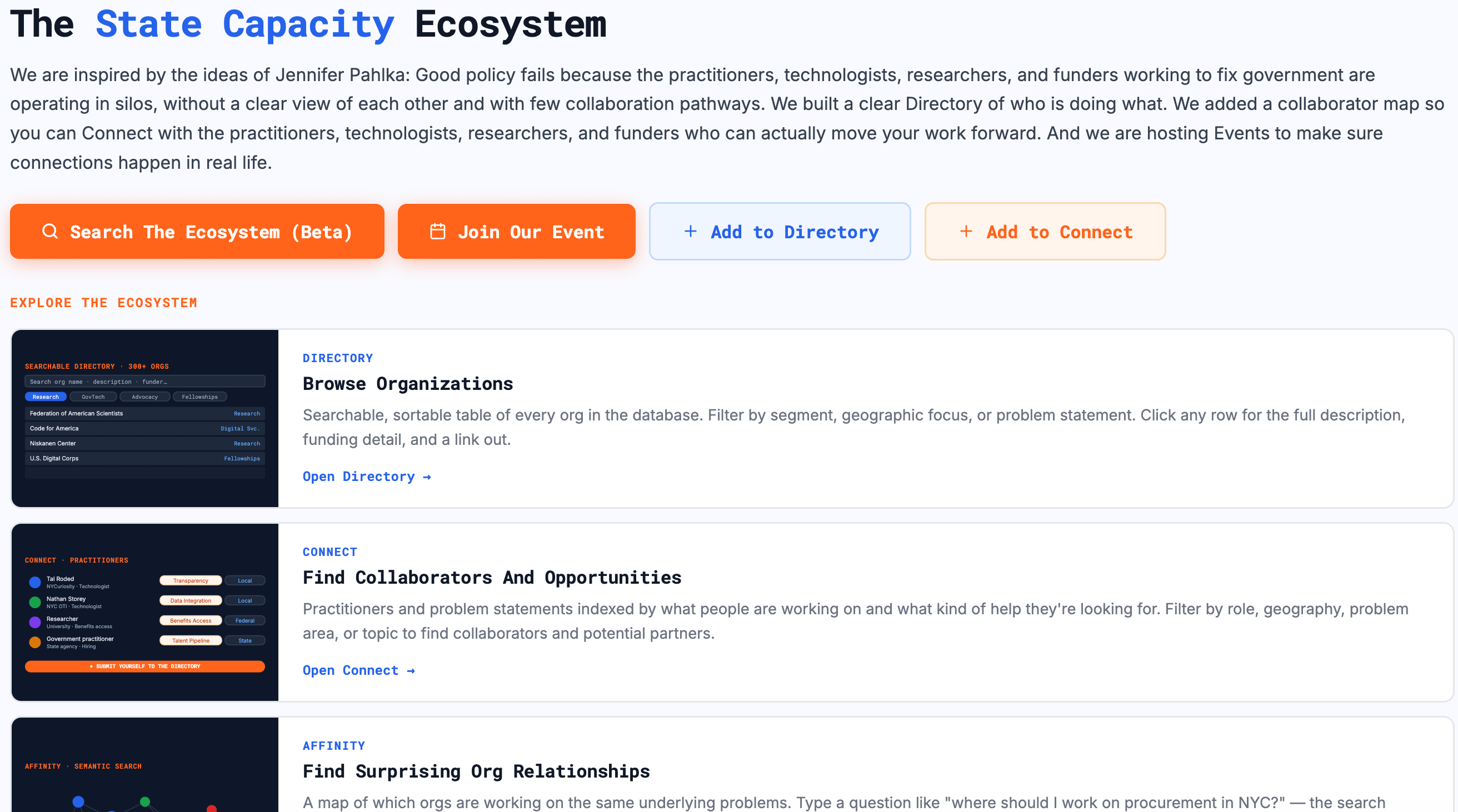
The State Capacity Ecosystem Hub is live.
Search (in Beta) curates a personalized view of who’s working on your specific areas of interest
Directory lists >300 orgs focused on government effectiveness and what they’re working on
Connect lets you add what you’re working on, seek and share opportunities, and find collaborators
Affinity helps you find surprise relationships between organizations, so you know who to work with
Two key things to do right now:
Submit yourself to Connect — tell us what you’re working on and what you need; we’ll curate a living database of challenges, funding opportunities, and practitioner partners
Sign up for our first event, a CivicTech AI Hackathon — June 24, 5:30- 9 p.m.
Why we’re building the Ecosystem
Good policy fails because the practitioners, technologists, researchers, and funders working to fix government are operating in silos, without a clear view of each other and with few collaboration pathways. Great talent is left out of the conversation, not by intent, but because it simply cannot find its way in.
We believe visibility is infrastructure. A clear map of who is doing what is the first step toward State Capacity acting like an ecosystem and not just a collection of isolated players.
Our goal is to help create that well-functioning ecosystem: one where every participant knows what the others are doing, sees them as collaborators rather than competitors, and can access shared knowledge and resources when they need them. Great theory gets operationalized. Hard-won practitioner knowledge travels. Capital flows toward the gaps, not just the familiar names.
Overview of the Tools
Search (Beta), located on the Hub, returns results relevant to you based on a mad libs-style interface that allows you to select your role, what you’re seeking, a problem area, and a geography. This feature can only show what currently exists, and will improve as we add more organizations and individual connections.
Directory offers you a view of all the organizations in the Ecosystem. Use it to understand who is working on what. Filter based on segment, problem statements, geographic focus, and more. It offers a more holistic view than Search’s curation.
Connect is the layer we’re most excited about. Find real people and organizations working on problems you care about. More importantly, submit what you’re working on so that others can find you. Together, we’ll curate a living, breathing picture of who’s working on what in the Ecosystem.
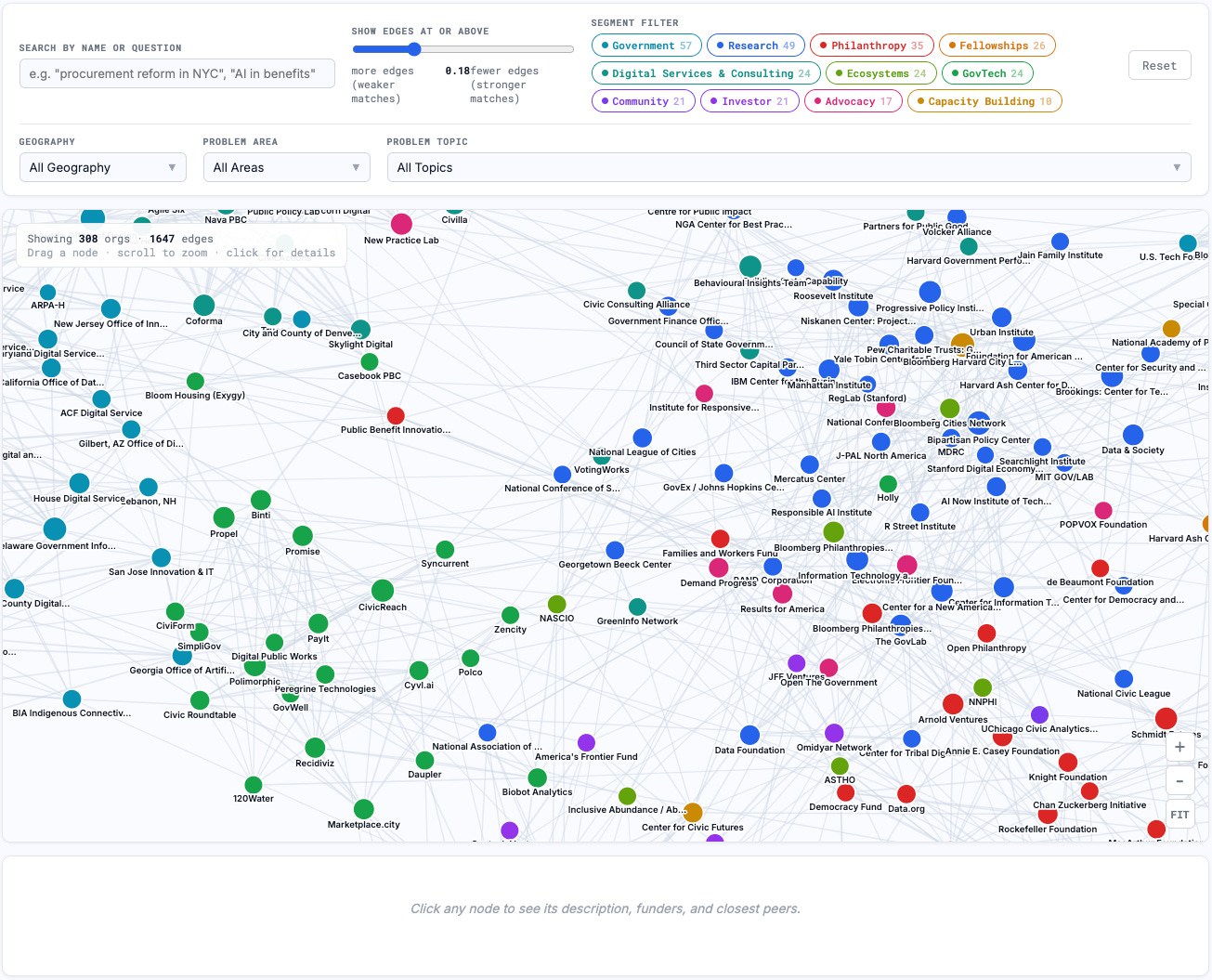
Affinity helps you find surprising relationships between organizations based on shared problem areas, overlapping funding sources, and description similarity. Use that knowledge to re-envision who you can work with and on what.
About the event
On June 24, we’re hosting a one-evening hackathon for civic technologists, government practitioners, students, and anyone else who wants to build tools that help strengthen our government’s ability to deliver.
The goal is connection, not perfection. Find collaborators interested in the same topics. Build quick, working prototypes that take ideas from -1 to 0 and show whether an idea is worth pursuing. See if someone in attendance can help connect you to the right folks to turn that idea into something real.
Check out the event page for more information.
How you can help
When we delivered the first version of the Ecosystem, we effectively shared a list of orgs, and an incomplete one at that. Folks appreciated the clarity it brought to who is working on State Capacity, but there was no way to act on that clarity. Dozens of follow-on conversations informed how to make our map more useful: living problem statements, the ability to find collaborators, and hosting live events move us from theory to action.
Chances are this version of the Ecosystem isn’t perfect either. You can keep helping us improve it. Add your organization and your problem statement. Join our events and host your own. Reach out with feedback.
Our hope is that our work echoes the lessons of State Capacity: agile delivery, test and learn methodologies, shared evidence, scalable results.
The closing message
Delivering State Capacity may be hard, but the roadblocks aren’t mysterious: they’re structural. Knowledge doesn’t travel because there’s no infrastructure for it to travel on. Capital concentrates because funders fund what they can see. Practitioners work in isolation because isolation is the default.
This is why we’ve built the Ecosystem, but it is only as helpful as the community behind it. And there are a million other ways folks can build out the infrastructure further in their own ways.
The State Capacity Ecosystem already exists. It just needs to act like one. Let’s build it together.
I wish I could make the hackathon! The stuff you're building is seriously so cool.