


TL;DR:
What: Public Engagement Hackathon, the State Capacity Ecosystem’s second flagship build event.
When: Wednesday, September 30, 5:30 pm to 11 pm. Matchmaking at 5:30, builds from 6:30 to 9, demos at 9, social hour after.
Where: Sign up to view location
Sign up: Register on Luma. Dinner will be provided.
Partners: CUNY PIT Lab, Civic Roundtable
Judges: Raj Korpan (CUNY PIT Lab), Jeremy Ney (American Inequality), Sara Lind (Open Plans), with more to be announced.
Want to find teammates before the event? Be the first to hear about future events? Help build the State Capacity Ecosystem? Join the SCE Slack.
At the first State Capacity Ecosystem build night, 80+ attendees produced 20 working tools that addressed real government tech gaps in under two hours. The takeaway wasn’t just the technology itself; the magic was in watching the force multipliers of the State Capacity Ecosystem. A practitioner who has lived inside a problem can now describe it to someone who can build against it, and the two of them can have a working prototype before the end of the night.
Our team wrote a bit about what those prototypes looked like here and spotlighted some of the products that shipped.
On September 30, we’re running it back. This time, the night’s problem statements are centered on how New York actually hears from New Yorkers. The city has no shortage of input channels: it has 59 community boards, a 311 line, participatory budgeting, and public hearings on everything from liquor licenses to land use, all meant to allow public feedback into city processes. But it lacks the tech infrastructure in many cases to make the information generated from those channels actionable, representative, equitable, and connected to outcomes.
Stream One: Community Boards Ops
CBs have a lot to listen to and track, with almost no supporting tools
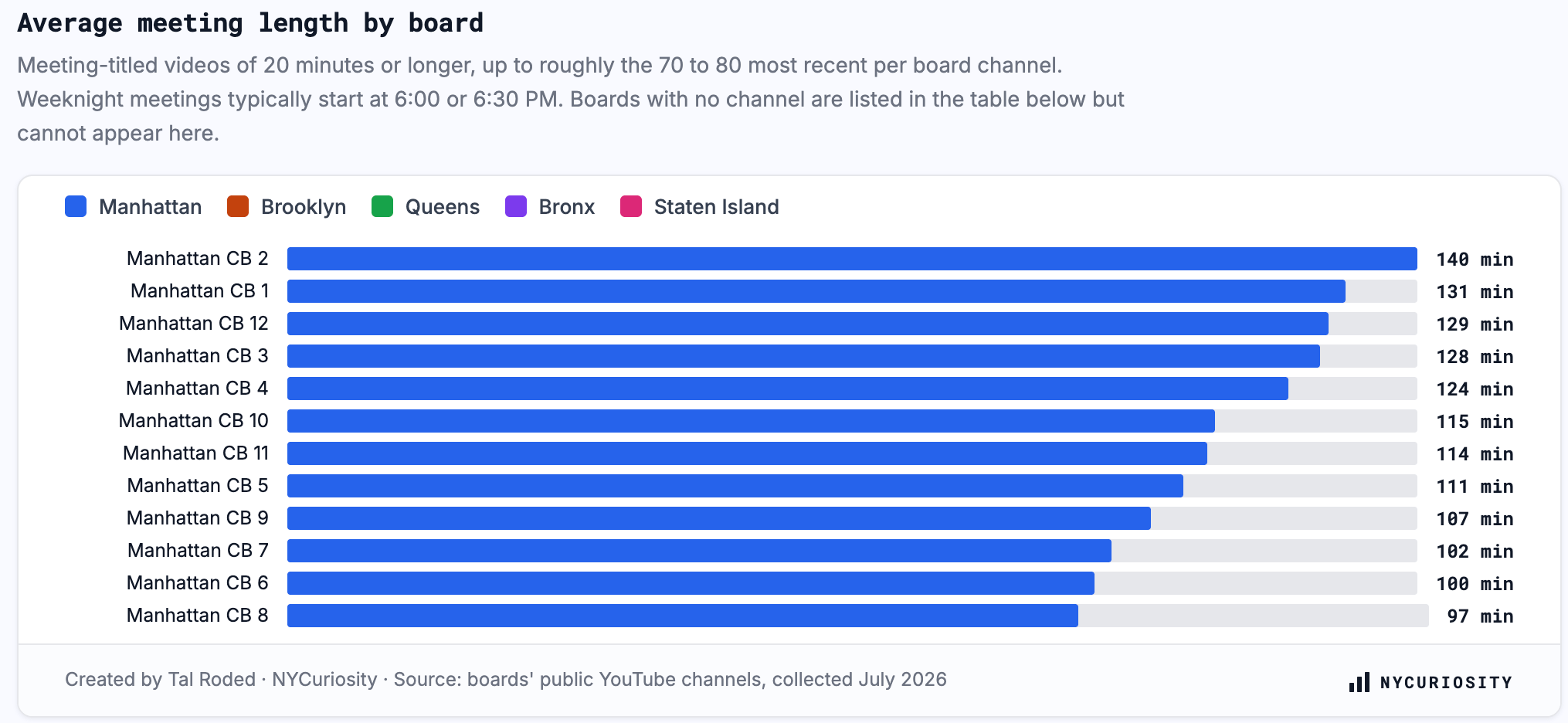
Community boards (CBs) are the city’s ground floor for public input: every land use action, liquor license, and street redesign passes through one of the 59 boards, and each board runs on volunteer members, a staff of two or three, and whatever filing system it has improvised on its own. Unfortunately, tech tooling for CBs is nearly nonexistent (and probably not a historically attractive venture capital market).

Here are three possible build paths for participants:
A meeting assistant. Robert’s Rules and parliamentary procedure trip up new members constantly. CB resolutions get drafted from scratch each time. A procedural helper or a resolution writing agent might solve hours of headache for CB members.
A member educator. Term limits from the 2018 charter revision force the first wave of open community board seats in 2027, which means hundreds of new members learning the job at once, and onboarding today is weak. An AI assistant or a data-backed member guide would arrive at exactly the right time.
An end-to-end resolution tracker. Boards pass resolutions addressed to agencies: Transportation Committee resolutions to the Department of Transportation (DOT), Parks Committee resolutions to the Parks Department, so on. Then, in many cases, nothing visible happens. A tracker that connects each resolution to its target agency and follows what the agency actually does would give boards something they might lack: clear evidence of whether anyone listens.
The data is plentiful but dispersed. NYC Planning’s Zoning Application Portal carries every Uniform Land Use Review Procedure (ULURP) action, the Community Boards dataset is on NYC Open Data, and the NYC Council’s Legistar has a public API. On my data website, I have already aggregated all 59 board websites, members, and leadership in one place. And of course, I have to plug Block Party, which has meeting transcripts and extracted resolutions ready to query for many community boards.
Stream Two: Public Voice At Scale
Governments take in a lot of citizen feedback, but is that feedback inclusive, fair, and effectively digested?
City Hall frequently holds hearings to understand public sentiment on high priority topics and issues. Agencies engage with communities to learn how they can best help constituents. New Yorkers filed 3,655,040 requests through 311 in 2025, about 10,000 every day. Democratic participation is great, but how and when citizens interact with the government can introduce significant bias and complexity to analysis: who gets to offer the feedback, how is each piece of feedback weighted, and who hears it? Ideas here include:
A complaint-pattern dashboard with a residual map. Model expected complaint volume for each district from its conditions, then map the gap between expected and actual. Where complaints fall well below expectation, you have likely found under-served blocks. Experts like Vital City’s rolling “CrowdVox” interviews could then validate whether the lack of complaints might mean community satisfaction or resignation.
A citizen-observation toolkit. The Central Park Squirrel Census proved that volunteer observers can produce a real dataset (3,023 squirrels, counted block by block). How might the city harness citizen energy and collective observations for other needs: on potholes, blocked bike lanes, broken park lighting, or otherwise? What tools might facilitate the collection, analysis, and display of such data?
Tools that serve the marginalized voice. Cluster participatory budgeting ideas by neighborhood and theme, mine the Council’s hearing archive to analyze public testimony at scale, or geo-tag social media conversations to neighborhoods, topics, and agencies, turning real unstructured public voice data into something an agency or a board can act on. Build agents that support language translation where human translators might not be available. Leverage technology to reach folks whom the government does not reach today
Participants might utilize the 311 Service Requests dataset, which covers every request since 2010 with location, type, agency, and resolution fields, as their base data layer. Social media data or public comment data are underused by the city and provide live feeds of the public voice. Or builders might instead prioritize tools that help generate new data from historically underserved and underheard constituents.
Stream Three: Judges Specials
Our Judges are mulling over problem statements of their own. Builders might decide to “play it by ear” and generate novel solutions day of.
This is a dealer’s choice category. Here are a couple of ideas the judges have floated thus far, and we expect more to follow:
How can we create a Big Tent that includes many different voices/organizations but does not find itself struggling with an ‘everything bagel liberalism’ where nothing gets done because the org has bitten off too much?
Could we map the areas around transit stations in NYC that are not zoned for residential but probably should be to increase transit-oriented housing (these would be C8 or M1 zones)? With a particular focus on the Bronx.
Get to know the judges
The judges attending the 9/30 hackathon are experts in these topics, and they’re excited to see what you can build for them.
Raj Korpan, CUNY PIT Lab.
Raj Korpan is an Assistant Professor of Computer Science at Hunter College, CUNY. Raj researches artificial intelligence, human-robot interaction, explainable AI, and socially aware robotics through Hunter’s Trustworthy, Intelligent, and Explainable Robotics (TIER) Lab. Expect him to push teams on who their AI is designed for, whose perspectives are missing, and whether they have built meaningful mechanisms for trust, explainability, inclusion, and community participation into the product.
Jeremy Ney, author of American Inequality.
Jeremy maps America’s regional divides county by county for more than 25,000 readers, work that has been covered by TIME, The New York Times, and NPR, and he publishes the underlying maps and datasets at americaninequality.io. In his spare time, he is also a full-time employee at Google and teaches as an adjunct professor at Columbia. Expect him to push teams on how data can reveal the less obvious relationships behind social problems, distinguish signal from conventional wisdom, and turn those insights into solutions that can meaningfully improve people’s lives.
Sara Lind, Co-Executive Director at Open Plans.
Sara Lind is Co-Executive Director at Open Plans, a nonprofit with the mission to transform how people experience New York City’s streets and public spaces. She has guided major public policies, driven agendas in City Hall and in Albany, and shaped the narrative on how to make New York’s streets more livable, safer, and joyful. Expect her to push teams on how technology can create stronger connections between public voice and the public realm, giving New Yorkers a meaningful role in shaping the streets and spaces we share.
Additional Judges to be announced!
How the evening runs
5:30 to 6: Facilitated team matchmaking. Color-coded name tags mark your problem-area interest and role so you can find a team quickly. You can also join our Slack to find a team ahead of time.
6 to 6:15: Introductions. A short welcome from us, CUNY, and our judges.
6:15 to 6:30: Breakout Q&A with the judges, then final team selection.
6:30 to 9: Build time. Dinner arrives around 7, and we run hourly check-ins.
9 to 10: Demos. Three minutes per team: one minute of demo, one minute of judge Q&A, and the next team prepping in the background so the hour moves.
10 to 11: Informal social hour at Clinton Hall (16 W 36th St., New York, NY 10018)
What winning teams get: Big kudos, a spotlight slot on the SCE website and at a follow-on demo night, and potentially a special surprise on the day-of.
Come build with us
June proved that the State Capacity Ecosystem community can ship viable solutions to important problems. September 30 asks builders to use those skills to help New Yorkers feel heard. If you work in or around government, study it, advocate for a neighborhood, or build tech products, there is a team on the 30th that needs exactly what you know.
Register for the Public Engagement Hackathon on Luma
While you are at it, join the SCE Slack to follow the run-up, and subscribe to the SCE Substack for updates.