


Following the death of two pedestrians due to a speeding vehicle on Canal Street in July 2025, the NYC Department of Transportation (DOT) initiated several immediate design changes to reduce vehicle speeds coming off the Manhattan Bridge. This includes reducing the speed limit to 20 MPH (which required a 60-day comment period, initiated Aug 8th, before taking effect) and creating additional signage and street markings. Such minor changes, similar to ones already implemented in 2015/2016, have shown to be ineffective at eliminating traffic fatalities, nor do they address congestion concerns. If DOT is serious about reaching its Vision Zero goal, it will take a more complete and permanent redesign of Canal Street.
That is precisely what DOT’s long-delayed Canal Street Safety Improvement Proposal aims to do, by widening sidewalks, reducing pedestrian crosswalk distances, and adding car-free spaces and protected bicycle lanes along the entire street.
At the September 2025 Full Board meeting of Manhattan Community Board 3, there was discussion brought forth by several local representatives, as well as by the CB3 Transportation Committee Chair, regarding DOT’s proposed redesign of Canal Street. Canal Street has been the site of numerous traffic accidents and pedestrian fatalities over the years, particularly on the section coming off the Manhattan Bridge. In addition, narrow sidewalks and minimal parks and pedestrian plazas along this storefront-heavy central corridor have led to pedestrian overcrowding, with tens of thousands of residents and tourists crowding onto street space adjacent to endless vehicular traffic. Compounding all this is a distinct lack of markings for crosswalks or dedicated bike lanes and an abundance of vendors and street sellers, many operating without permits.
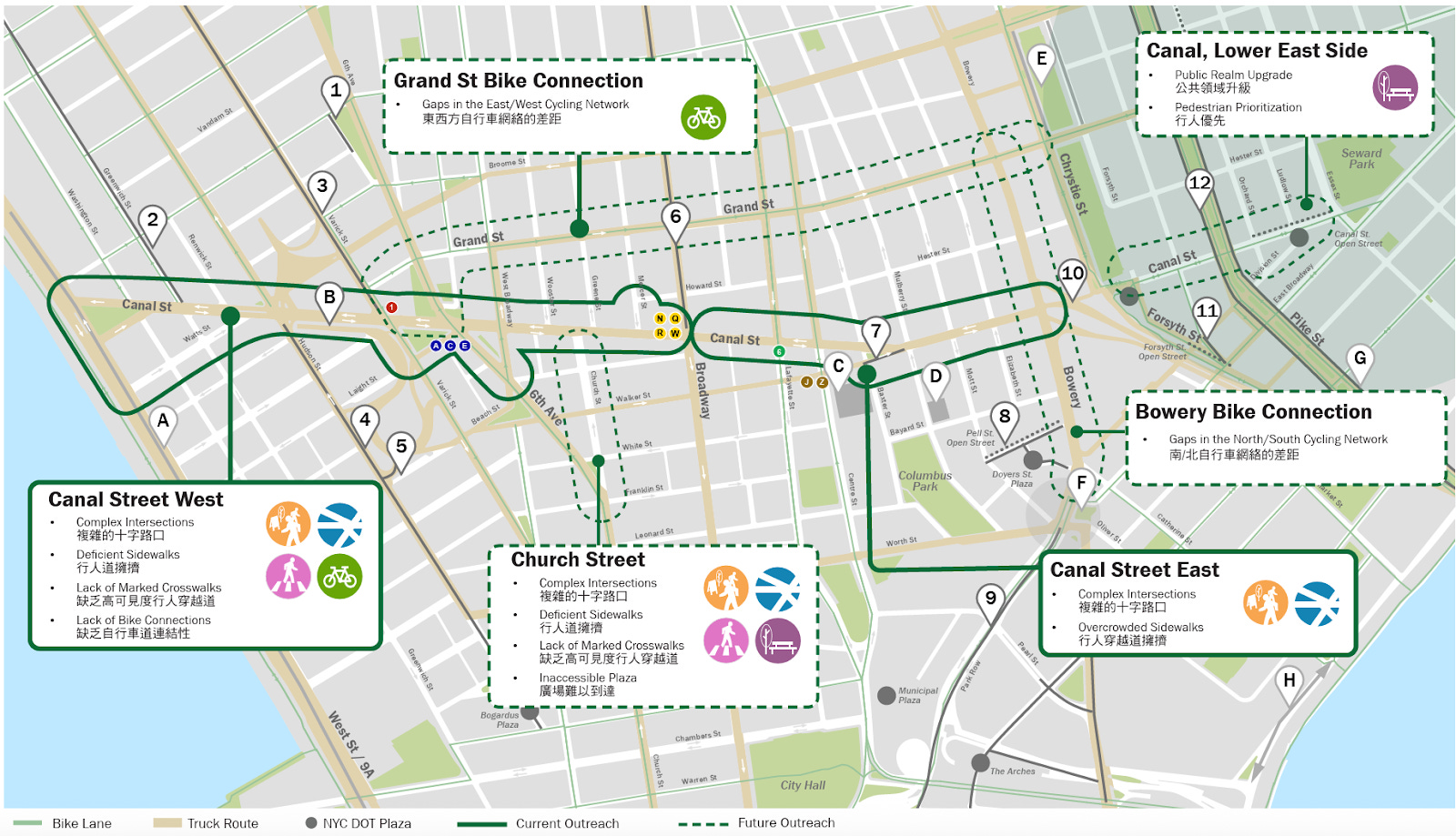
In this article, I will take a look at the data showing why a redesign is necessary and should be prioritized by DOT. I will also share the progress that has been made on the safety improvement proposal so far, and how residents of NYC and readers of this post can get involved. With DOT having recently opened a public survey requesting feedback, this is a pivotal moment to help shape the design of a major thoroughfare and improve the lives of Lower Manhattan residents and visitors.
The Ugly Data on Canal Street
The entire stretch of Canal Street from West Street (in the west, no surprise there) and Bowery (in the east) to the Manhattan Bridge connection has long been an endless traffic congestion zone. Looking at May-June 2023 traffic data collected by NYC DOT’s Automated Traffic Recorders, over a thousand cars pass through Canal Street per hour during peak times. Compare this to a similar street like Grand Street in Brooklyn (a connector to the Williamsburg Bridge), which during peak hours in 2022 averaged around 200-300 vehicles per hour, only 20% of Canal Street’s traffic volume.1 Similar volumes to Grand Street are also experienced on nearby and parallel streets to Canal, like Worth Street and Spring Street. The vast majority of these vehicles are also through-traffic, as less than 1 in 4 households living within a quarter-mile of Canal Street own a car.
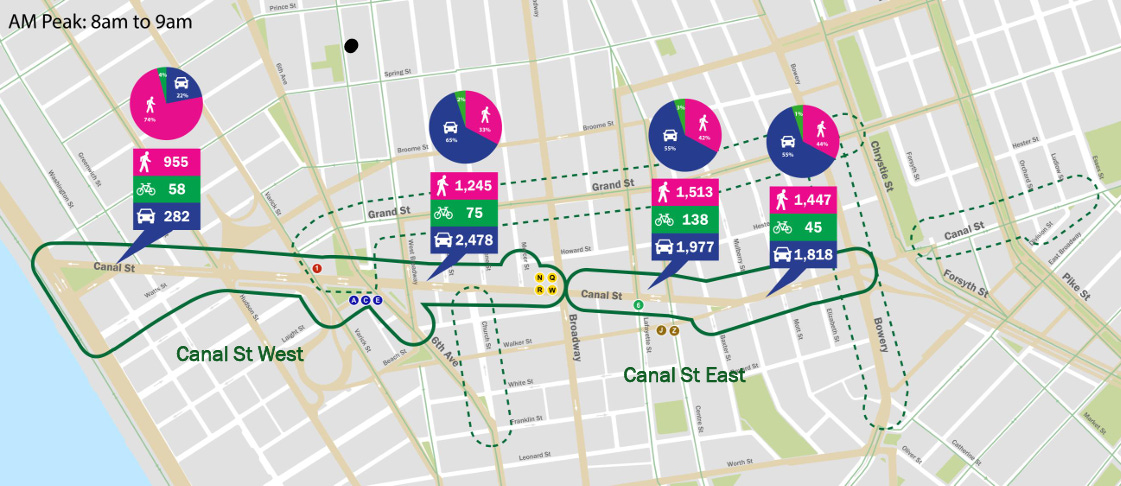
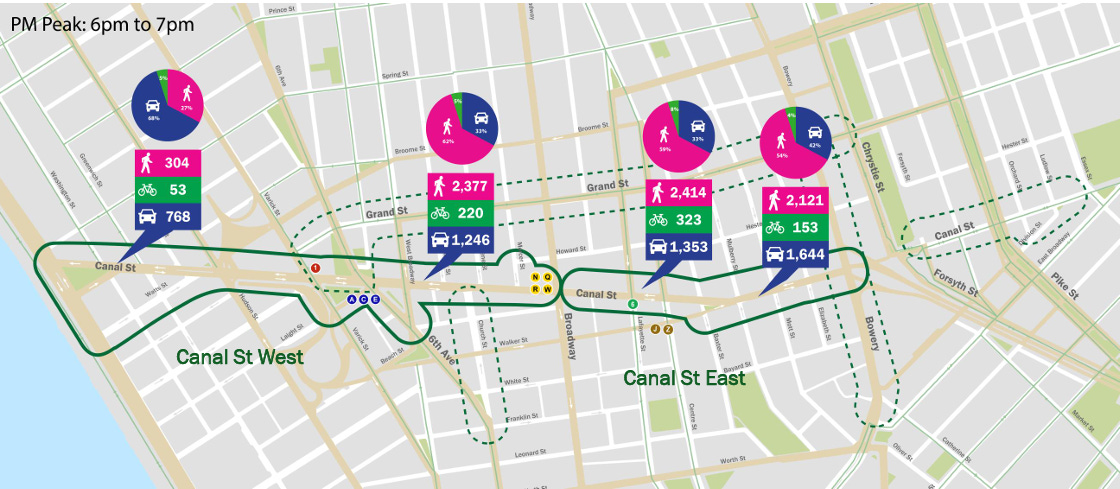
Meanwhile, side street connections and the Manhattan Bridge off-ramp have been subject to numerous traffic collisions and fatalities over the past several years. NYC Crash Mapper data counts 692 crashes along Canal Street between July 2021 and June 2025, resulting in 45 pedestrian injuries and 45 cyclist injuries. Nearly all these incidents with specified factors involve driver error or unsafe driving behavior.
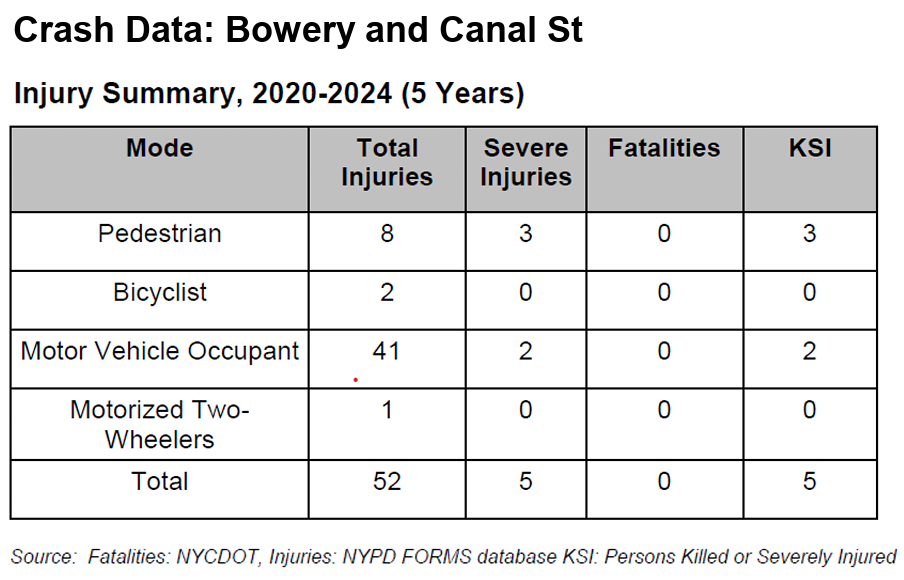
NYC DOT data also shows that over 50 injuries caused by crashes occurred between 2020 and 2024 on the intersection of Bowery St and Canal St, with 10% of those involving serious injuries. The entirety of Community District 3, which encompasses this portion of Canal Street, averaged 45.8 traffic injuries and 0.3 traffic fatalities in 2023. With a population of around 153,000, this comes out to about 70 traffic injuries in a typical year, meaning that this single intersection is likely responsible for around 15% of the entire district’s traffic injuries.
What’s in the Redesign & How It’s Progressing
The current Safety Improvement Proposal presents more effective, more permanent solutions that would be a win for both pedestrians and drivers. Preliminary analysis conducted by DOT has found that the redesign would improve safety for pedestrians while simultaneously reducing traffic congestion for vehicles.
“A robust traffic analysis showed the proposed treatments would lead to shorter pedestrian crossing distances and reduced cut-through traffic at major intersections. The proposal would also simplify travel for drivers by reducing conflicts with pedestrians, encouraging through traffic to avoid smaller side streets, and simplifying complicated intersections across the corridor.”
The main goals and elements of the proposal are:
Relieve pedestrian crowding & improve sidewalk accessibility
Achieved by reducing crossing distances with full block sidewalk extensions along the entirety of Canal Street
Enhance crossing safety & comfort
Achieved by installing new marked crosswalks and painted curb extensions for shorter, safer crossings on six separate intersections
Simplify complex intersections for all users
Achieved by shortening crossings with a concrete island on the intersection with 6th Avenue and closing (from cars) Walker Street from Baxter Street to Canal Street
Rebalance vehicle space with public space
Achieved by streamlining curb regulations to meet curb access needs and moving local deliveries from Canal Street to side streets
Improve bicycle network connectivity
Achieved by creating new bike network connections with protected bike lanes on the connection to Watts Street and the stretch between Hudson Street and Varick Street
At the end of the September CB3 meeting, the full board held a vote and approved the CB3 Transportation Committee’s resolution in support of the Canal Street redesign. While support from CB3 means the DOT redesign will not be inhibited from this stage of the policymaking process, it does not provide any guarantee or impetus for DOT to actually move forward with implementation. DOT launched a similar study two years ago, but did not follow up with any actions. The most recent timeline provided by DOT states that public engagement and presentations at community boards will continue until Spring 2026. The actual start for the proposed redesign is not anticipated until July 2026.
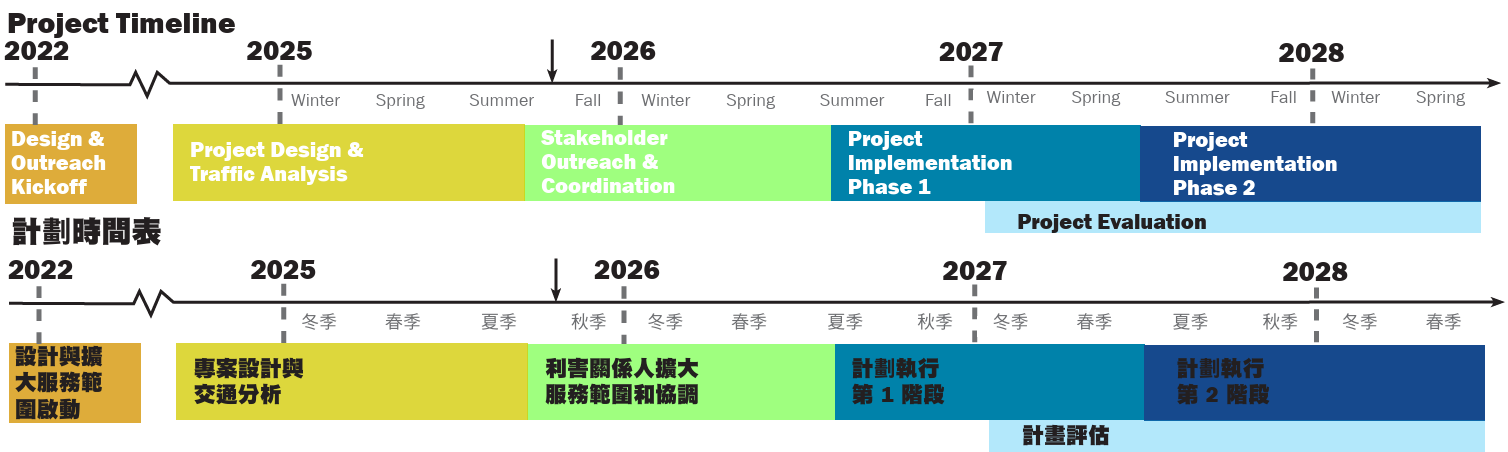
While the agency continues the important step of gathering public feedback and support for the project, mounting pressure due to continued traffic casualties may finally spur action on this proposal. Every month that the street remains in its current form is another month where crashes are likely to happen and pedestrians are likely to get injured or killed. However, if elected officials step up their calls for improved traffic safety and offer real support in resourcing and financing for such projects as Canal Street, then the redesign may finally come to fruition soon.
Conclusion
Throughout the discussions concerning the Canal Street redesign, all parties expressed their support for the DOT’s proposals - the elected officials, the CB3 Transportation Committee Chair, and the community board members present. If there was any opposition at all, it was to how long the DOT has spent crafting its proposals and the delays in implementing the project. However, all stakeholders also expressed support for the DOT holding public input workshops, which will occur over the next several months and may delay executing on such proposals. The desire to allow ample time to gather public feedback while also speedily moving forward with essential public infrastructure and improvement projects is a core tension in community boards.
DOT has also released a public survey requesting feedback to measure support for the redesign and additional comments. I highly encourage all NYC residents who care about street safety to fill out the survey and show DOT their support for the redesign, while urging them to move forward with the changes immediately. Note that the current request for comment is for the sections in the above map marked in solid lines, and that the dotted line sections will be subject to future outreach. Marking your support for the project only takes a moment, but it can have a huge impact on DOT’s decisions to prioritize and complete this project.
For those who would also like to provide comments to further encourage DOT to speed up its redesign, Transportation Alternatives has provided the following helpful sample responses, which I have pasted below:
Question 1:
Canal is one of the most dangerous streets in Manhattan. Fixing it is long overdue. Wider sidewalks and shorter crossing distances are a crucial step forward. It’s also great that Walker Street is being closed to traffic, and that the Grand Street bike lane is becoming two-way.
Question 2:
We can’t wait years for safety — DOT should speed up the timeline and start implementation ASAP, not next summer. To make room for pedestrians to walk and cross safely, Canal needs super sidewalks and shorter crossings across the entire length from Bowery to the West Side Highway. Traffic is down in Lower Manhattan, and a street that serves huge numbers of pedestrians is unsafe with more than four lanes.
There should be hardened daylighting all along Canal to protect pedestrians. In particular, the lack of hardened infrastructure at Canal and Bowery is a glaring omission from the current plan, when two New Yorkers were killed there just a few months ago.
Another street that mirrors Canal Street’s direction in usage is Houston Street, a connector to the Williamsburg Bridge, also experiencing over 1,000 vehicles per hour during peak times. While certain parts of Houston Street have seen street improvements with protected bike lanes and improved traffic markings, this street may present another opportunity for DOT to implement a comprehensive redesign.
Do you know when the next public input session would be? Like are they going to other CBs soon where people could come and voice their approval in person?