


The growing list of overreaches and abuses of power by President Donald Trump has had detrimental effects on American society and the national economy that are only beginning to be felt. Other examples of misuse of power by elected officials can be found on more local levels too, like with NYC Mayor Eric Adams’ corruption cases or ex-NY Governor Cuomo’s use of his office for power trips.
In times like these, it is tempting to want to restrict the power of executives and prevent such abuses from being further perpetuated. Reasonable checks on authority are sensible, and limits on executive power are necessary to prevent despotic rulers. But such checks on power themselves should be measured and justified, to prevent stripping executive offices of their agency and completely hamstringing their ability to govern. Weak and ineffectual executive offices only serve to further corruption and inefficiency in government. The executive branch itself must also serve as a check on legislative branches at the federal, state, and local levels, and can only do so when imbued with a certain level of power. Therefore, an overcorrection in dismantling the executive office can be just as harmful in weakening the political system and disabling leaders from performing their duties.
Empowering Competent Executives
Enabling executives to act is particularly important to preserve the ability for political leadership to drive change in difficult times, allowing those who would wield such offices to take action. While reading Doris Kearns Goodwin’s excellent biography of the lives of two American Presidents who were leading voices of the Progressive Era1, I found that both Roosevelt and Taft were believers in and examples of the potential of right-minded leaders granted the space to use the powers of their position. Both men used their positions to fight the injustices arising from the concentration of corporate power and political machines of the Gilded Age. In examining the qualities and actions of these two men, I find models for leadership and a powerful argument for giving the right people in public roles the ability to act on their beliefs.
Theodore Roosevelt himself spoke of the need for unchaining leaders and executives in the public sector. As he wrote in his 1913 autobiography,
I believe in a strong executive; I believe that the duties of government should be discharged by capable men, not fettered by routine or red tape.
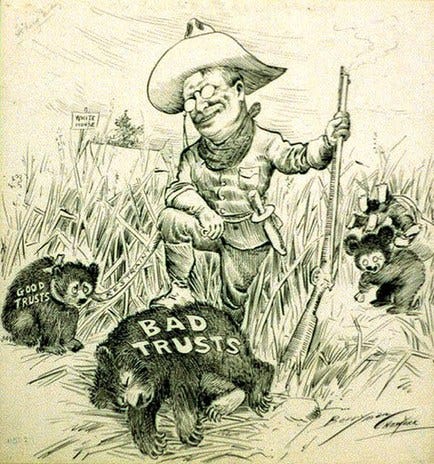
The core idea here being that if you don’t let “good men do good work”, then bad men will find workarounds and do bad work anyway, while the good men will be powerless. In times like today, when we find rampant abuses of political power and poor leadership, there is a temptation to instill greater restraints on executive offices. But this would be the wrong move, playing into the hands of bad actors who will simply find ways around the rules (or completely disregard them from the start) and discouraging the exact leaders we need to take up the mantle of the presidency. Rather than determining how to weaken already overburdened government processes by adding more layers of red tape, we should focus on how to find and encourage the types of leaders our country needs. These capable leaders must then be empowered to act, or we risk prioritizing inefficiency and further promoting corruption to fill the power vacuum.
When I look back on times of crisis in the U.S. - the Civil War, the Great Depression and World War 2 - the key pattern that emerges is a strong leader who acted largely unfettered and unobstructed. Abraham Lincoln served as an active and involved Commander in Chief, replacing Union Generals who displayed incompetence and even (controversially) suspending the writ of habeas corpus. FDR constructed entirely new government agencies and rewrote the structure of bureaucracy to fight the Depression, himself controversially threatening to pack the Supreme Court when they fought against his efforts. I do not defend all these decisions as perfect or even necessarily right. In the hands of corrupt or ill-intentioned leaders, these would be frightening and dangerous acts. But it was the very ability to act nearly unilaterally - with checks on their power occurring only when stepping too far - that enabled these executives to steer the ship through stormy waters. Lincoln’s and FDR’s confidence that they could do what was needed to lead the nation through crisis serve as further models of effective executive agency.
Meanwhile, pre-Civil War President James Buchanan attempted to please all parties and left slavery decisions to the states, a passive role that consequently accelerated the path toward secession for Southern states. Herbert Hoover’s similar refusal to extend the powers of the federal government in response to the Great Depression did nothing to slow the downward spiral and ended with his name glorifying the Hoovertowns that popped up nationwide. These men voluntarily self-limited the role of the President to command and to use the powers of the office, and in both cases the country paid dearly. An encoding of their policies in law, preventing their successors from acting more vigorously, would have doomed us entirely.
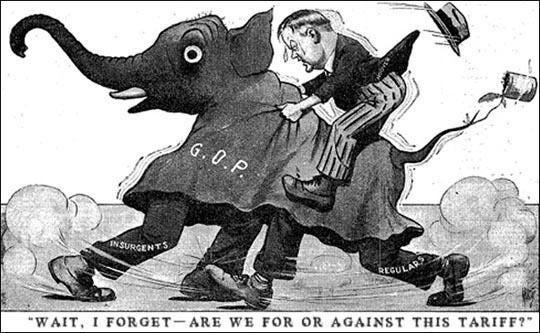
Progressive Era Models of Strong Executives
Roosevelt and Taft present two archetypes of strong political leaders and effective executives. Each displayed a rare-for-the-time passion for acting in the best interests of the public and using government to fight for the working class. Roosevelt took up the mantle of progressive reform early, giving impassioned speeches in the New York State Assembly and becoming a Civil Service Commissioner, where he worked to dismantle the spoils system. Taft came about progressive reform in a more roundabout way, prosecuting corrupt men in court and receiving endless praise for his energetic leadership as the Secretary of War under President Theodore Roosevelt.
Despite each man having extensive experience fighting corruption and misuse of power, neither advocated for a complete weakening of public offices. They recognized the need to let capable leaders act. Much of Roosevelt’s time in executive office involved speaking to the leading Progressive reformers, shining the spotlight on those succeeding in driving change, and drawing attention to the issues they believed required work. While executives should be checked by the other branches of government, they should not be hamstrung and unable to effect any change whatsoever. Otherwise, our executives become little more than ceremonial leaders, and power is given by proxy to other branches of government, which have their own issues of corruption and misuse of authority.
In his inaugural address upon being elected governor of New York, Roosevelt said that nothing would be accomplished, “if we do not work through practical methods and with a readiness to face life as it is, and not as we think it ought to be.” Roosevelt would go down in history as one of the most successful reformist governors2 (and later President), not due to his pure idealism and adherence to progressive principles, but because he accepted the reality that reform is achieved through vigorous leadership, collaboration with campaigns driven by the public, and fair compromise.
Strong Leaders Cooperate with the Will of the Public Citizenry
However, it would also be a mistake to assume that change is driven solely by top-down action, or is even possible without the support of a wide base. Effective leaders recognize that they must act with the support of the public and can use the demands of their constituencies to achieve change. In this way, democratic leaders can and should exert their powers to drive action aligned with the will of the public. Another trait that Theodore Roosevelt, Lincoln, and FDR all shared in common was an impressive ability to sense public opinion and act accordingly.
As Goodwin repeatedly makes clear throughout the narrative, Theodore Roosevelt would not have been able to execute his reform agenda without the support of the public. Only through the decades of work by prior reformers and the attention-shifting articles of McClure’s magazine journalists who shed light on issues of corruption and injustice could Roosevelt push his policies through Congress. In fact, Roosevelt himself was often given ideas of where to concentrate his efforts by the articles he read in McClure’s and the conversations he held repeatedly with its journalists. Roosevelt and the journalists’ collaboration is a model of a successful symbiotic relationship between leadership and the public, with only the combined power of the two being enough to overcome the business trusts and conservative Congressmen.

What is key, however, is the trust that developed between the reformers and journalists on the ground and the executives like Taft and Roosevelt. Upon exposing corruption in cities, states, or on the national level, McClure’s writers did not call for a complete shackling of political power in those positions. Rather, they threw their support behind the reform candidates and led popular movements to place public-minded characters in charge who could wield the power of their offices for good. Had the reform movement insisted upon handcuffing the powers of these offices instead, progressive leaders would have had no opportunity to enact their own agendas or improve the lives of their constituents. Instead, newly elected officials who replaced those exposed as corrupt were able to enact the reform that the public so greatly desired.
Despite seeing and exposing corruption in executive offices up close, McClure’s journalist Lincoln Steffens realized the answer was action, not the blocking of future action. As he wrote when covering municipal corruption for Outlook Magazine,
“...the twin stupidities which dull the conscience of American municipalities - the optimism which says that all is so good that nothing need be done, and the pessimism which says that all is so bad that nothing can be done.”
Conclusion
The excessive roadblocks we have erected at all levels of government may be partially to blame for many of the inept leaders we find ourselves subject to today. Layers of regulatory red tape diminish the ability of bureaucrats to effectively administer government programs or implement new policies. Increasingly high requirements of votes for legislation have reduced Congress’s ability to pass new policies at all, and thrown more power to the other branches of government by default. Even excessive processes at the local level, like endless environmental reviews and tight land use and zoning restrictions, have contributed to the cost of living crisis that has driven many to vote against their interests, desperate for anyone who promises change3.
To deny effective action to government actors, through the erection of excessive regulatory burdens or the stripping of power from executive offices, is to fall prey to this pessimism that nothing good can be done by such governmental powers. In the wake of corruption and misgovernance we currently see, the national response should not be to shackle the presidency and throw more power to a gridlocked Congress or unknown federal judges. The better path would be to find and elect new leaders who are not afraid to use the powers of their office to restore proper governance and shared national prosperity.
How to achieve this is not a clear or straightforward answer. If the Progressive Era taught us anything, however, it is that fighting corruption and consolidation of power in the hands of bad actors must occur on all fronts. Investigative journalists exposing misdeeds, local politicians and community leaders driving civic participation, and state and federal leaders working in collaboration with each other and citizen leaders. The good news is that such popular movements have roles for everyone, and you can participate regardless of your occupation, geographic location, or societal standing. It begins with taking a role in your local community and supporting the leaders who will pursue similar initiatives on the national scale with vigor.
All quotes and statements attributed to Theodore Roosevelt, William H. Taft, and the McClure’s Magazine journalists in this article come directly from Doris Kearns Goodwin’s “The Bully Pulpit” book.
Goodwin, Doris Kearns. The Bully Pulpit: Theodore Roosevelt, William Howard Taft, and the Golden Age of Journalism. Simon & Schuster, 2013.
Roosevelt passed “legislation establishing an eight-hour day for state employees, limiting the maximum hours women and children could work in private industry, improving working conditions for children, hiring more factory inspectors, and mandating air brakes on freight trains.” It was because of, not despite of, Roosevelt’s willingness to meet with both the party bosses and the reformist journalists that he was able to marshal through such progressive change while NY Governor. And it was because of his power in the offices of the Chief of Police and Governor that he was able to push through badly-needed reform.
Also interesting is that one of the key tenets of Roosevelt's Progressive Party platform of 1912 (AKA the Bull Moose Party) was addressing the high cost of living. The platform advocated for government involvement in removing artificial constructs to development, combining an argument for enabling government power with the need to remove unnecessary red tape. Effective government is empowered without overreaching, establishing regulations that promote commerce and development in fair manners.