

Welcome to the complete version of NYCuriosity’s NYC Community Board guide!
If you are a New Yorker wishing to “get involved” in local politics or desiring to gain a better understanding of the political developments both in your neighborhood and citywide, there is no better place to start than attending community board meetings. All full board meetings, and most committee meetings, are open to the public and allow anyone to speak up in their meetings (to varying degrees and often during pre-specified intervals, as will be explained below).
Below, I have combined all previous parts of this series into a final, comprehensive post so that future readers can have an easily accessible, all-in-one guide. Feel free to Control+F to find certain topics and jump around sections. If you find this series is missing anything, or you wish to learn more or chat about community boards, please reach out to me here or at my email!
For individual parts of this guide, see the articles below:


Note: The below guide is tailored to Manhattan Community Board 3 (MCB3), of which I am a member and most familiar with their meeting procedures and rules. Other community boards have their own bylaws and procedures, and while there is significant overlap, they will likely have some differences in how meetings are run and when and how the public can participate. Please talk to your local community board members for guidance and check your community board’s website for resources if you are interested in getting involved!
If you happen to live in Community District 3, reach out to me or check out my running CB3 Reports series to get caught up:


Lastly, before we dive into the next part, here is more information if you are interested in applying to your community board this year:
Bronx Community Boards - apply by March 9, 2026
Brooklyn Community Boards - apply by February 6, 2026
Manhattan Community Boards - apply by February 27, 2026
Staten Island Community Boards - rolling application open year-round
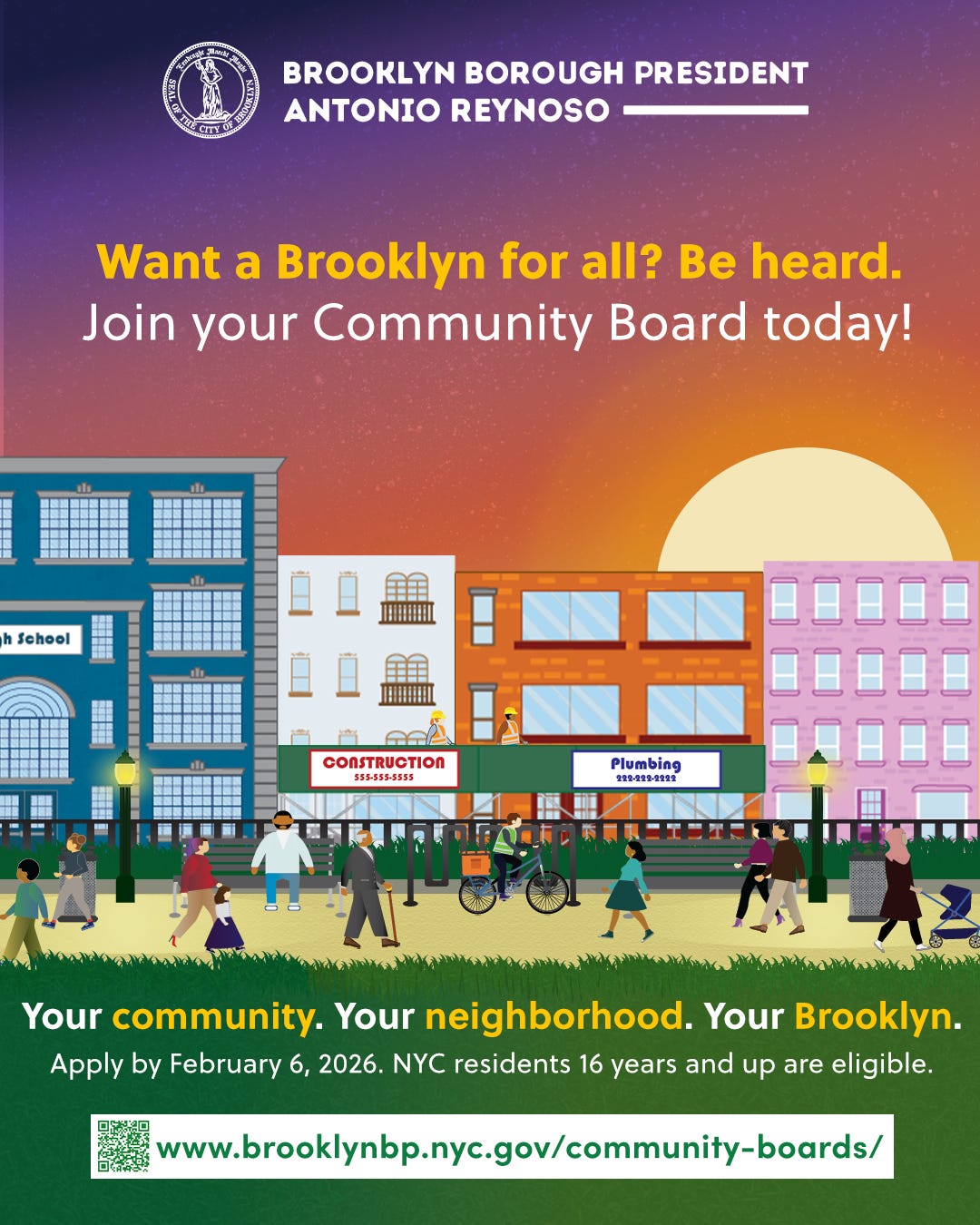
If you are planning to apply or are interested in applying, please reach out to me; I would be more than happy to share my experience or connect you with CB members in your community district.
Note: Any opinions expressed below are solely my own and do not represent the views of Manhattan Community Board 3.
1. Intro to Community Boards
Community Board 101
Community Boards are non-partisan, governmental, public bodies. The City Charter provides this mandate for Community Boards: “Consider the needs of the Community District which it serves, cooperate with, consult, assist, and advise elected government officials about any matter that “relates to the welfare of the District and its residents.” The Charter does not specify how exactly CBs should go about achieving this mandate nor does it grant any formal powers to the CBs. Thus it is up to each Borough President and each of the 59 Community Boards to shape their individual structure and processes best fit to serving their community.
Why this matters: This is one of the Borough President’s most direct powers. Otherwise, the BPs don’t have much decisionmaking power. But they do directly control who is on the community boards. So if you care about community board demographics or dynamics, you mostly care about the BP’s office.
Significant differences have formed in these ways of work, and I would recommend reading the bylaws for your community board to learn how exactly it functions. For example, in some CBs most of the decision-making happens in committees, with full board meetings used to briefly summarize and pass committee resolutions. In other CBs, much more action happens in the full board meetings and subsequently the full board meetings take much longer.
Community Board members are appointed each year around April to May for two year terms, with application periods differing by borough, but usually open sometime in the preceding fall to winter period. Community board members must be nominated by either their local City Councilmember (whose districts overlap with the Community District) or Borough President, and are then appointed by their Borough President following the borough’s specified selection process.
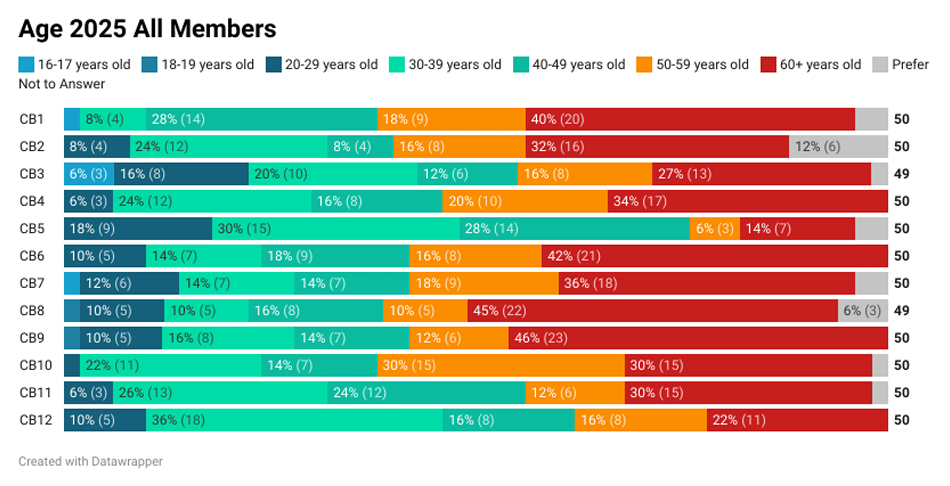
Members are uncompensated and serve on a voluntary basis for two years. In order to be re-appointed, CB members must re-apply to their CB and be selected by the Borough President for another term. CBs are structured so that half of the membership is up for potential re-appointment each year. Term limits were implemented by a City Charter amendment in 2018, so that beginning in 2019, CB members can serve no more than four consecutive two-year terms.
Besides being required to either live, work, or have “some significant interest in the community”, there are no other requirements to be appointed to a CB., In Manhattan, prospects submit a written application and undergo a single-round interview process with a group of other applicants.
Similarly, CB members mostly have no formal obligations or duties. Typically, they are only expected to attend monthly CB full board meetings and their respective committee meetings, and if they are absent from too many of these meetings they are subject to removal.
Why this matters: CB membership is a pretty significant time commitment with no direct compensation. So you can see how this would impact who would apply – it’s easier to attract older, wealthier residents. Less easy to attract young parents or students. And if older, wealthier residents are the ones weighing in...community boards will have a significant bias toward issues they care about.
Besides being able to attend full board meetings and most committee meetings (more on that below), public members can also become non-board committee members. Non-board public members have no voting power on resolutions, but are allowed to fully participate in discussions and make non-binding recommendations. There is no standard procedure for becoming a non-board committee member - if you are interested, check your Community Board’s website and reach out stating your interest.
Why this matters: Being a public member is significantly less time commitment than being a full board member. If there’s just one topic you care about (housing! weed stores!) you can be a public member and not have to deal with any other issues.
I also encourage any interested readers to consider applying for their Community Board. There are many great reasons to apply to serve on your Community Board. Sachi Takahashi-Rial, Manhattan CB5 member, has written a compelling list of reasons. Sebastian Hallum Clarke, Manhattan CB8 member, touches on his reasons for joining here and provides an honest and balanced reflection here.

The Structure of the Community Board
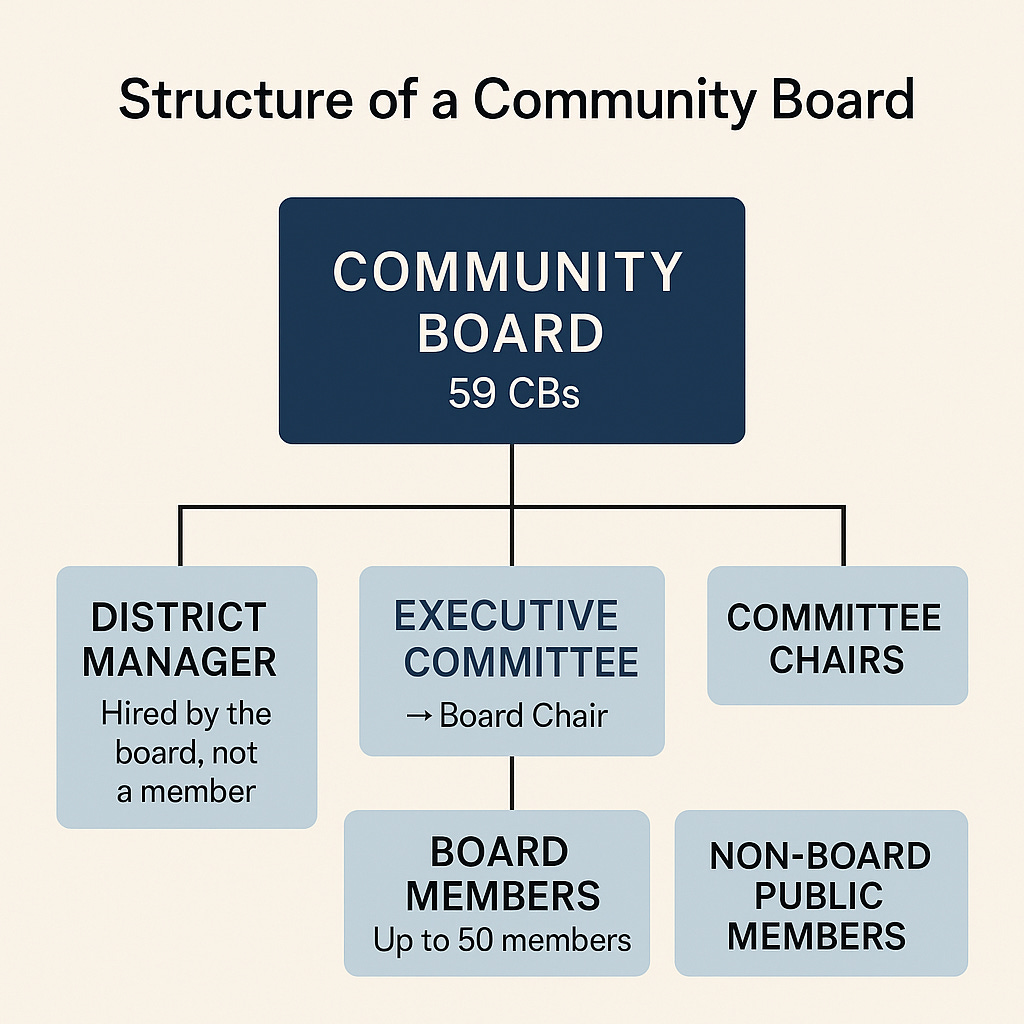
Community Boards follow a parliamentary structure with an “Executive Committee elected by the board that includes a chair, vice chairs, a secretary and a treasurer”. Because of the highly engaged nature of these roles, Community Board Executive Committee members - the Chair in particular - often go on to successfully run for City Council or other elected positions in NYC. Community Board Chairs also serve on their Borough Board, which includes the Borough President and City Councilmembers representing the respective Borough. Community Boards may also create additional Executive Committee positions, such as Vice-Secretary.
In addition to the Executive Committee, every Community Board also has a District Manager. The District Manager is unique in that they are not actually a member of the CB, but are hired and paid by the CB to assist with operational matters.
Why this matters: CB staff are super useful for helping you get stuff done in your neighborhood. If you have a problem, they can advise on which agency to go to. If you have a question on the status of a project, they can help guide you. They can advise you as to which CB meetings might be most relevant to you.
Lastly, community Boards also have Committee Chairs. As the name implies, Committee Chairs lead their respective CB committee and run the committee meetings. Typically in the full board meeting, they will provide updates to the entire board on what was discussed in committee. Committee Chairs have significant soft power, as it is in committees when most policies are actually debated and resolutions are written up.
Full Board vs. Committees
Community Boards hold full board meetings, which include all members and are open to the public, once a month. Times and locations for these meetings and meeting agendas are provided in advance, usually on the CB website and/or sent out in a newsletter. These are the meetings that typically cover all that was discussed in the various CB committees, are attended by elected officials providing updates, and may include more Citywide discussions.
CBs also have committees that usually hold monthly hearings and presentations on more niche subject matters. There is no requirement for having certain committees or any minimum number of them. MCB3 has around a dozen committees, ranging from broad topics like Transportation and Parks and Land Use to more focused committees like Economic Development and Landmark and temporary task forces like Cannabis Control and Waterfront. Transportation, Parks, SLA (State Liquor Authority), and Landmarks are all common committee types across CBs.
In MCB3, members rank their committee preferences and assignments are then made by the Board Chair. Other CBs allow board members to self-select committees or use more democratic processes. While most committee meetings can be attended by all board members (and often the public), attendance at these tends to be even more sparse than full board meetings.
Why this matters: If you care about a policy that’s coming before a community board, you HAVE to influence that policy when it’s at the committee stage. If you start your advocacy when the policy is before the full board, you’ve lost your leverage to influence the language and outcome.
For those with more niche interests themselves, these tend to be the most informative and interesting meetings. While full board meetings by nature are broad and must cover all relevant matters in a meeting, committee meetings go deep - very deep - on their subject matter. As a member of MCB3’s Parks Committee, I have personally sat in meetings where the direction a new park bench would face was protractedly debated.
Committees are also excellent places to get to hear from and know extremely knowledgeable city agency workers, as they are often called in to present on projects and proposals by their agency occurring in the district. Meanwhile, full board meetings will likely only mention the topics discussed in committee and move to vote on any resolutions forwarded from the committee.
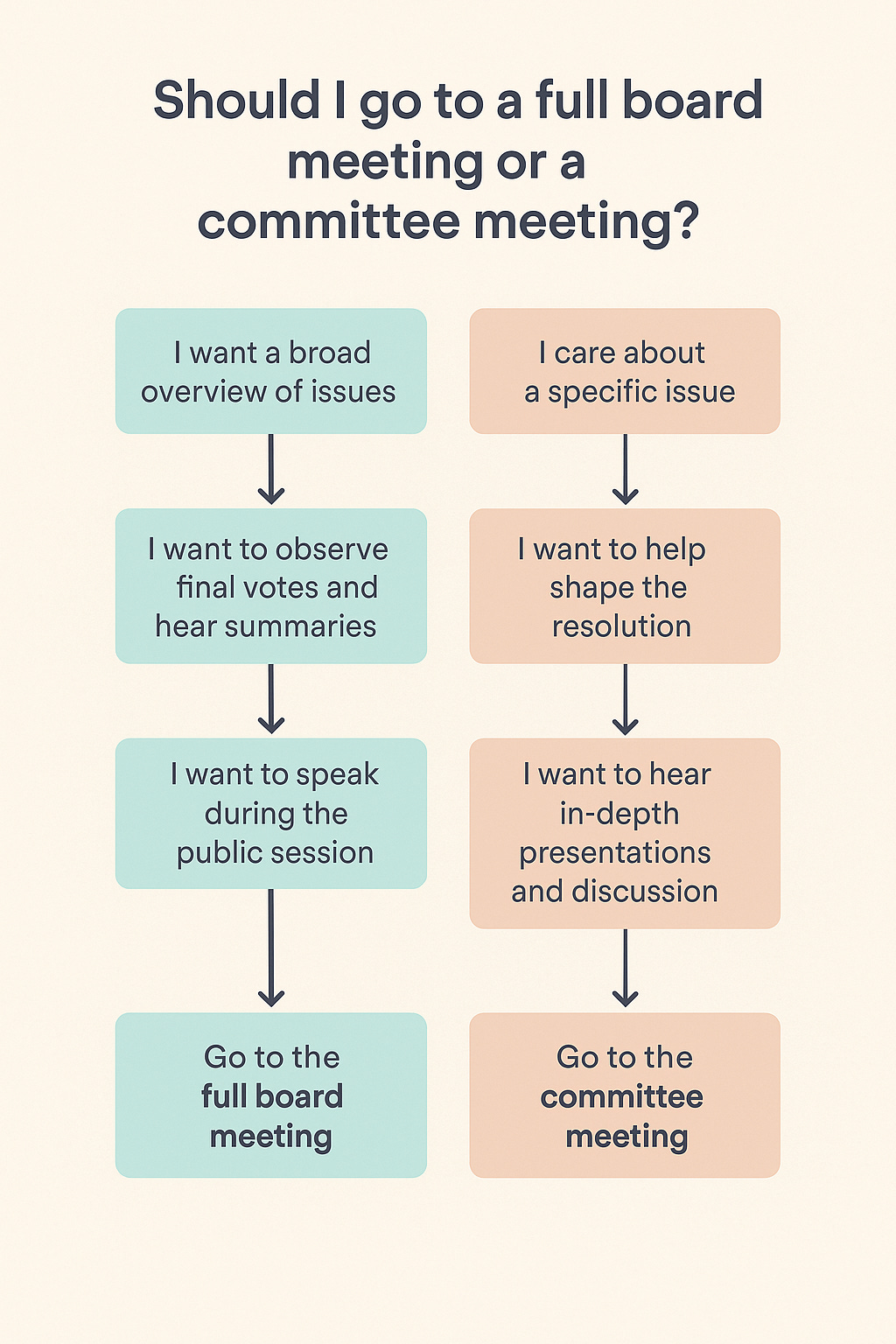
In summary:
Attend a full board meeting when…
You want a broad overview of everything happening across the community board that month.
You want to hear summaries of discussions and decisions that took place in each committee.
You want to observe final votes on resolutions, because committees draft and debate them, but full board meetings usually vote on them.
You want to understand overall board dynamics, how members interact, how the Chair runs meetings, and how committees report out.
You’re new to community boards and want a general introduction rather than a deep dive into a single policy area.
You want to meet elected officials, including both local district representatives and possibly Citywide electeds.
Attend a committee meeting when…
You care about a specific policy issue (e.g., transportation, parks, land use, nightlife, cannabis licensing).
You want to influence the actual content of a resolution, because that work happens in committee, not at the full board.
You want to hear detailed presentations from city agencies, since committees often bring in agency staff to walk through projects in depth.
You want deeper, more technical discussion, since committee meetings go very deep on their subject matter.
You want the most effective point of intervention to influence a policy issue or community board stance on an issue.
You are following ongoing project updates, which are typically handled repeatedly at the committee level before reaching the full board.
II. Walking through a typical CB agenda
Every district’s community board structures its meetings differently and may include different agenda elements or use different terminology. The best way to get familiar with how your CB is run is to attend meetings yourself and observe, and to browse previous meeting minutes/agendas if available online. Some CBs even record their meetings and post them to their website or YouTube!
However, there are also many similarities between these full board meetings. Given the similarities and the opportunity to learn from the differences, I will walk through a typical Manhattan CB3 full board meeting. For more details on these meetings, see my past MCB3 reports.
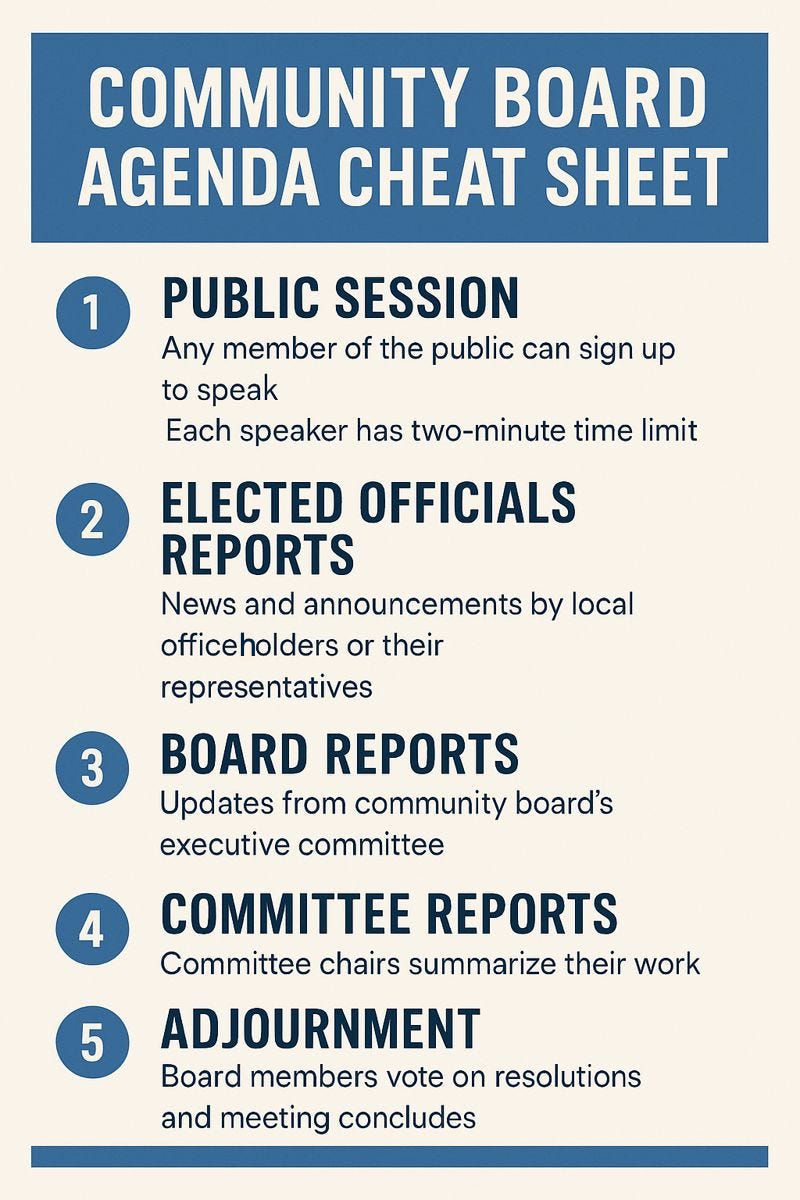
1. Public Session - the best chance to speak up!
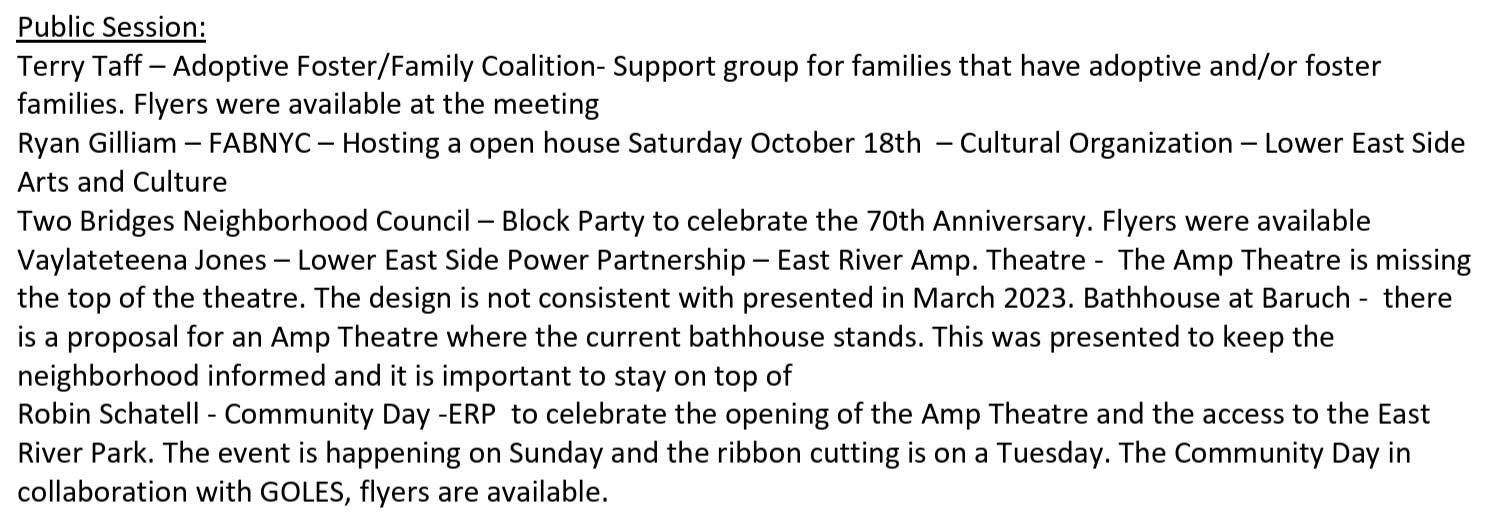
MCB3 full board meetings open with a public session. Any member of the public can speak during this time, given that they added their name to the speaker sign-up sheet before the start of the meeting (for which we place a physical piece of paper at the entrance to the meeting room that the public can fill out with name and speaking topic on the spot if they wish - other CBs may have you sign-up by filling out a digital form in advance of the meeting).
In MCB3, public session speakers have a time limit of two minutes.
Why this matters:
The public session is your chance to bring to the attention of the community board, and any local representatives who may be in attendance, issues relevant to your district or the City. I have seen past public speakers come in to complain about traffic issues on their street, request CB support for a public services program, announce community events, or even to chew out their elected representative (in person!).
This two-minute time limit will be enforced. I recommend interested public speakers to launch straight into their main point, speak clearly, and be concise. Many a speaker has spent the majority of their allotted time prefacing and meandering, only to be cut off right as they began to address what they wanted us to know.
Also - practice projecting your voice! While microphones are usually provided, they do not always function well. Speaking loudly and clearly will draw the room’s eyes to you, providing special attention to what you wish to share.
Generally, I would recommend trying not to come off as excessively angry or cynical. Well-spoken public speakers often get the chance to speak to elected officials in attendance - or a representative from the elected official’s office - about the topic they brought forth. If you come off as a passionate individual who cares about the issue you are speaking to, your representatives will be more likely to approach you after you speak or more receptive to you approaching them. Yelling or derogatory remarks tend to have the opposite effect than desired.
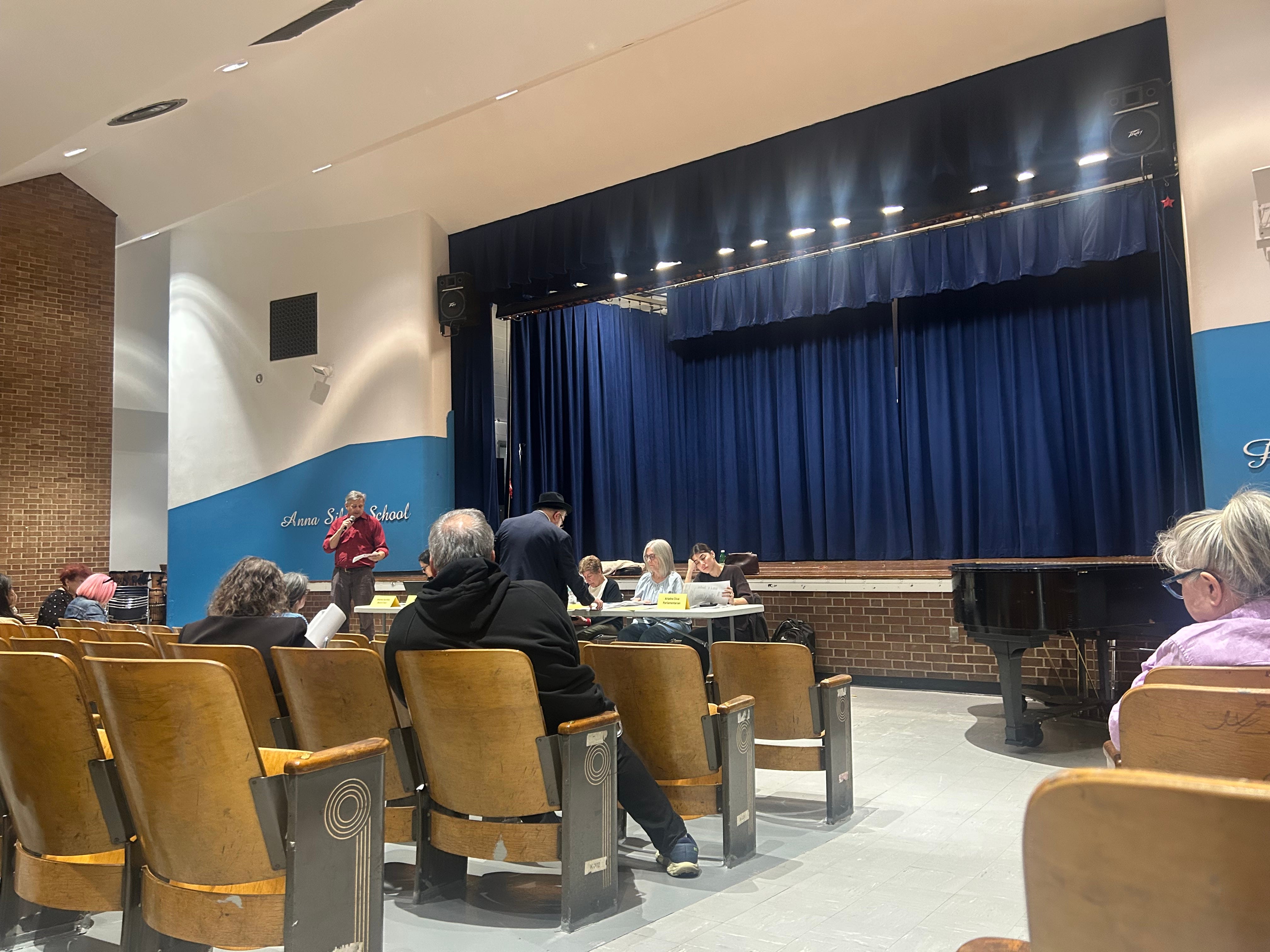
There are few better ways to access your local representatives than attending (and speaking!) at community board meetings. This is a rare opportunity to speak directly to them, with few other people in attendance. While signing up for a public speaking session is not mandatory to speak to these representatives, it does guarantee you will receive time to speak your mind.
Which leads to the next component of the MCB3 agenda…
2. Elected Officials Reports
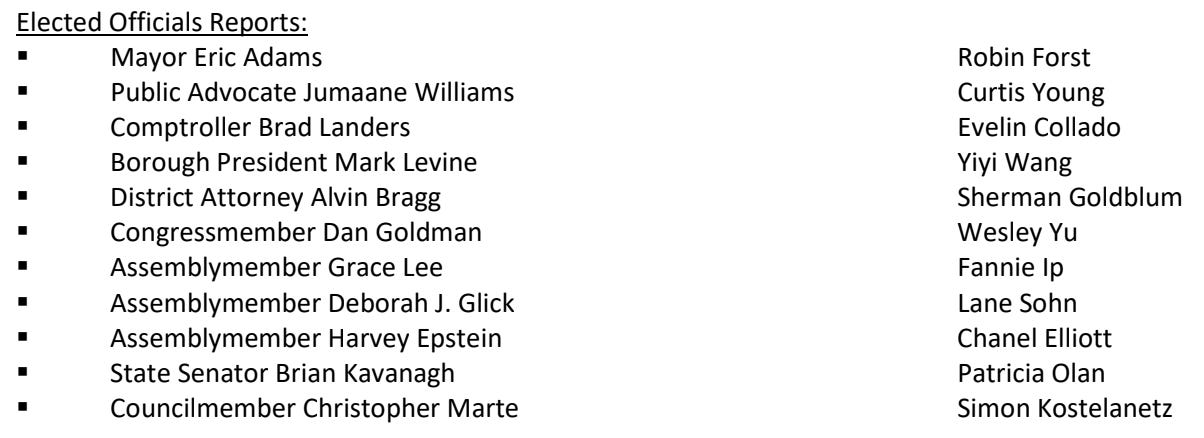
Following the public session, the floor is then given to elected officials or, more often, a representative from their office, to make any announcements they wish. This is the time when elected officials will share news on bills that they introduced, sponsored, or contributed to moving forward or passing.
Representatives often also share updates about events or resources they are offering, or where support related to recent events can be found. While this sometimes means listening to politicians toot their own horn and parade their wins, this is also the best way to stay on top of political developments in the legislative bodies and progress on new legislation.
Why this matters:
For Community Board members, this is an excellent opportunity to directly ask elected officials or their representatives questions or provide comments. In MCB3, the public is not allowed to speak during this segment of the meeting. However, for both board members and the public who wait around after the meeting, there is often a chance to catch an elected official before they leave and speak to them directly.
Being a CB member is an immediate boost to your ability to both speak to and develop relationships with representatives. Particularly for Executive Committee members, the district’s representatives often get to know them personally and will take the time to chat with them when they attend meetings. Similarly, CB members often make requests directly to elected officials to look into matters they care about during this portion of the meeting.
3. Board Reports
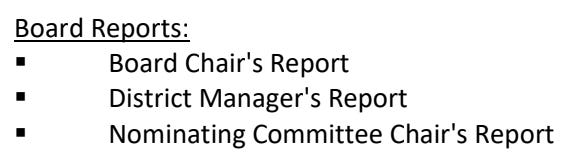
Self-explanatory, this is a chance for the Chair, District Manager, or other Executive Committee members to make announcements or present resolutions from the Executive Committee. While shorter than the other sections of the meeting, this portion may cover some of the CB’s most important and public work, like budget prioritization, District Needs statements, and borough-wide initiatives.
This is also when CB staff, such as the District Manager (DM), are given an opportunity to speak. While not mentioned explicitly on the agenda, MCB3’s DM is constantly help run the show throughout our full board meetings. Being a CB DM can be both a powerful and thankless job.
This is also when operational decisions are presented, such as a resolution to use CB funds to hire new CB staff or for a project, or announcements about CB elections.
4. Committee Reports
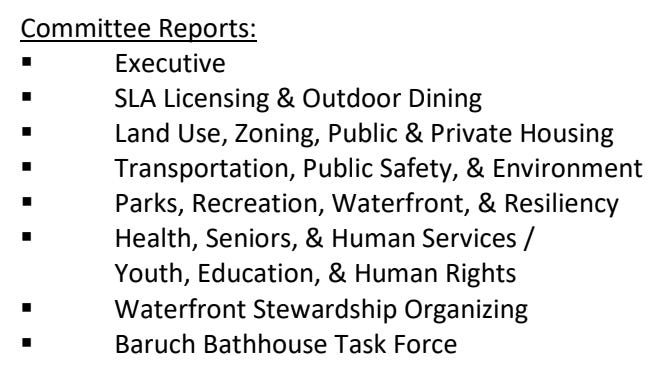
As mentioned above, every Community Board has its own set of committees that hold meetings separate from the full board meeting. In MCB3, the final section of full board meetings covers what happened at that month’s committee meetings (full board meetings occur at the end of the month, typically after all the committee meetings for the month).
Committee Chairs provide high-level overviews summarizing what was discussed and providing any additional context on resolutions that were drawn up by the committee. This may be supporting/opposing projects and proposals by agencies in the district, lists of approvals/denials for land use applications and/or SLA licenses, or more symbolic statements of support/opposition to city policies or political events.
At the end of the meeting, all MCB3 members present provide a vocal vote on all the resolutions with one of three options: Yes, No, and Abstain (effectively counts as No). To save time, MCB3 uses a process in which members can vote Yes on all resolutions with a simple “Yes” or stipulate which resolutions they vote “No” and/or “Abstain” on, with “Yes” granted to all non-specified resolutions.
Resolutions receiving a simple majority of “Yes” votes by those present pass, and those that do not are not adopted by the board. Since potential critiques to a resolution are discussed prior to this vote, a resolution that does not pass gets sent back to committee and can be revised and voted on again at the following full board meeting.
Why this matters:
To be informed about the topic a resolution is addressing or how the resolution was written, you will need to attend the relevant committee meeting. Often, most of the resolutions on the agenda at a full board meeting are not even discussed, receiving Yes votes from the CB members who trust that matters were handled in committee. Controversial or more complicated topics, like resolutions for or against zoning reform or major housing developments, are more likely to be discussed in full board meetings.
For a sample of what committee meetings may cover, I recommend checking out Zachary Thomas’ running series reporting on MCB3’s Parks Committee meetings:


The full text of resolutions being voted on in the full board meeting is provided as printed handouts at the start of the meeting. Grabbing one of these, or pulling up the digital meeting agenda emailed out beforehand (subscribe to MCB3’s newsletter here to receive meeting agendas ahead of time), is a necessity to know what is being voted on.
Resolution text is rarely read out loud, and discussion as to how the resolution was written or why it includes certain clauses usually does not occur at full board meetings. Attending committee meetings can give some insight. For a full explanation of how to read and write resolutions, look out for a later part of this series.
5. Adjournment
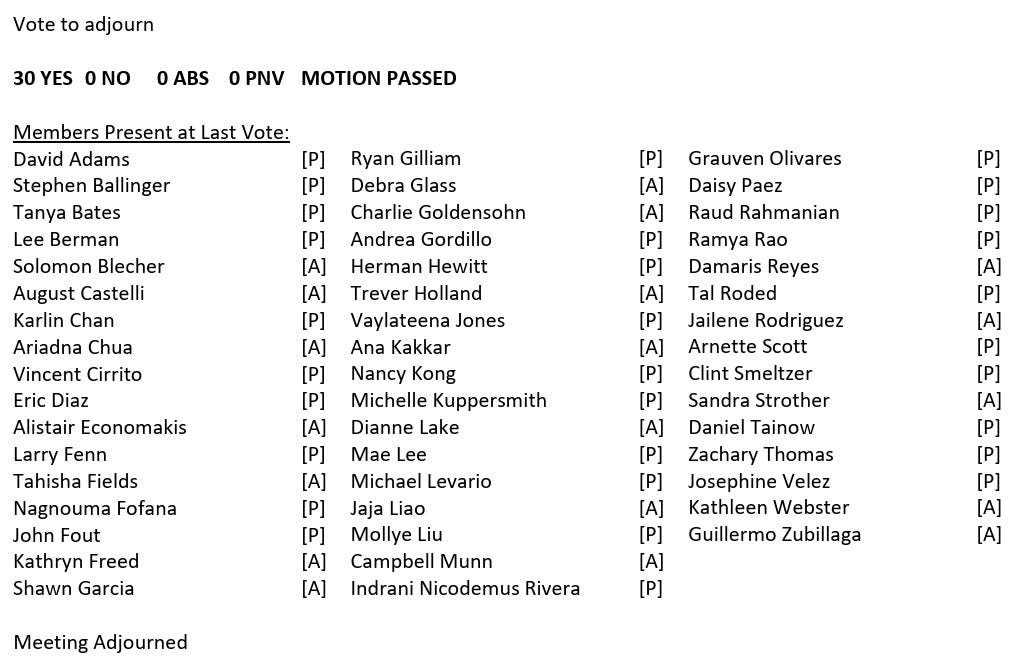
Following a full roll call and votes of all present members, the meeting is then adjourned.
Stick around and talk to your local CB members or elected officials/liaisons to voice your opinions, or head home while basking in the glory of witnessing the ground floor of NYC local governance.
III. Robert’s Rules of Order and Parliamentary Procedure
Community Board (CB) meetings are formally governed by Robert’s Rules of Order (RRO) for parliamentary procedure. RRO is a long-established system designed to provide a clear structure so that all members understand how meetings are run and how decisions are made. The main goal is to allow majority rule while protecting the rights of the minority, ensuring that everyone has a fair chance to speak, propose ideas, and question proposals before votes are taken. RRO is used across public bodies nationwide, and is what keeps meetings fair, organized, and democratic.
And yet, my experience on my CB so far, which mirrors the experience of most other CB members I have spoken to across the City, is that few people are actually familiar with RRO. The lack of training and understanding for parliamentary procedure is a major contributor to the overly lengthy meetings and occasional lack of appropriate decorum in CB interactions. It also concentrates power in the hands of those who already know how to work the room, unfairly favoring the loudest individuals.
Conversely, learning the basics of Robert’s Rules will enable you to more effectively participate in and influence community board meetings. Simply being familiar with how meetings should be run can also be a major advantage for CB members wishing to step into leadership positions. At the very least, more members knowing RRO could prevent the circular debates and out-of-order speaking that so often unnecessarily causes meetings to drag on.
To cover all of RRO is outside the scope of this guide and would likely take a series of articles, which I may tackle at some point. For now, I will provide some of the main takeaways below and refer interested readers to the guide to parliamentary procedure for NYC Community Boards handbook. Everything you need to know about RRO and its application to CBs is likely found in here, and if I was granted a wish from a genie, I would ask that every NYC resident become intimately familiar with this handbook.
The Basics of Robert’s Rules of Order
A quick rundown of key parliamentary procedure basics for CBs:
A majority of the CB’s appointed members must be present to conduct business
Board members address only the Chair or each other through the Chair
Board members must first be recognized by the Chair before speaking
Any Board member obtaining the floor can introduce any legitimate matter
Business brought before the Board should be in the form of a motion (more on this below)
Board members should allow others to speak before they speak again
The Chairperson should insure that all sides of an issue are heard
Why this matters:
In previous parts of this guide, I mentioned that CB Chairs are incredibly powerful because they can appoint committee chairs and run board meetings. Now we see how running the meetings makes the Chairs the most influential person on the CB: they decide who gets to speak, in what order members will speak, how many speakers they will allow on one side of an issue, and generally all discussion is conducted through them. Simply by deciding who to call on, Chairs have tremendous power to control the discussion!
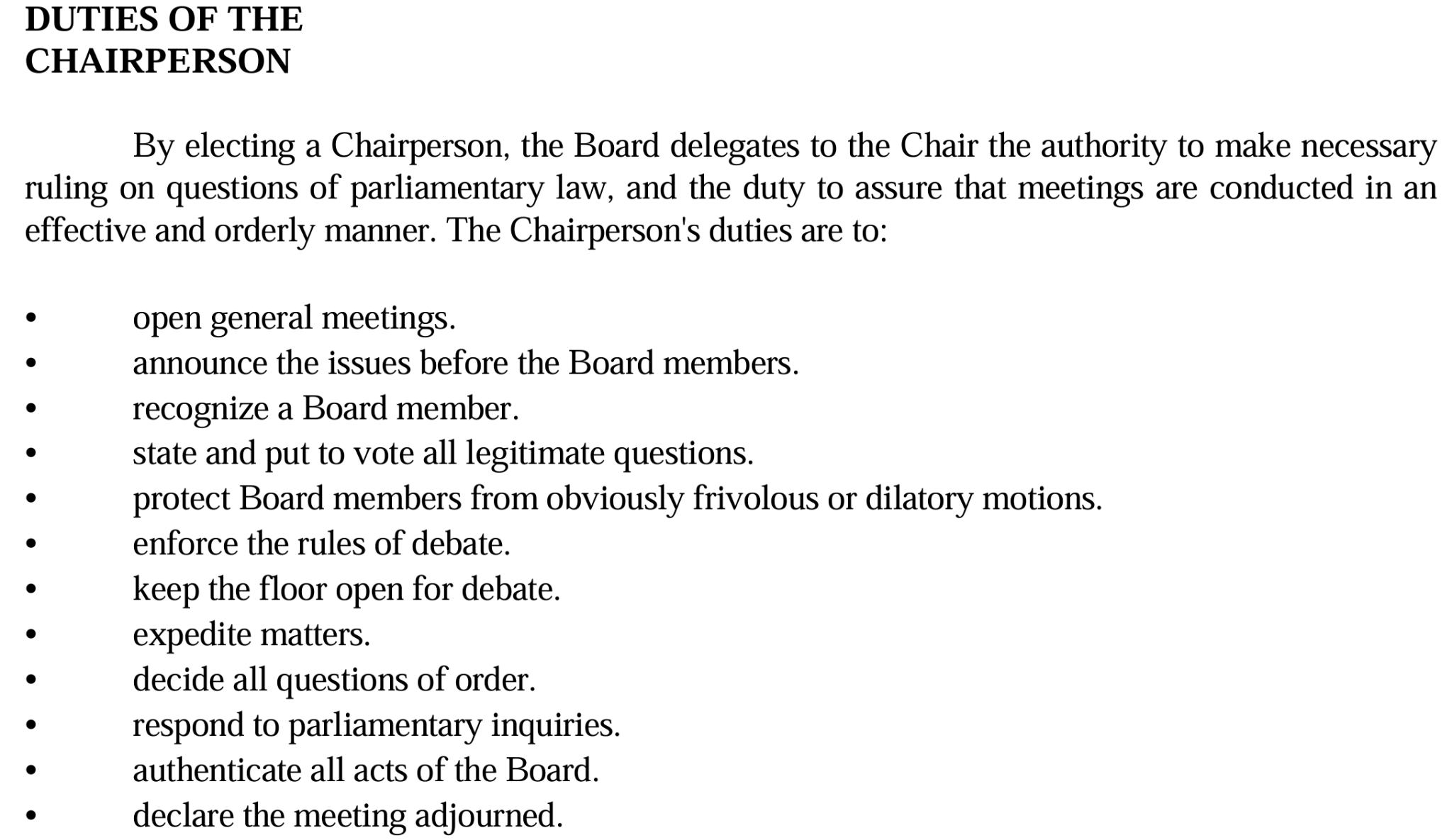
The rights of non-Chair CB members mostly involve the ability to “obtain the floor, introduce motions, enter discussions, oppose, amend, and vote on motions.” These are the tools of the trade for speaking, making arguments, and influence official CB actions.
Motions: The Trusty Tools of CB Actions and Debates
CB debates and discussion thus center around motions, the basic unit of decision-making. When a board member wants to take an official position - say, to support a street redesign or oppose a liquor license - they “make a motion.” Another member must then “second” it, signaling that at least two people believe the idea deserves discussion. From there, debate begins. The chairperson recognizes speakers one at a time, alternating between those for and against when possible, and makes sure the conversation stays on topic. When the discussion seems complete, the chair “calls the question,” meaning it’s time to vote. Most votes are by voice (“all in favor, say aye”), but significant or contested items may go to a show of hands or roll call.
Robert’s Rules also define how motions can be adjusted or delayed. A motion to amend allows members to tweak the proposal’s wording before the vote. A motion to table temporarily (or potentially permanently) pauses discussion of an issue, which is useful if more information is needed or time is short. Members can also raise a point of order if they think the meeting isn’t following proper procedure, or appeal a ruling if they disagree with the chair’s interpretation of the rules. These tools might sound procedural, but they protect the rights of minority voices and keep the process transparent.
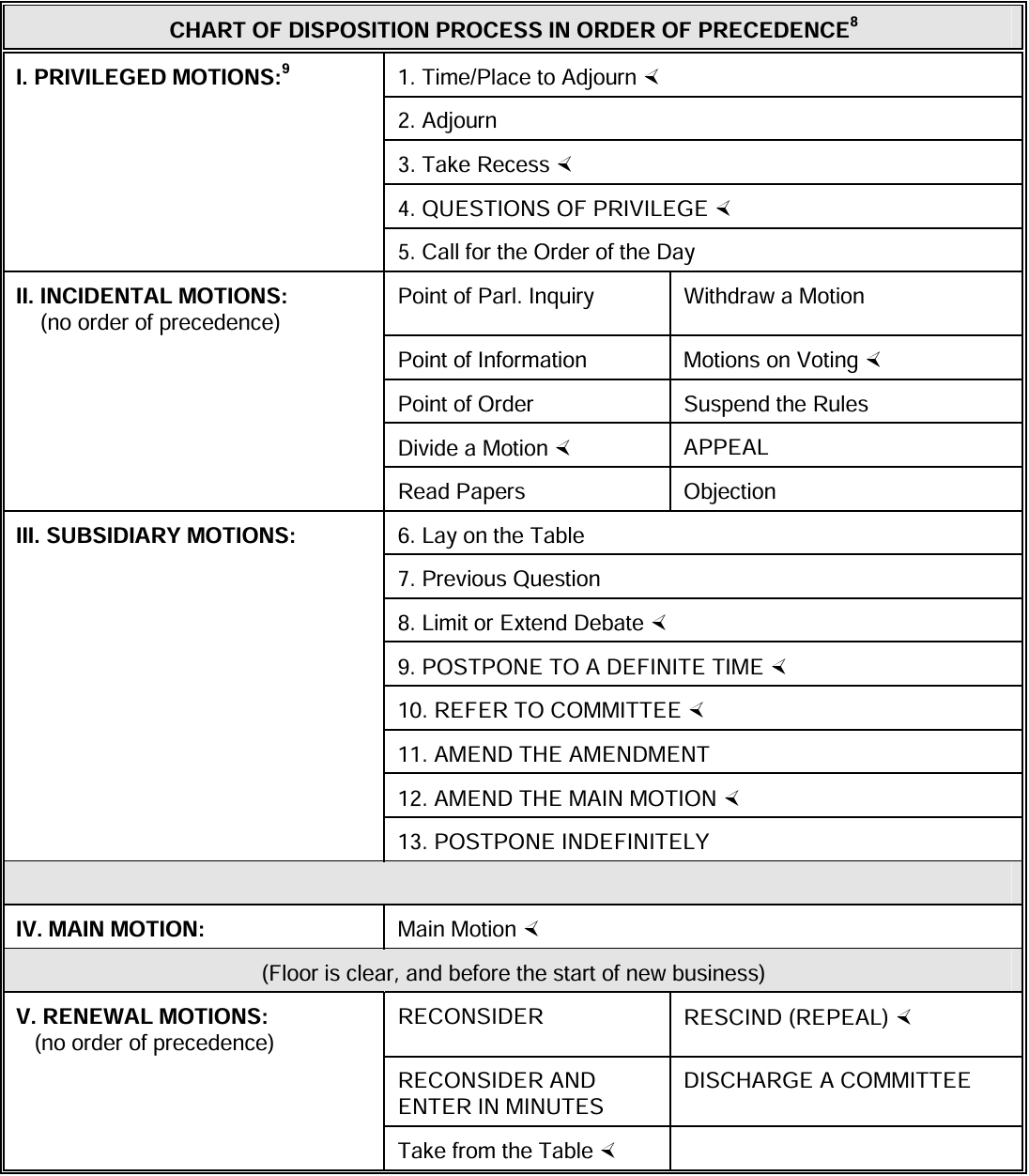
There are other types of motions available to CB members than those listed above, providing pathways for limiting debate, extending discussion of a motion, amending motions, and more. One useful motion not discussed here is the point of privilege, which members can use to protect their rights or the interests of the CB. CB members and public members attending CB meetings should familiarize themselves with these secondary motions in order to participate and guide discussion to their full potential.
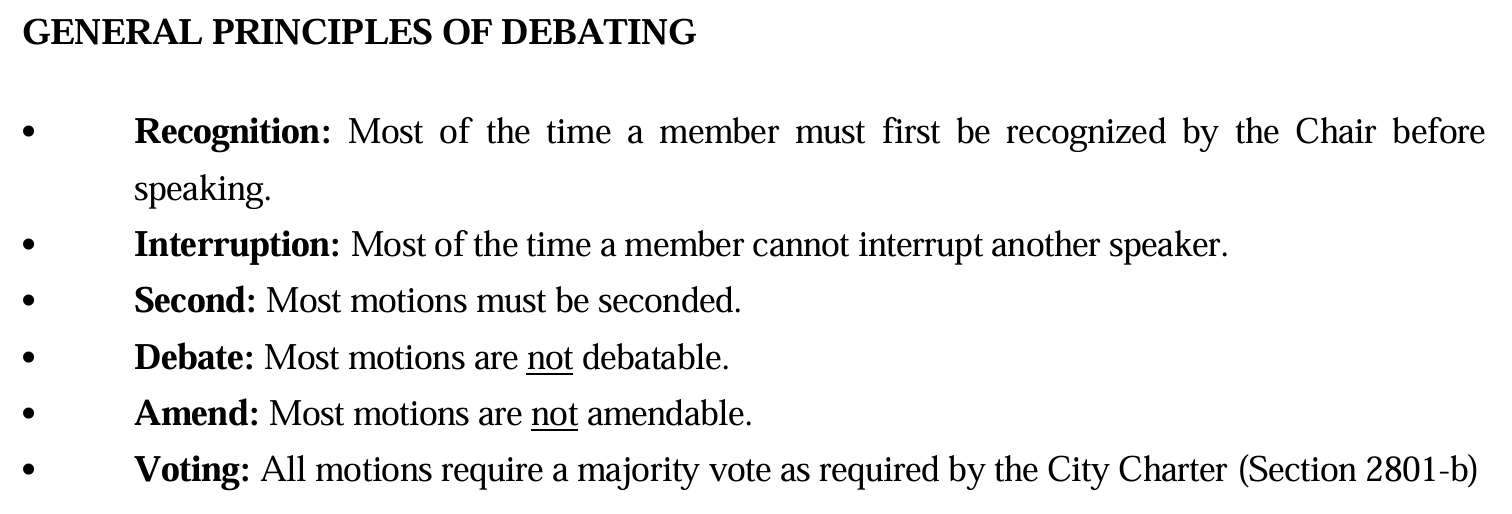
The general flow of discussion is:
The Chair recognizes a member to speak
The member introduces a motion, the choice of which defines how the discussion will proceed (whether debate or amendments will be allowed, for example). The motion is seconded by another member.
If debate is allowed, other members are recognized by the Chair to speak on the motion that is on the floor
If amendments are allowed, members can propose such motions to amend the primary motion, with votes taken on these amendments
The Chair puts the questions to the members for a vote and the motion is passed (or rejected) by a majority vote of the CB members present
Other important parliamentary procedure rules to know
When a vote is taken, all Board members who are present and entitled to vote must either vote or abstain
Absentee ballots, proxies and telephone votes are not permitted
There must be more “yes” votes than the total of “no” votes and abstentions combined in order for a motion to pass
All Community Board votes, including the election of officers, must be conducted by open ballot - that is, CBs must record each member’s vote and make the record available to the public by including it in the minutes of the meeting
Community Boards are mandated to meet at least once a month, except during July and August
Boards are required to conduct two public hearings during the budget process, and one during their review of the Citywide Statement of Needs
The mandate to hear from the public at every public meeting requires that a public session be conducted even if a Community Board has held a public hearing on a specific issue that month
Community Boards are defined as public bodies and governmental agencies subject to the applicable provisions of the City Charter and the New York State Open Meetings Law
Final Note
The procedures described above are Robert’s Rules of Order as formally written down. Attend just a single Community Board meeting and you will quickly notice that many RRO guidelines are not followed or have been adjusted. This is partially due to general lack of understanding of RRO, but also because CBs have leeway to disregard RRO as they see fit. As the above cited handbook itself states, “Robert’s Rules are meant to be a means to an end and not an end in themselves” - and so CBs are allowed and encouraged to “adopt written rules of procedures which confirm, add to, or deviate from parliamentary law itself”.
Understanding parliamentary procedure for CBs helps explain how community boards could run best more than how they are actually run. Ultimately, better adherence to RRO would likely shorten lengthy CB meetings and improve equity in participation. But that’s a discussion for another time.
IV. Advice for Community Board Members & Other Topics
For those who are already community board (CB) members, and to the newly appointed (welcome!), I wanted to provide some additional guidance and resources. When I first joined my own CB in April 2025, I was plunged headfirst into the world of local politics with no training whatsoever. While the materials are out there if you know where to look and who to ask, it is likely that no one is going to hold your hand and walk you through parliamentary procedure, resolution writing, or coalition building. Yet these are the tools that make a CB member an effective community representative and policymaker.
The previous parts of this series covered the building blocks of CBs and their structure and operation. But there are still some major topics to know about, and many little things to be aware of if you wish to be an agent of change in your community. Let’s dive into them.
Resolutions: the Swiss Army Knife of the Community Board
Resolutions are the Community Board’s primary means of fulfilling its advisory role and typically the outcome of any full board or committee discussion/debate. This means that knowing how to write a resolution can make you a more influential CB member. For that reason, I want to dedicate space to covering what exactly they are, how to read them, how to write them, and why they can matter.
As I noted in Part I of this guide, most of the work to debate and shape a resolution happens in the committee meetings. By the time resolutions reach full board, they are often voted on and passed with minimal discussion, if any. What this effectively means is that the way to influence a resolution, i.e. your community board’s stance on an issue, is to show up to committee meetings and participate in the discussion there. As an added benefit, you’ll likely witness committee members orally drafting or editing resolutions in real-time. Sometimes resolutions are pre-written ahead of the committee meeting, or provided by the committee chair, but many times members need to brainstorm one that resolves an issue or request brought up in committee.
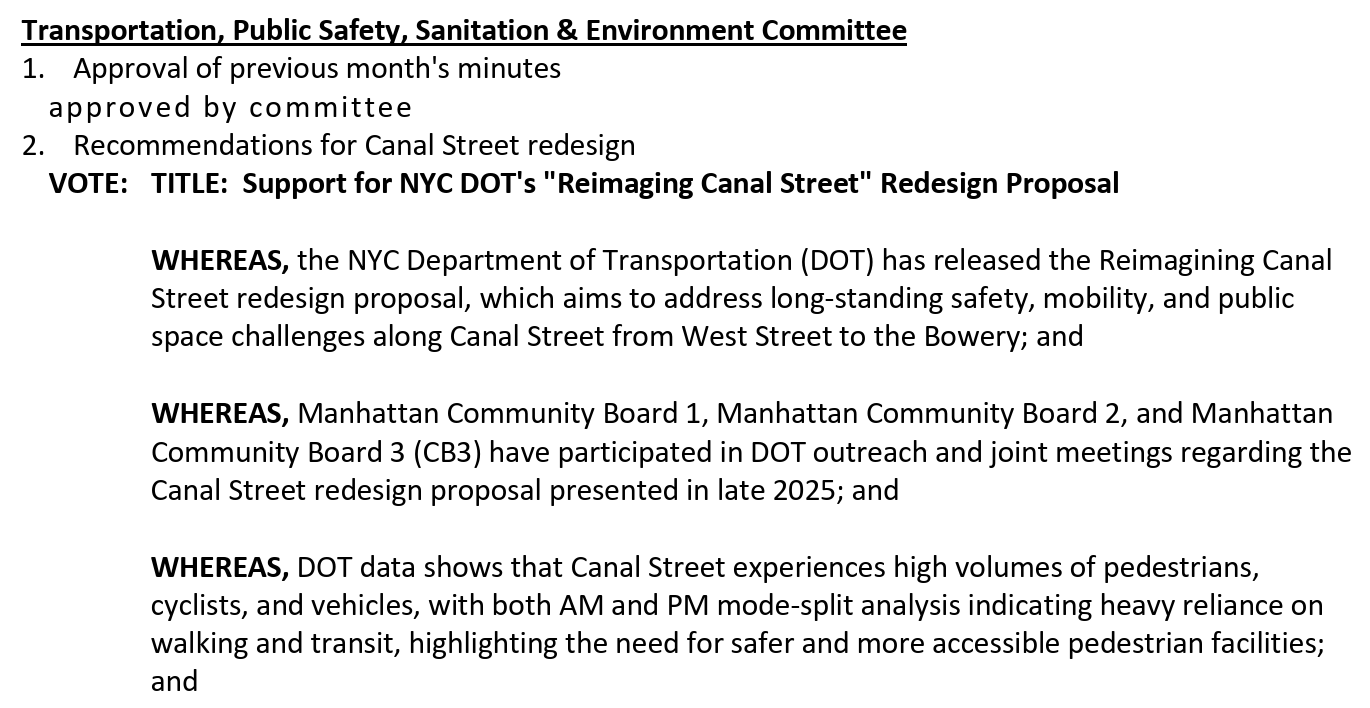
Reading your CB’s previous resolutions can help you quickly familiarize with the general structure and tone of relevant resolutions. Manhattan CB3 posts minutes from all its previous meetings here, and the text of resolutions can be found in each PDF (search for the keyword “VOTE” and check out the bolded text). Resolutions tend to follow the same structure, especially within committees when they are addressing the same subject matter, and so previous resolutions can even be directly reused with wording updated or adjusted where needed.
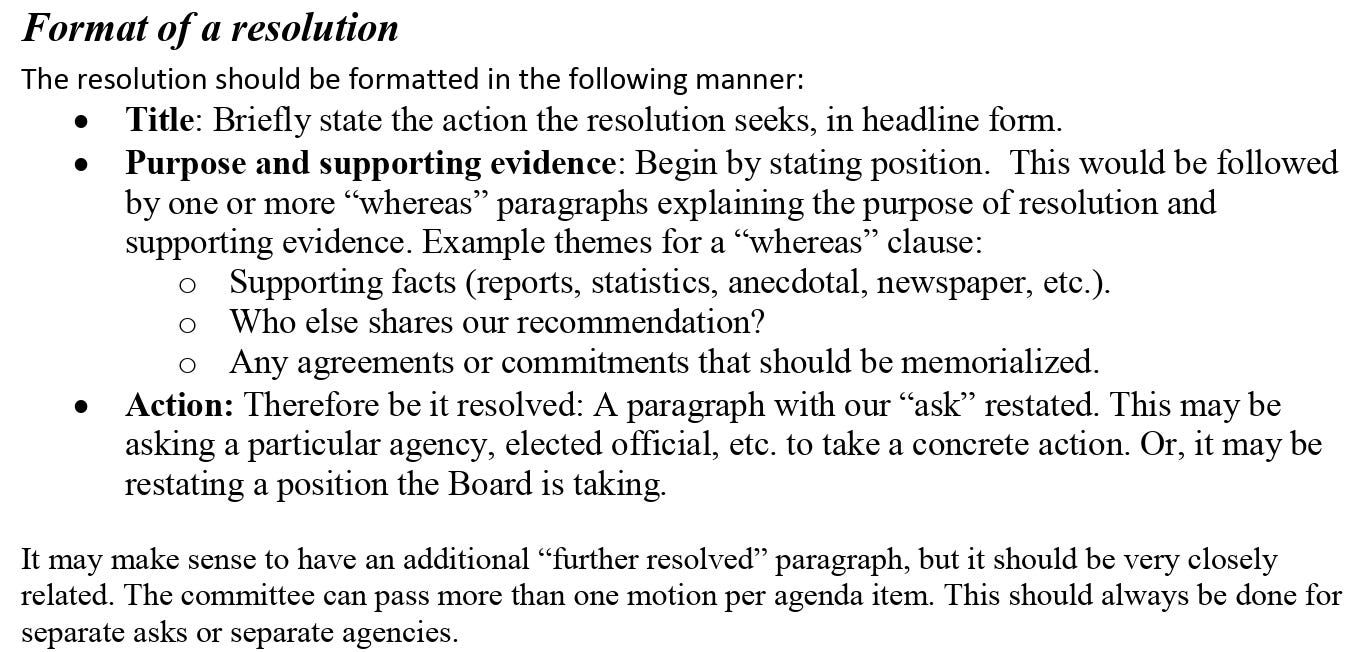
The basic structure of a resolution:
TITLE: one sentence summary of the resolution’s content and proposed action
WHEREAS: A series of clauses, each beginning with the word “whereas” and making a statement that may provide context, background, or reasoning as to the resolution’s proposed action. There can be as many whereas clauses in a resolution as the drafter would like, and I have seen resolutions with pages of whereas clauses.
THEREFORE, BE IT RESOLVED: The proposed action/actions, itself formatted as its own paragraph beginning with the phrase “Therefore, be it resolved, …”. This is where the position of the CB is stated, or the request to an agency is made, or whatever the purpose of the resolution may be. Typically there is only one of these clauses, concluding the resolution, but where there are multiple proposed actions there can be multiple of these clauses as well.
Other helpful resolution writing advice and good/bad examples from MCB3 can be found here. One big tip: Include in the resolution context, background, rationale and agreements memorialized.
One last note on resolutions: public members can also have an outsized impact on CB policies, because many CBs allow non-board public members to vote on committee resolutions. On some committees, like CB3’s SLA committee, there are nearly as many public members as board members. Since committees in general are smaller than the full board, a public member’s vote is powerful and can be enough to swing the outcome.
The District Needs Statement: an under-appreciated but powerful CB tool
While resolutions are the primary tool for CBs to act and to communicate their desires, they are not the only tool. Every year, no later than August, each community board must also publish a district needs statement (DNS) that outlines what the priorities for the community district are and where City funding should go towards. This is an opportunity for the CB to make a symbolic stance on what issues it thinks are most important, require the City’s prioritization to address, and why they matter for the community.
This statement is also not entirely rhetorical - it can influence discretionary funding available to City Councilmembers or the Borough President. Critically, City agencies must respond to community board budget requests in the City’s annual budget. Thus, determining the priorities listed in the DNS is another tool that directly influences the funding provided and projects chosen for development in the district.
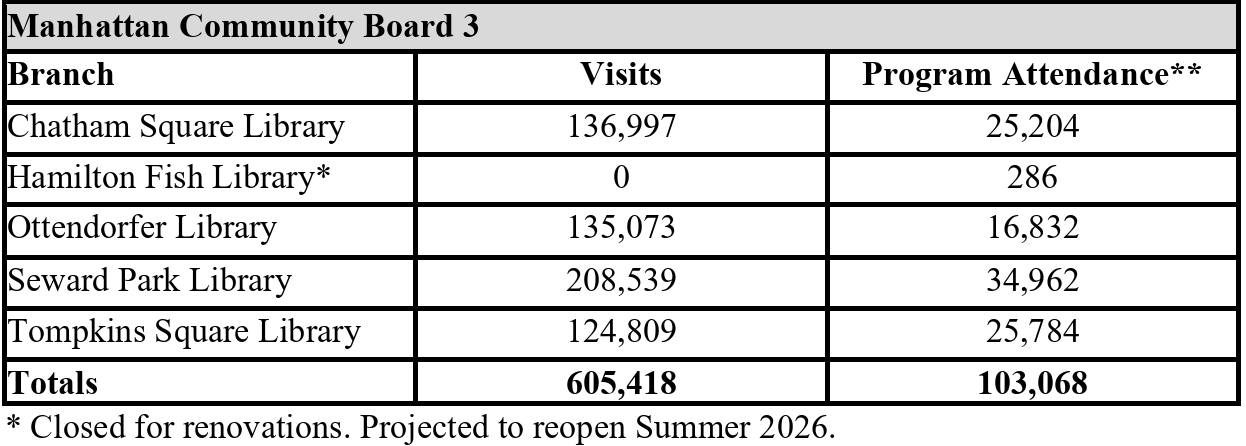
In Manhattan CB3, we begin work on the DNS in May, and the entire board votes on the DNS in July. Committees usually determine and vote on their portion of the DNS, covering priorities and projects related to their subject matter, in June. This timeline is meant to match with the City’s fiscal year budget timeline, which itself begins in July for the coming year’s budget. Following the full board vote, the CB then sends the DNS to the NYC Department of City Planning in October.
Being actively involved in the DNS formulation process is one way to have a direct impact on the allocated funding and greenlit projects by City agencies for your community. Similar to resolutions, participating in discussion, particularly in committee, is key to influencing DNS priorities prior to their finalization. This is another area where being a committee chair is powerful, as chairs lead the discussion and meet with the relevant City agencies to align on budget priorities. However, even those who aren’t chairs can play a large role by participating in the discussion and voting on both the DNS and budget priorities.
How to be an effective member
For current CB members, I recommended considering carefully what policy areas you would like to shape (land use? roadways? new business openings?) and talk to the relevant Committee Chairs and Board Chair to ensure you get placed on your desired committees (most CBs put members on two committees).
This leads to a larger point that in order to have an actual impact on your CB’s policies, you need to participate in the discussions. There are a number of strategies to take:
Talk to your fellow CB and committee members, get to know them and their political leanings, and build coalitions. Ally with the ones aligned with you to support or even introduce resolutions pushing the policies you care about. Find out who is on the fence or less passionate about certain issues, and tailor your arguments to them and their interests to win their vote. And remain friendly with those you are politically opposed to, both because it is good manners and because you never know when someone might change their mind. Ultimately politicking is a more pleasant experience when you treat others with dignity.
Get to know your community district’s representatives and agency leads. Developing relationships with these key political actors will allow you to score policy wins outside the limited CB procedures/tools and go direct to the holders of power to influence change. City Councilmembers also hold the keys to discretionary funding (see below) and can directly implement your policy suggestions.
Speak up and present. At the end of the day, speaking your thoughts on an issue is the only lever you control besides your own vote. Even in cases where you end up on the losing side of a vote, what you said will go down on the record for others to read and see. Other CB members, elected officials, and the public will take notice when you speak eloquently and passionately about a topic. While you may not change minds or win in the short-term, repeated participation will grow your profile and your opinions visibility and respect.
CBs are the ground floor of NYC politics, and many City Councilmembers began their careers as CB members. Sachi also provides additional reasons to consider applying to your community board in this great article, including:
“In my time on Manhattan CB5, I’ve voted on issues from Manhattan congestion pricing to Penn Station redevelopment to local casino policy. I read up on topics before the vote, and in the process, I learn a lot about the way the city works. I also learn about how the world works.”

APPENDIX & FURTHER READINGS
For anyone interested in the details of community boards’ structure, history, and the exact laws governing their procedures, see the extensive Handbook for Community Board Members, last revised 2014. Much of the above guide was drawn from this handbook, but a large amount of detail had to be left out.
Equally fundamental to Community Board procedures is the Bloomberg administration’s A GUIDE TO PARLIAMENTARY PROCEDURE FOR NEW YORK CITY COMMUNITY BOARDS. The CB members I know who respect parliamentary procedure treat this PDF as the CB Bible. Further recommended readings on Robert’s Rules of Order here.
For an overall deeper dive into all the issues a community board typically faces, I have to plug Manhattan Community Board 3’s excellent Resources page. It is full of links to guides and reports that cover critical CB processes and training on how things are typically done. Note the date of any resource however as some have become quite aged and have outdated information.
The NYC Civic Engagement Commission website also has a great backlog of recorded community board trainings and is scheduling new online trainings all the time. Very useful recordings on parliamentary procedure, how the City budget works, and other subjects that CB members often interact with in their roles and responsibilities!
Always be aware of Conflict of Interest Concerns: Community board members must abide by the New York City’s conflicts of interest law (Chapter 68 of the New York City Charter) and all relevant guidance from the Conflicts of Interest Board, including but not limited to the requirement that a member must disclose a conflict and abstain from voting on a matter that impacts the member’s private interest, as well as the prohibition on the use of a city title or resources for political activity.
Thank you to Sachi Takahashi-Rial and Sebastian Hallum Clarke for their contributions to this guide. Check out their Substacks for more helpful and informative NYC policy content!