


Thank you to Sachi Takahashi-Rial and Sebastian Hallum Clarke for their contributions to this guide. Check out their Substacks for more helpful and informative NYC policy content!
Imagine a government body that is capable of stopping housing developments and zoning changes, determining the hours and prices of bars and restaurants, and shaping where and how new infrastructure like parks and bike lanes gets built. This body interacts with and is well-known by City Councilmembers, mayoral officials, and community nonprofit leaders, often with direct access to these local powerplayers. At the same time, members of this body are unelected, subject to almost no public scrutiny, and, until recently, were not term-limited.1 If you haven’t guessed yet based on this description or the post’s title, I am describing New York’s Community Boards.
Community Boards stand at the forefront of local government, often being the first step in public approval processes such as for new housing developments. They are also directly involved in providing permits for businesses to operate, obtain liquor licenses, or provide sidewalk shed seating. And that’s only scratching the surface of all the municipal and political decisions in which community boards have a part to play.

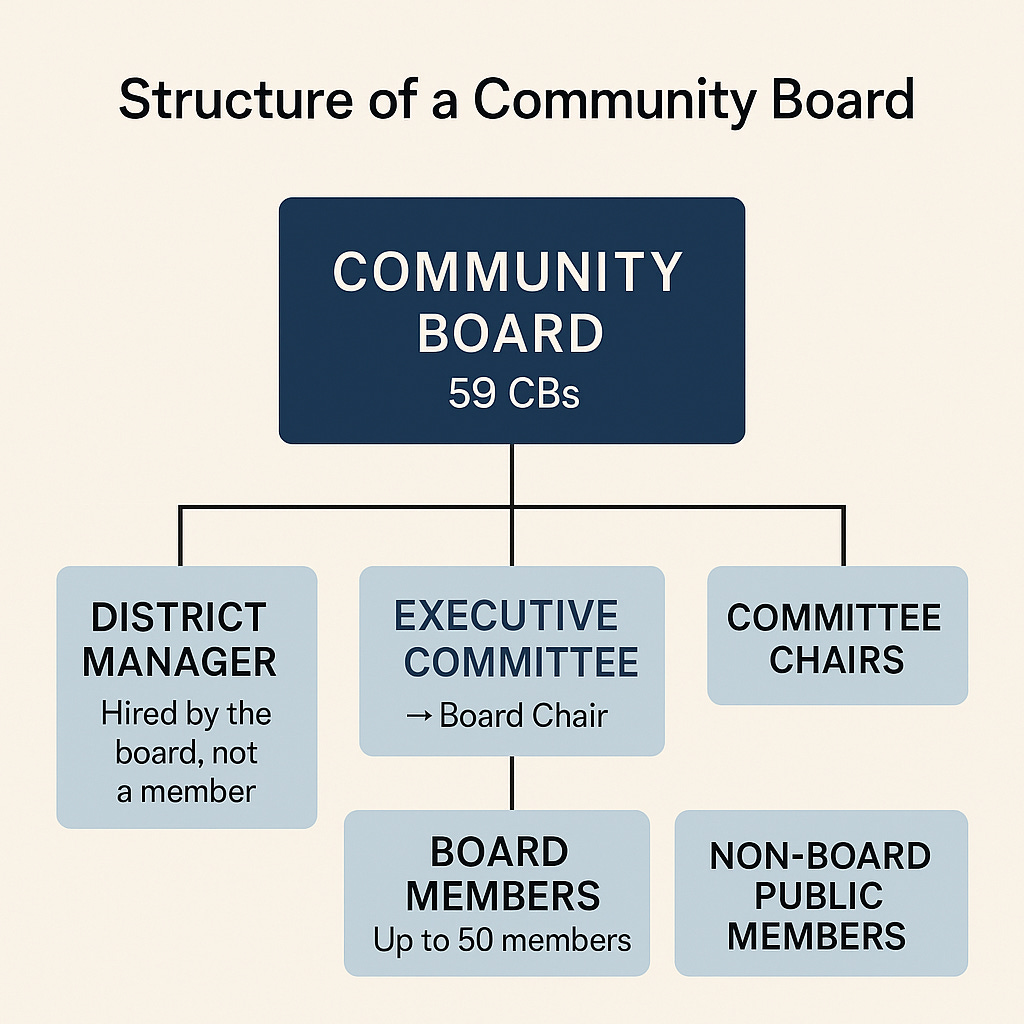
There are 59 community boards (CBs) collectively representing NYC - one for each community district - that are composed of up to 50 members each, appointed by either the CB’s respective Borough President or City Councilmember. The main priorities of CBs are ostensibly to play an “important advisory role in land use and zoning matters, City budget, municipal service delivery”, but basically any matters affecting the represented neighborhood can fall under the CB’s purview. Granted very limited formal powers, community boards can exhibit tremendous soft power thanks to their reviewer role on those land use and zoning matters and their close relationships with local representatives.
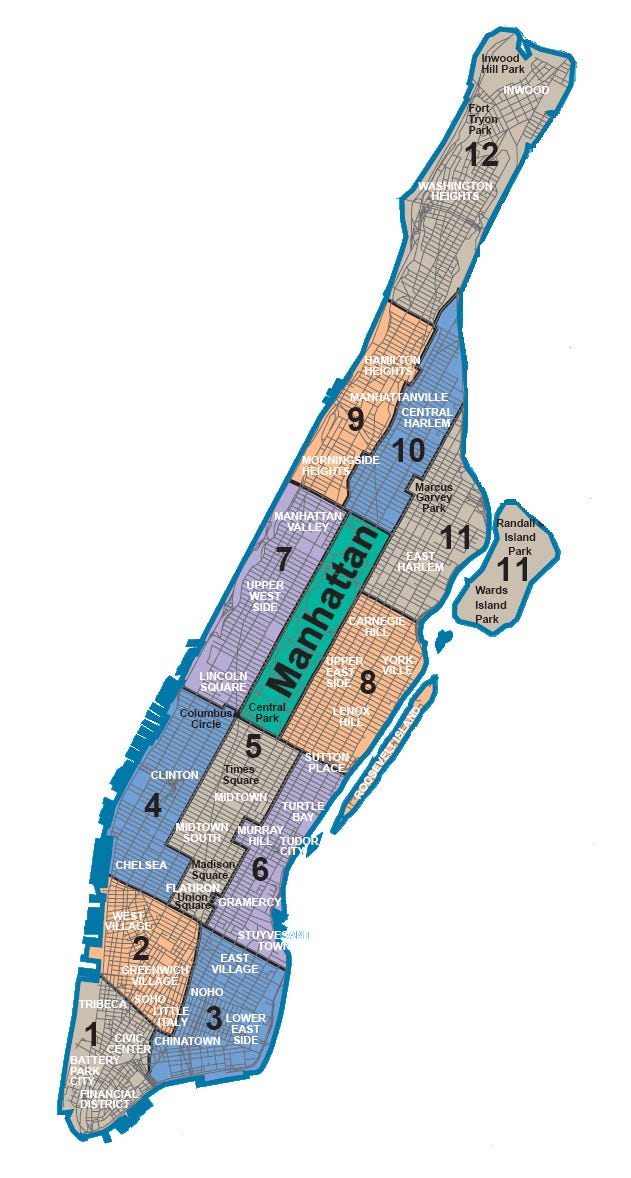
If you are a New Yorker wishing to “get involved” in local politics or desiring to gain a better understanding of the political developments both in your neighborhood and citywide, there is no better place to start than attending community board meetings. All full board meetings, and most committee meetings, are open to the public and allow anyone to speak up in their meetings (to varying degrees and often during pre-specified intervals, as will be explained below).
Politics, Proclamations & Public Engagement: Manhattan CB3’s April Session in Review

Earlier this week, I attended the Full Board meeting for my community district - Manhattan Community District 3 (CD3). I have been a resident of CD3 since April 2023 - two full years now - but have only recently begun attending Community Board 3 (CB3) meetings
As a member of a community board myself since April 2025, I have written the following guide on community board meetings in the hopes of informing and encouraging NYC residents to attend and participate in their local CB’s meetings. To make things more digestible, I have split the full guide into a series of posts. Over the next few weeks, you can expect to find explainers on:
Community Board 101: The Basics
Walking through a typical CB agenda: what CB meetings tend to look like and what they cover
Robert’s Rules of Order and Parliamentary Procedure: the rules and norms governing how to participate in CB meetings, as a member of the public or CB member
Resolutions: The primary tool in the CB toolbelt, covering what they are, how to read them, and how to write them
…and more!
At the conclusion of the series, I will make a final, comprehensive post including all the above guides so that future readers can have an easily accessible all-in-one guide. If you find this guide is missing anything, or you wish to learn more or chat about community boards, please reach out to me on here or at my email!
Note: The below guide is tailored to Manhattan Community Board 3 (MCB3), of which I am a member and most familiar with their meetings procedures and rules. Other community boards have their own bylaws and procedures, and while there is significant overlap, will likely have some differences in how meetings are run and when and how the public can participate.
Please talk to your local community board members for guidance and check your community board’s website for resources if you are interested in getting involved! If you happen to live in Community District 3, reach out to me and check out my running CB3 Reports series to get caught up.

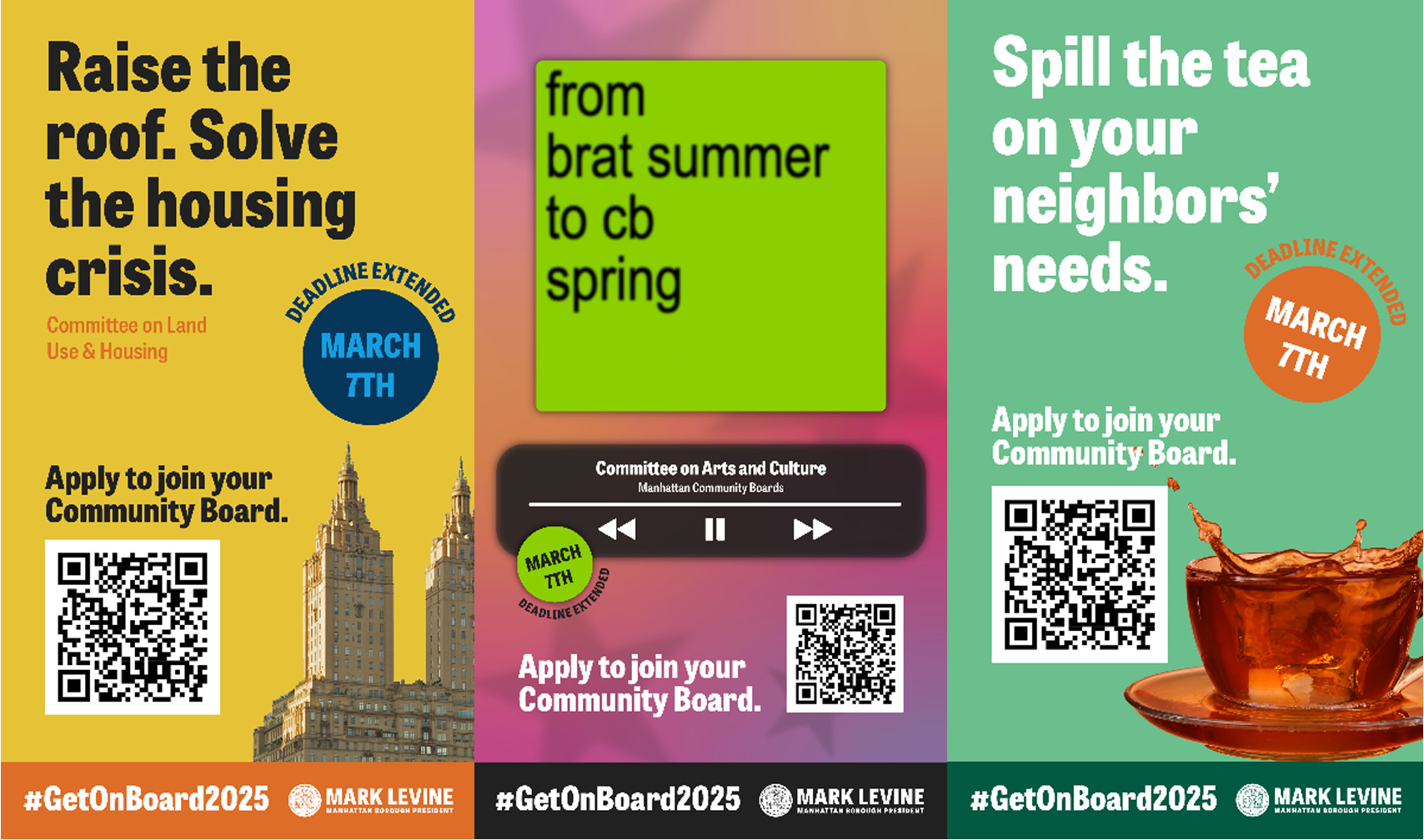
Lastly, before we dive into the guide, here is more information if you are interested in applying to your community board:
Brooklyn Community Boards - apply by February 6, 2026
Staten Island Community Boards - rolling application open year-round
Other boroughs will open their applications in January, links will be added here as portals open
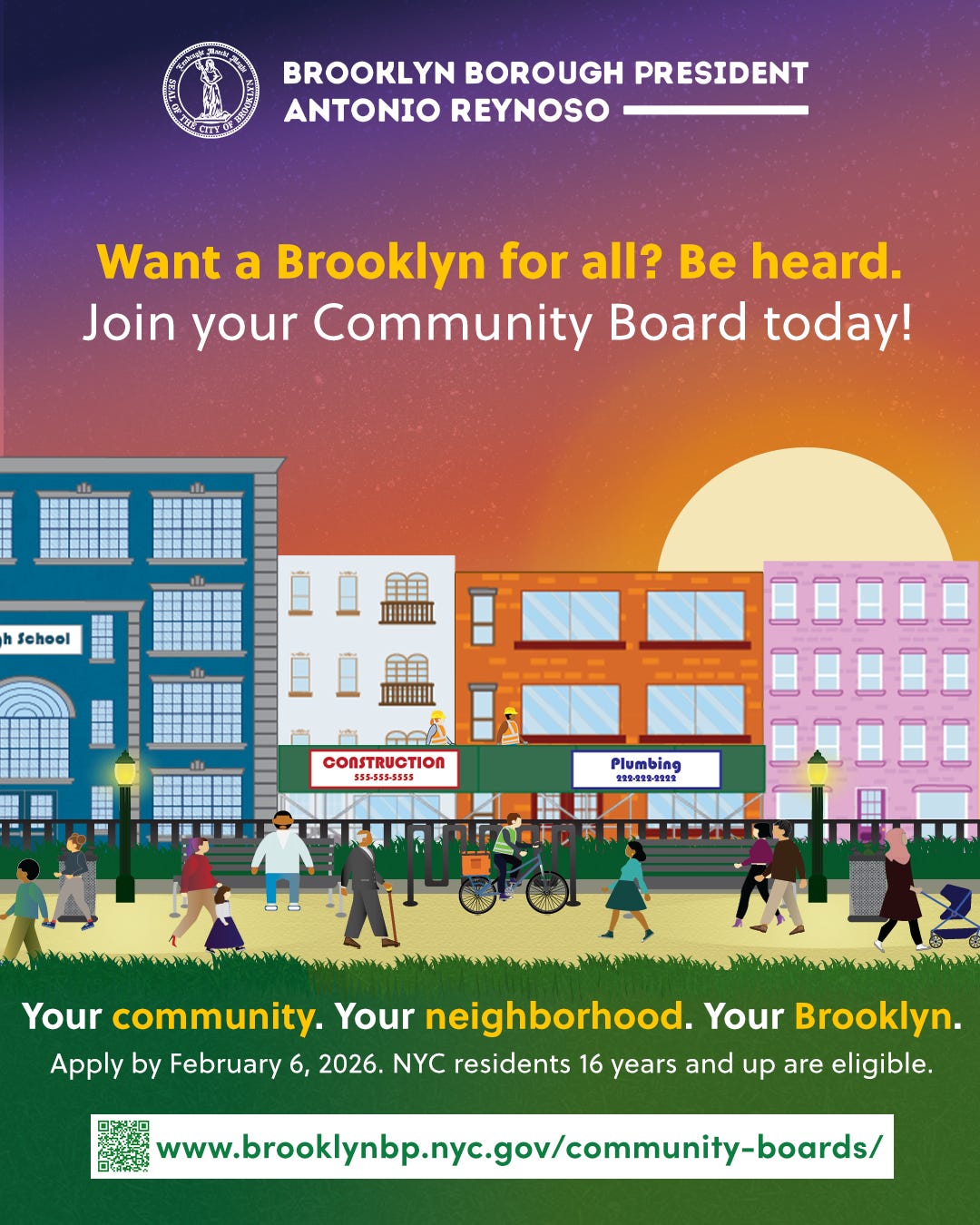
If you are planning to apply or interested in applying, please reach out to me and I would be more than happy to share my experience or connect you to CB members in your community district.
1. Intro to Community Boards
Community Board 101
Community Boards are non-partisan, governmental, public bodies. The City Charter provides this mandate for Community Boards: “Consider the needs of the Community District which it serves, cooperate with, consult, assist, and advise elected government officials about any matter that “relates to the welfare of the District and its residents.” The Charter does not specify how exactly CBs should go about achieving this mandate nor does it grant any formal powers to the CBs.2 Thus it is up to each Borough President and each of the 59 Community Boards to shape their individual structure and processes best fit to serving their community.
Why this matters: This is one of the Borough President’s most direct powers. Otherwise, the BPs don’t have much decisionmaking power. But they do directly control who is on the community boards. So if you care about community board demographics or dynamics, you mostly care about the BP’s office.
Significant differences have formed in these ways of work, and I would recommend reading the bylaws for your community board to learn how exactly it functions. For example, in some CBs most of the decision-making happens in committees, with full board meetings used to briefly summarize and pass committee resolutions. In other CBs, much more action happens in the full board meetings and subsequently the full board meetings take much longer.
Community Board members are appointed each year around April to May for two year terms, with application periods differing by borough, but usually open sometime in the preceding fall to winter period.3 Community board members must be nominated by either their local City Councilmember (whose districts overlap with the Community District) or Borough President, and are then appointed by their Borough President following the borough’s specified selection process.
Members are uncompensated and serve on a voluntary basis for two years. In order to be re-appointed, CB members must re-apply to their CB and be selected by the Borough President for another term.4 CBs are structured so that half of the membership is up for potential re-appointment each year. Term limits were implemented by a City Charter amendment in 2018, so that beginning in 2019, CB members can serve no more than four consecutive two-year terms.
Besides being required to either live, work, or have “some significant interest in the community”, there are no other requirements to be appointed to a CB.5,6 In Manhattan, prospects submit a written application and undergo a single-round interview process with a group of other applicants.
Similarly, CB members mostly have no formal obligations or duties. Typically, they are only expected to attend monthly CB full board meetings and their respective committee meetings, and if they are absent from too many of these meetings they are subject to removal.
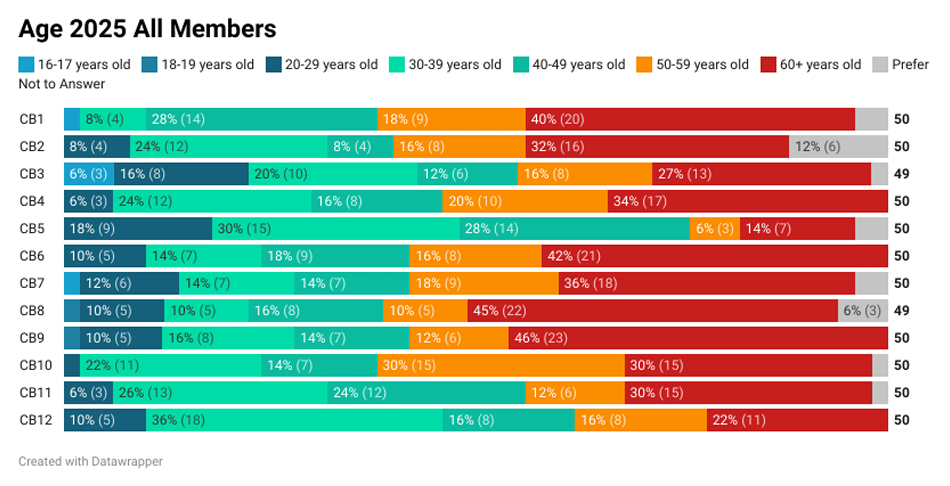
Why this matters: CB membership is a pretty significant time commitment with no direct compensation. So you can see how this would impact who would apply – it’s easier to attract older, wealthier residents. Less easy to attract young parents or students. And if older, wealthier residents are the ones weighing in...community boards will have a significant bias toward issues they care about.
Besides being able to attend full board meetings and most committee meetings (more on that below), public members can also become non-board committee members. Non-board public members have no voting power on resolutions, but are allowed to fully participate in discussions and make non-binding recommendations. There is no standard procedure for becoming a non-board committee member - if you are interested, check your Community Board’s website and reach out stating your interest.
Why this matters: Being a public member is significantly less time commitment than being a full board member. If there’s just one topic you care about (housing! weed stores!) you can be a public member and not have to deal with any other issues.
I also encourage any interested readers to consider applying for their Community Board. There are many great reasons to apply to serve on your Community Board. Sachi Takahashi-Rial, Manhattan CB5 member, has written a compelling list of reasons. Sebastian Hallum Clarke, Manhattan CB8 member, touches on his reasons for joining here and provides an honest and balanced reflection here.
The Structure of the Community Board
Community Boards follow a parliamentary structure with an “Executive Committee elected by the board that includes a chair, vice chairs, a secretary and a treasurer”. Because of the highly engaged nature of these roles, Community Board Executive Committee members - the Chair in particular - often go on to successfully run for City Council or other elected positions in NYC.7 Community Board Chairs also serve on their Borough Board8, which includes the Borough President and City Councilmembers representing the respective Borough. Community Boards may also create additional Executive Committee positions, such as Vice-Secretary.
In addition to the Executive Committee, every Community Board also has a District Manager. The District Manager is unique in that they are not actually a member of the CB, but are hired and paid by the CB to assist with operational matters.
Why this matters: CB staff are super useful for helping you get stuff done in your neighborhood. If you have a problem, they can advise on which agency to go to. If you have a question on the status of a project, they can help guide you. They can advise you as to which CB meetings might be most relevant to you.
Lastly, community Boards also have Committee Chairs. As the name implies, Committee Chairs lead their respective CB committee and run the committee meetings. Typically in the full board meeting, they will provide updates to the entire board on what was discussed in committee. Committee Chairs have significant soft power, as it is in committees when most policies are actually debated and resolutions are written up.
Full Board vs. Committees
Community Boards hold full board meetings, which include all members and are open to the public, once a month. Times and locations for these meetings and meeting agendas are provided in advance, usually on the CB website and/or sent out in a newsletter. These are the meetings that typically cover all that was discussed in the various CB committees, are attended by elected officials providing updates, and may include more Citywide discussions.
CBs also have committees that usually hold monthly hearings and presentations on more niche subject matters. There is no requirement for having certain committees or any minimum number of them. MCB3 has around a dozen committees, ranging from broad topics like Transportation and Parks and Land Use to more focused committees like Economic Development and Landmark and temporary task forces like Cannabis Control and Waterfront. Transportation, Parks, SLA (State Liquor Authority), and Landmarks are all common committee types across CBs.
In MCB3, members rank their committee preferences and assignments are then made by the Board Chair. Other CBs allow board members to self-select committees or use more democratic processes. While most committee meetings can be attended by all board members (and often the public), attendance at these tends to be even more sparse than full board meetings.
Why this matters: If you care about a policy that’s coming before a community board, you HAVE to influence that policy when it’s at the committee stage. If you start your advocacy when the policy is before the full board, you’ve lost your leverage to influence the language and outcome.
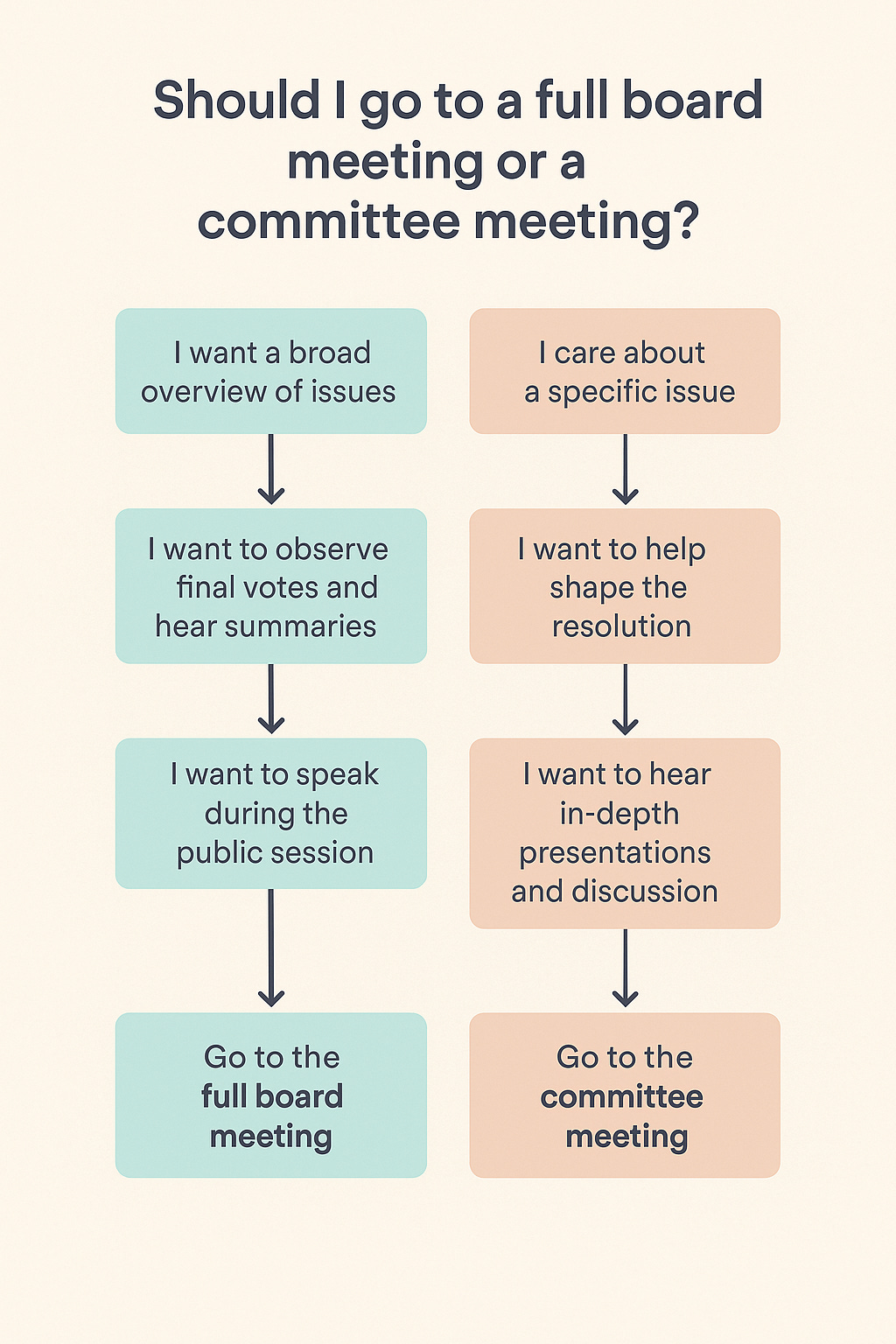
For those with more niche interests themselves, these tend to be the most informative and interesting meetings. While full board meetings by nature are broad and must cover all relevant matters in a meeting, committee meetings go deep - very deep - on their subject matter. As a member of MCB3’s Parks Committee, I have personally sat in meetings where the direction a new park bench would face was protractedly debated.
Committees are also excellent places to get to hear from and know extremely knowledgeable city agency workers, as they are often called in to present on projects and proposals by their agency occurring in the district. Meanwhile, full board meetings will likely only mention the topics discussed in committee and move to vote on any resolutions forwarded from the committee.
In summary:
Attend a full board meeting when…
You want a broad overview of everything happening across the community board that month.
You want to hear summaries of discussions and decisions that took place in each committee.
You want to observe final votes on resolutions, because committees draft and debate them, but full board meetings usually vote on them.
You want to understand overall board dynamics, how members interact, how the Chair runs meetings, and how committees report out.
You’re new to community boards and want a general introduction rather than a deep dive into a single policy area.
You want to meet elected officials, including both local district representatives and possibly Citywide electeds.
Attend a committee meeting when…
You care about a specific policy issue (e.g., transportation, parks, land use, nightlife, cannabis licensing).
You want to influence the actual content of a resolution, because that work happens in committee, not at the full board.
You want to hear detailed presentations from city agencies, since committees often bring in agency staff to walk through projects in depth.
You want deeper, more technical discussion, since committee meetings go very deep on their subject matter.
You want the most effective point of intervention to influence a policy issue or community board stance on an issue.
You are following ongoing project updates, which are typically handled repeatedly at the committee level before reaching the full board.
Note: Any opinions expressed below are solely my own and do not represent the views of Manhattan Community Board 3.
NYC voters in 2018 approved a proposal to institute term limits for Community Boards: starting in 2027, members may serve a maximum of four consecutive two-year terms.
The Charter does provide a formal role in decisions on land use, in the preparation of the capital and expense budgets and in the monitoring of local service delivery - but this is an entirely advisory role. Community Boards cannot order elected officials or City officials to perform any action.
Manhattan applications tend to be open in January, interviews in March, and appointments made by early May
Reappointment is not guaranteed. Re-applying members are subject to the same application process as prospective members but are automatically granted interviews. Members must continue to demonstrate a significant interest in their community board, the ability to make the required time commitment, and a track record of constructive participation.
This includes no citizenship or immigration status requirement to join a community board, making CBs an excellent opportunity for foreign-born residents to still be represented politically and have a voice in their community!
In addition, no more than 25 percent of the members of any board may be New York City employees.
In the 2022-2024 New York City Council, 41% of Council Members were former members of a Community Board.
Borough Board monthly meetings cover further land use and budget questions concerning the entire borough and can usually be attended by the public virtually. See your borough’s Borough Board website for more details.